The numbers that frame Sri Lanka's narrative are striking. In 1970, when the island was still referred to as Ceylon, the per capita income stood at about $ 187 (World Bank Open Data, 2026). Today, Sri Lanka has regained “upper-middle-income” status in the World Bank's 2026-27 classification cycle, with the per capita GDP dramatically increasing to $ 5003 (CBSL Annual Economic Review, 2025), despite facing a brutal civil war and an economic crisis, including a recent sovereign default. This transformation reflects an extraordinary resilience in the face of adversity. However, resilience does not equate to success, and the path to progress was filled with difficulties.
Beginning in the early 1960s, Sri Lanka faced a persistent shortage of foreign currency, leading to a self-imposed isolation. These problems intensified in the mid‑1960s and again in the early 1970s under the “closed economy” policies. Around 1974, only about 40% of its industrial capacity was utilised, as factories built under protective tariffs struggled with a shortage of raw materials and high production costs. A significant turning point occurred in 1977 when Sri Lanka opened its economy. This led to the establishment of garment factories, especially in Katunayake area, and by the mid-1990s, Garment exports accounted for more than half of Sri Lanka’s export earnings (Weerakoon & Thennakoon, 2006)
The liberalisation programme continued through the 1980s, making Sri Lanka the most liberalised economy in South Asia. Alongside industry, two quieter revolutions were taking shape. Banking expanded rapidly, increasing from about 2,000 licensed commercial bank branches in 2008 to over 2,900 by 2015, reaching areas that had long been cut off from formal finance, especially in the North and East after the war ended in 2009.
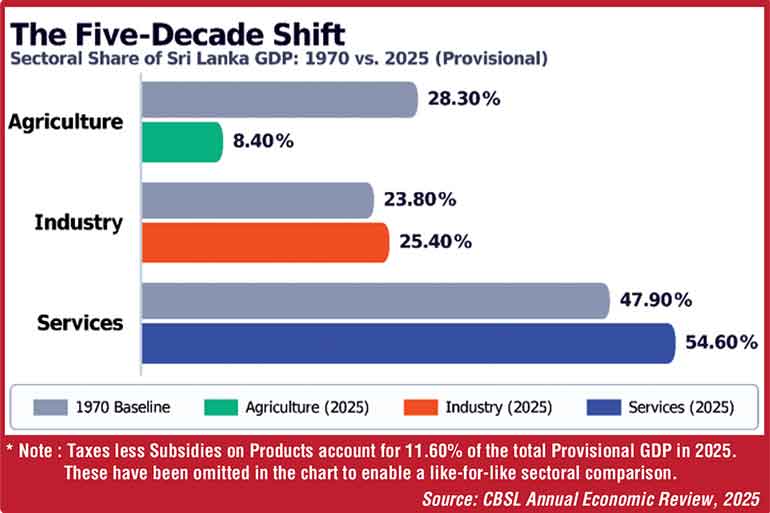
Education also evolved, growing from a single colonial university in 1942 to seventeen national universities today, with at least one university located in each province. Universities, banks, and a new wave of young entrepreneurs are now present throughout the island, a scenario that would have seemed impossible fifty years ago. These institutions form the foundational elements of a modern economy. However, these elements operate in isolation and have yet to unify effectively. The gap between a university graduate, a local bank branch, and a viable business idea has never been smaller; yet no one has managed to create the necessary framework to leverage this for economic acceleration.
The Pettah effect
While liberalisation led to growth in the industry and services landscape, one more thing happened - it brought forth the mindset of its business community. Before liberalisation, scarcity defined the business landscape, where success depended on connections to obtain import licences and quotas. However, liberalisation transformed this dynamic, favouring those who could import quickly, set competitive prices, and accurately gauge market demand. This shift revealed an inherent trading instinct and the entrepreneurial gut of the Sri Lankan Entrepreneurs – a trait that makes the proposed model special.
The Pettah area in Colombo exemplified this transformation, emerging as a vibrant wholesale centre and a key player in the new import economy. It became a bustling hub for importers, distributors, and small traders, facilitating the distribution of goods across the island. This phenomenon, termed the Pettah Effect, highlights how an open economy rewards keen observation, swift transactions, and an understanding of consumer desires. This Entrepreneurial spirit is, even today, the key enabler and driver of this hugely successful informal urban economy. Channelling this proven, irrepressible entrepreneurial appetite outward - into every province, and into building as much as trading - is precisely the imbalance that the proposed model is trying to resolve.
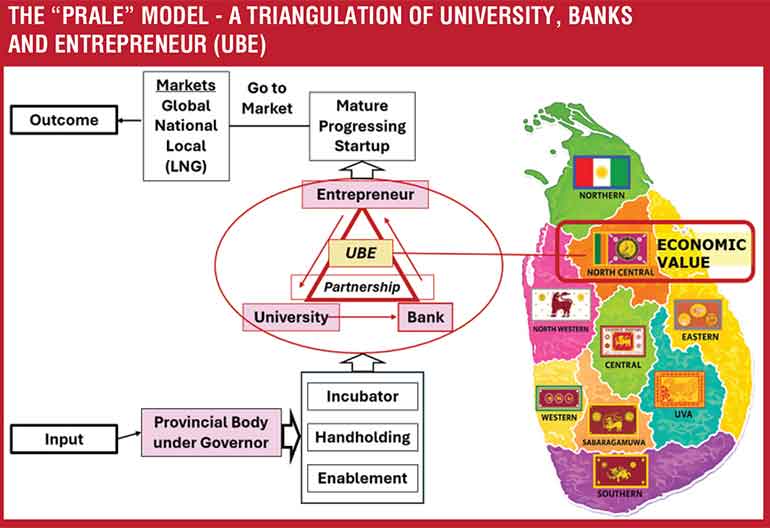
The “PraLe” model does not call for the creation of complex state structures or excessive fiscal spending. Instead, it establishes a systematic approach to connect three essential components present in every province: the University, the Banks, and the Entrepreneur, collectively known as the UBE Triangle.
n The University (U) acts as the crucial incubator, focusing on creating local mentoring systems, safeguarding early-stage design risks, and preparing students and regional talent to become capable founders. It serves as a supportive environment that encourages talent development, minimises the fear of failure, and transforms academic research into practical business opportunities before engaging with financial institutions.
n
The Bank (B) plays a vital role within this triangle, ensuring that financial resources are integrated into the innovation process, especially in a credit-restricted setting. By collaborating with the university ecosystem, which has already assessed and validated entrepreneurs and their prototypes, banks can confidently offer financing options that do not rely on traditional credit histories, thus supporting promising entrepreneurs.
n
The Entrepreneur (E) is the primary development agent. She/He emerges from the university's nurturing environment, equipped with tested prototypes ready to leverage local commercial credit and turn innovations into successful businesses.
At the core of the "PraLe" model is the "Pradeshiya Lekham," which acts as a local facilitator and overseer. It provides essential support, streamlines administrative processes, offers risk-sharing guarantees, aligns local infrastructure and regulations, and connects public services to minimise obstacles. Essentially, the Pradeshiya Lekham plays a crucial role in fostering the UBE triangle by aligning the interests of various stakeholders and ensuring that validated concepts quickly evolve into job-creating economic activities rooted in local communities. The Pradeshiya Lekham’s competitive advantage lies in its local credibility, swift administrative processes, and ability to absorb risks cost-effectively, which together facilitate rapid and impactful economic development. What sets this model apart is not just the triangle itself, but its unique nine-fold symmetry. The model does not have to be built. It just needs to be “switched on”.
Once the UBE triangle is switched on, the entrepreneur's journey does not stop at just validation; it scales through the LNG progression of Local, National, and Global markets. Early traction within the home province builds the credibility and cash flow needed to "Go to Market" nationally, where the venture is tested against broader competition and demand. Achieving success at this level paves the way for entry into global markets, allowing Sri Lankan innovation to compete at an international level. Each stage compounds the gains of the last, transforming a fragile prototype into a mature, progressing startup that no longer relies on university support or the bank’s credit line, instead becoming a self-sustaining engine of economic value.
As the entrepreneur grows from Local to National to Global, the value created flows back into the system that built it: the University gains real-world case studies, research partnerships, and reputational capital, while the Bank gains a proven client with a track record, repeat business, and a stronger loan book. The UBE triangle thus creates a virtuous cycle, where success at one node of the triangle strengthens the other two for the next entrepreneur in line.
Choosing whom to back - A business model canvas for entrepreneurs
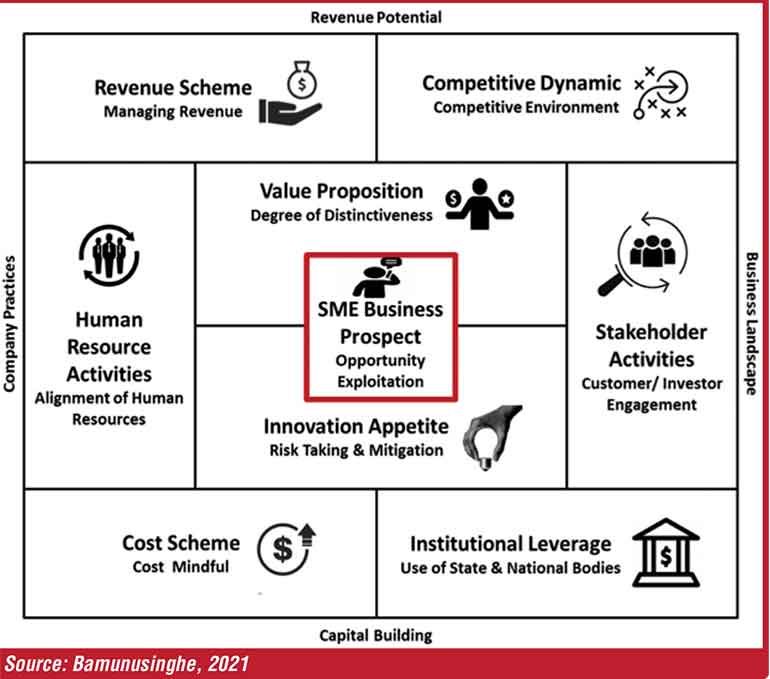
The success of this triangle hinges on the entrepreneur at its third corner. If banks are to lend and universities to mentor, both need a common, honest way to ask the oldest question in enterprise: is this founder, and this idea, worth backing? The “PraLe” Model introduces a straightforward diagnostic tool, the Business Model Canvas (Bamunusinghe, 2021), aimed at identifying promising entrepreneurs rather than creating merely a business plan. An interactive version of the BMC can be accessed at https://slsme.org/
This tool is very simple, featuring eight dimensions surrounding a central question - the “SME Business Prospect”, which measures the founder's capability to recognise and leverage opportunities. The dimensions are organised along four axes: Revenue Potential, Company Practices, Capital Building, and Business Landscape. Each is scored on a ten-point scale, from unsatisfactory to satisfactory. The aggregate score gives an honest read on the entrepreneur's overall business potential.
The strength of the tool is evident in its comprehensive approach to enhancing the triangle's functionality. It provides banks with a clear and consistent framework for making credit decisions that extend beyond mere collateral considerations. For universities, it offers a structured curriculum and a mentoring checklist, while entrepreneurs receive a detailed assessment of their ventures, highlighting both strengths and areas for improvement. For entrepreneurs, it gives an honest mirror, cell by cell, of where a venture is strong and where it must improve. A founder who scores low on Cost Scheme but excels in Value Proposition knows exactly where the next conversation with a mentor or a lender must begin. The BMC is currently being developed as a mobile application that would enable aspiring entrepreneurs across various provinces to self-evaluate and connect, based on merit, with the corresponding university and bank at the other vertices of the triangle.
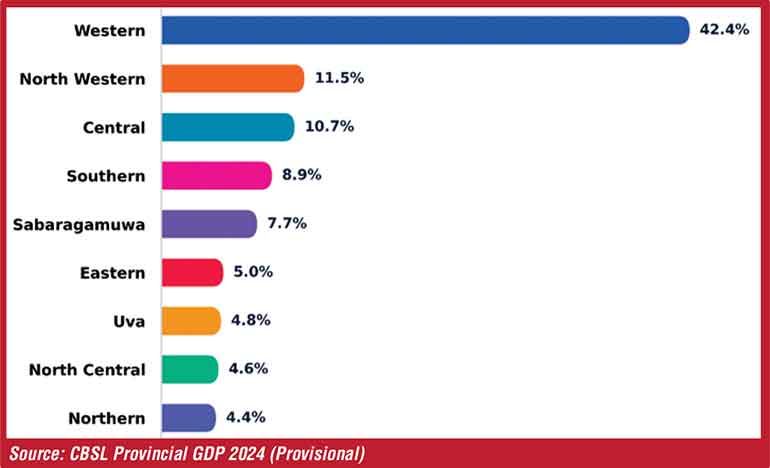
Nine autonomous engines, each to its strength
When provinces are liberated from the singular goal of enhancing Colombo's service economy, they can tailor their UBE triangle to leverage their distinct competitive advantages. Say…..
n
The Western Province can establish itself as a hub for finance and technology, exporting its banking and university expertise to support the other provinces.
n
The Central Province can focus on tea value addition, Agri-tech, and tourism, utilising Peradeniya for research and development alongside plantation finance.
n
The Southern Province can capitalise on logistics and light manufacturing driven by the Hambantota port, supported by local talent and trade finance.
n
The North-Western Province can enhance agribusiness and food processing, with Wayamba University serving as the core of agri-innovation.
n
Sabaragamuwa can specialise in gems and hydropower, leveraging its university's design and geology programs.
n
The Eastern Province can develop its deep-water port, fisheries, and tourism sectors, with support from local universities and post-war investment finance.
n
Uva can focus on highland tea, eco-tourism, and renewable energy, with Uva Wellassa University fostering entrepreneurship.
n
The North-Central Province can enhance irrigated agriculture and heritage tourism, with Rajarata University as the Agri-water cluster.
n
Finally, the Northern Province can drive growth through reconstruction in fisheries, agriculture, and trade across the Palk Strait with assistance from Jaffna University, supported by targeted development banking initiatives.
Keyu Jin's "Mayor Economy": A real-world validation of The PraLe Model's decentralisation approach
The “PraLe” Model’s core argument that decentralised, locally driven ecosystems can produce better economic outcomes has powerful real-world validation in the experience of other economies, the most compelling one coming from China, as documented by London School of Economics economist Keyu Jin in The New China Playbook (2023). The common Western assumption, Jin argues, is wrong. China is not run top-down by a handful of people in Beijing. Politically, it is highly centralised; economically, it is fiercely decentralised. The decisions that built modern China were made on the ground, by local officials.
(Authors Yash Naik, MBA Merit, PIM, University of Sri Jayewardenepura; Imandee Gunaratne, Undergraduate, Department of Decision Sciences, University of Moratuwa; Dr. Ravi Bamunusinghe , Senior Lecturer. PIM, University of Sri Jayewardenepura and Dr. Indra Mahakalanda, Senior Lecturer Department of Decision Sciences, University of Moratuwa)
 Sri Lanka has spent six decades proving it can build institutions: Universities, Banks, and Entrepreneurs. The harder question is whether it can finally make them work together, province by province. A look through the lens of decentralisation, and a proposal: the “PraLe” Triangulation Model.




