Friday Oct 02, 2026
Friday Oct 02, 2026
Friday, 14 August 2026 04:40 - - {{hitsCtrl.values.hits}}
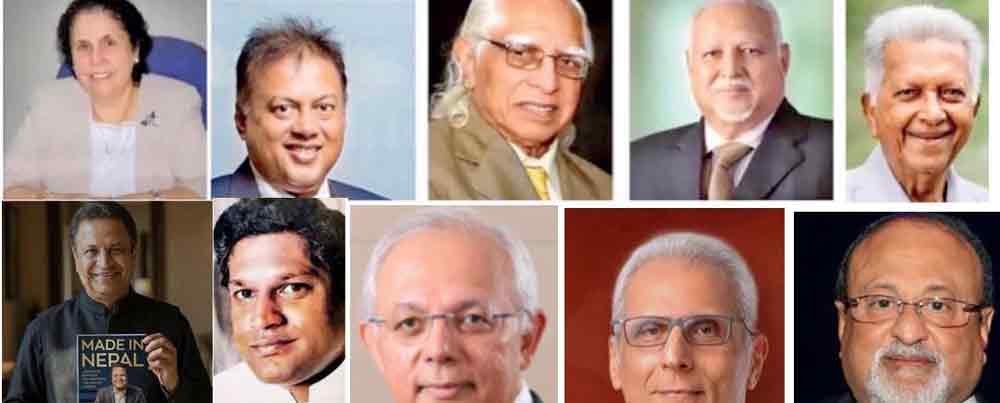
 Among those whose careers I have had the opportunity to observe closely are the late Harry Jayawardena, Aban Pestonjee, Binod Chaudhary, Sumal Perera, the late Merrill J. Fernando, Sohli Captain and Chandra Schaffter. There are, of course, many other Sri Lankan entrepreneurs including Late Rajamahendran, Dhammika Perera, Ranjit Page, Akbarally, Damitha Ramanayake, Ashok Pathirage, Late Upali Wijewardana and Ishara Nanayakkara. There are also home-grown brands, such as Spa Ceylon. Their businesses and personalities are distinctly different. Yet beneath those differences lie a number of common traits. They did not simply build companies. They built institutions, brands, people and, ultimately, legacies. And, importantly, many of them achieved their success without feeling the need to constantly flaunt it
 There is a fundamental difference between making money and building something that outlives you.
Some entrepreneurs become wealthy by taking a spectacular risk, capitalising on a moment of extraordinary opportunity or leveraging powerful networks and contacts. Others build their fortunes—and their reputations—more gradually, brick by brick, through persistence, conviction and an ability to see beyond the next quarter.
It is the latter group that offers the most valuable lessons.
Over the years, I have had the privilege of working closely with several of Sri Lanka’s most successful entrepreneurs, including at the board level. I have also had the opportunity to hear them speak candidly about their journeys through interviews, conversations and industry forums.
At the 2018 FT–ICCSL–CIMA Fireside Chat, for example, a number of these business leaders shared experiences that extended well beyond conventional management wisdom, revealing the motivations, setbacks and convictions behind their success. More recently, the SLID 2026 Fireside Chat provided another opportunity to hear directly from business leaders about their entrepreneurial journeys and perspectives.
Among those whose careers I have had the opportunity to observe closely are the late Harry Jayawardena, Aban Pestonjee, Binod Chaudhary, Sumal Perera, the late Merrill J. Fernando, Sohli Captain and Chandra Schaffter. There are, of course, many other Sri Lankan entrepreneurs including Late Rajamahendran, Dhammika Perera, Ranjit Page, Akbarally, Damitha Ramanayake, Ashok Pathirage, Late Upali Wijewardana and Ishara Nanayakkara. There are also home-grown brands, such as Spa Ceylon. Their businesses and personalities are distinctly different. Yet beneath those differences lie a number of common traits. They did not simply build companies. They built institutions, brands, people and, ultimately, legacies. And, importantly, many of them achieved their success without feeling the need to constantly flaunt it.
Successful entrepreneurs tend to see possibilities before they become obvious to everyone else. But vision alone is cheap. What separates the exceptional from the merely ambitious is the ability to translate an idea into an operating reality
The business environment rarely stands still. Markets evolve, technology advances, customer preferences shift and competitors emerge from unexpected quarters. The strongest entrepreneurs do not wait for disruption to arrive at their doorstep. They anticipate it
Vision is worthless without delivery
Successful entrepreneurs tend to see possibilities before they become obvious to everyone else. But vision alone is cheap. What separates the exceptional from the merely ambitious is the ability to translate an idea into an operating reality.
Aban Pestonjee and the late Merrill J. Fernando built businesses around ideas they believed in deeply. Their brands were not merely commercial propositions; they reflected values and convictions embedded in the very fabric of their operations.
Fernando, in particular, understood that Sri Lanka could compete globally not simply by exporting a commodity, but by building a brand around the provenance and quality of Ceylon Tea.
That requires more than imagination. It demands discipline, patience and relentless execution.
Change before you are forced to
The business environment rarely stands still. Markets evolve, technology advances, customer preferences shift and competitors emerge from unexpected quarters.
The strongest entrepreneurs do not wait for disruption to arrive at their doorstep. They anticipate it.
Sumal Perera’s journey with Access Engineering exemplifies this capacity for adaptation. His businesses have navigated difficult cycles in construction, infrastructure and property by continually seeking new opportunities rather than becoming prisoners of past success.
Harry Jayawardena adopted a similarly pragmatic approach. One observation that has stayed with me was his remark: “It is better to light a candle than curse the darkness.”
There is a powerful entrepreneurial philosophy embedded in that sentence: stop complaining about circumstances and take action.
Resilience is not merely surviving adversity. It is having the confidence to act while others are still debating what went wrong.
Take risks—but make them calculated
Entrepreneurship without risk is impossible. But successful entrepreneurs understand that courage is not the same as recklessness.
Harry Jayawardena built much of his career around calculated bets, often entering businesses where the outcome was far from certain. The ability to make such decisions requires judgement: knowing when to move, when to wait and when to change direction.
Binod Chaudhary’s investments in Sri Lanka demonstrate similar characteristics: a willingness to see opportunities beyond conventional boundaries and the confidence to commit capital where others may have hesitated.
Chandra Schaffter’s contribution to Sri Lanka’s insurance industry similarly reflected entrepreneurial conviction. Building and sustaining Janashakthi required the willingness to challenge an established market and create a new institution in a sector where the odds were not always obvious.
The lesson is critical. The best entrepreneurs are not necessarily those who take the biggest risks. They are those who understand the consequences of risk—and still have the courage to act.
 Resilience is not merely surviving adversity. It is having the confidence to act while others are still debating what went wrong. Entrepreneurship without risk is impossible. But successful entrepreneurs understand that courage is not the same as recklessness
The best entrepreneurs are not necessarily those who take the biggest risks. They are those who understand the consequences of risk—and still have the courage to act
Make quality and consistency part of the brand
A business can attract customers through price, promotion or novelty. It earns their loyalty through consistency.
Merrill J. Fernando understood this exceptionally well. His insistence on quality, provenance and authenticity helped transform Ceylon Tea from a commodity into a globally recognised brand.
That principle extends beyond products. It applies to service, culture, governance and reputation.
The strongest businesses develop a consistency that customers, employees and investors can trust. They do not reinvent their values every time the market changes.
Increasingly, enduring businesses recognise that financial performance and social impact are not mutually exclusive.
The MJF Foundation exemplifies how a business legacy can extend beyond shareholders. The work associated with MAS Holdings and Brandix similarly demonstrates how large enterprises can create employment, develop talent and influence the communities in which they operate.
Sohli Captain represented another dimension of this philosophy. His business contribution was accompanied by a strong commitment to philanthropy and community service. For him, success was measured not solely by what could be accumulated, but also by what could be given back.
Build people, not just businesses
Perhaps the most important lesson is that no entrepreneur builds a lasting institution alone.
Behind every enduring company is a team capable of carrying the vision forward.
The best entrepreneurs understand that talent is not simply a cost on the Balance Sheet. It is an asset that compounds.
They create cultures where people are trusted, challenged and given opportunities to grow. They build leaders who can eventually assume responsibility beyond the founder.
MAS and Brandix provide powerful examples of businesses where investment in people has been central to organisational development, while also contributing significantly to the communities in which they operate.
This is ultimately what determines whether a company remains a founder’s business—or becomes an institution.
Perhaps the most important lesson is that no entrepreneur builds a lasting institution alone. Behind every enduring company is a team capable of carrying the vision forward. The best entrepreneurs understand that talent is not simply a cost on the Balance Sheet. It is an asset that compounds. Businesses where investment in people has been central to organisational development, while also contributing significantly to the communities in which they operate. This is ultimately what determines whether a company remains a founder’s business—or becomes an institution
The real measure of success
The defining characteristic of these entrepreneurs is not the amount of money they made.
It is what remained after they made it.
They created brands that became recognised beyond Sri Lanka. They transformed industries. They generated employment. They developed generations of managers and entrepreneurs. They supported communities. And, in different ways, they helped reshape how Sri Lankan business is perceived.
That is a very different definition of success from simply accumulating wealth.
Sri Lanka, like every economy, has no shortage of businessmen. What it needs are more institution-builders.
The distinction matters.
A businessman can build a profitable company. An entrepreneur can build a successful enterprise. But a true business leader builds something that continues to create value after he or she is no longer in the room.
That is what a lasting footprint looks like.
In an environment where mediocrity can often appear safer than ambition, these entrepreneurs chose the road less travelled. They entered markets others avoided, backed ideas others doubted and persisted when the easier option was to walk away.
They saw possibilities where others saw limitations.
And that, perhaps more than wealth itself, is the enduring lesson of their careers: the greatest entrepreneurs do not simply build businesses. They build legacies—and create new products, services and possibilities that change the markets around them.
Sri Lanka may not yet have produced entrepreneurs whose businesses operate on the global scale of Elon Musk, Bill Gates or Mukesh Ambani, whose success has been supported by much larger markets, deeper pools of venture capital and vastly greater access to global capital. But that should not diminish what Sri Lankan entrepreneurs have achieved.
There is much to learn from their journeys—and much to emulate.
The challenge for the next generation is not simply to become wealthier than those who came before them. It is to think bigger, take calculated risks, build globally competitive businesses, create new products and services, develop people and leave behind institutions that are stronger than when they found them.
That is the difference between creating wealth and creating a legacy.
(The views expressed in this article are the author’s personal views and do not necessarily represent the views of any organisation or company with which he is associated as Chairman or Director)
References
Sri Lanka’s next growth chapter.”



