Friday Oct 02, 2026
Friday Oct 02, 2026
Saturday, 1 August 2026 01:51 - - {{hitsCtrl.values.hits}}
 Why legal recognition alone will not solve Sri Lanka's human-elephant conflict
 There has been much talk about “elephant corridors “ these days , with the Government trying to re-establish such corridors, declared by gazette. The aim of this essay is to explain exactly what an elephant corridor means, what purpose it serves, and if such an initiative would work.
The Government recently announced in Sri Lanka that it has officially cleared and gazetted three major elephant corridors: Koholankala, Hadapanagala, and Wetahirakanda. Announced by Environment Ministry, this program aims to reduce the human-elephant conflict by restoring traditional migration paths.
What are elephant corridors?
In English, a corridor refers to a long, narrow passage connecting two areas, such as a hallway linking rooms in a building. In conservation, however, an elephant corridor is something quite different. It is not merely a narrow strip of land, but an unobstructed stretch of natural habitat that connects two larger elephant ranges, allowing elephants to move safely between them, while maintaining their natural seasonal movement patterns.
Therefore a healthy, well established elephant corridor is anything but narrow - it could be as wide as 500 m to even 1.5 km. it is sufficiently wide and undisturbed, for elephants to move naturally without feeling threatened or being forced into conflict with people.
Elephants require extensive home ranges and travel considerable distances in search of food, water, mates and suitable habitat. A well-designed corridor therefore provides an attractive route by maintaining natural vegetation rich in preferred food plants, adequate shade and, where possible, access to water. Equally important is careful land-use planning around the corridor so that agriculture, settlements and other human activities do not encourage elephants to leave the designated route. In essence, the corridor becomes the safest and most rewarding path for elephants to follow, while reducing the likelihood of human-elephant conflict.
 The greater challenge lies in protecting the corridor from human encroachment. Unauthorised settlements, agricultural expansion, fencing, roads and other developments can gradually narrow or completely block these ancient pathways. Once fragmented, elephants have little choice but to seek alternative routes, often bringing them into direct conflict with people. Unfortunately, preventing such encroachments is frequently complicated by social and political realities
Often there are boundary buffers (deterrent barriers) created along the outer edges near human villages, by planting dense rows of thorny, unpalatable bushes or crops that elephants naturally avoid (like citrus, chilies, or ginger) to keep them from straying off the path. In some cases the more drastic method of erecting an electric fence is also utilised.
An important point to appreciate is that elephant corridors are seldom “designed” by people. More often than not, conservationists simply identify, map, and protect the natural routes that elephants themselves have established over centuries. These pathways represent the safest and most efficient means of moving between feeding grounds, water sources and seasonal habitats. They are often called “mankada” in Singhalese which is really “A path used by wild animals.”
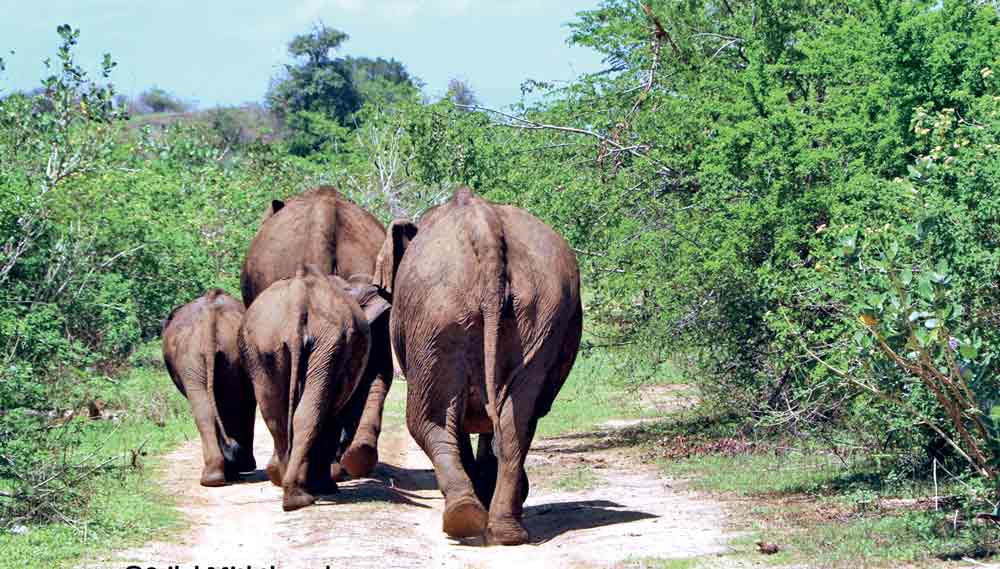
The remarkable aspect is how this knowledge is passed on. Elephant society is matriarchal, with the oldest and most experienced female leading the herd. Possessing an extraordinary long-term memory, the matriarch remembers the location of water, food resources and traditional migration routes, even over vast landscapes. As successive generations accompany her on these journeys, they learn and internalise these routes, ensuring that the knowledge is passed from one generation to the next.
In this way, many elephant corridors are not human inventions at all, but ancient highways created and maintained by the elephants themselves over countless generations.
And one cannot expect the elephants to walk along these corridors in a disciplined manner, in single file! It will be quite the opposite. They will meander along at their own pace, sometimes walking briskly, but lazing along at other times. They may take days to walk through the corridor, depending on its length.
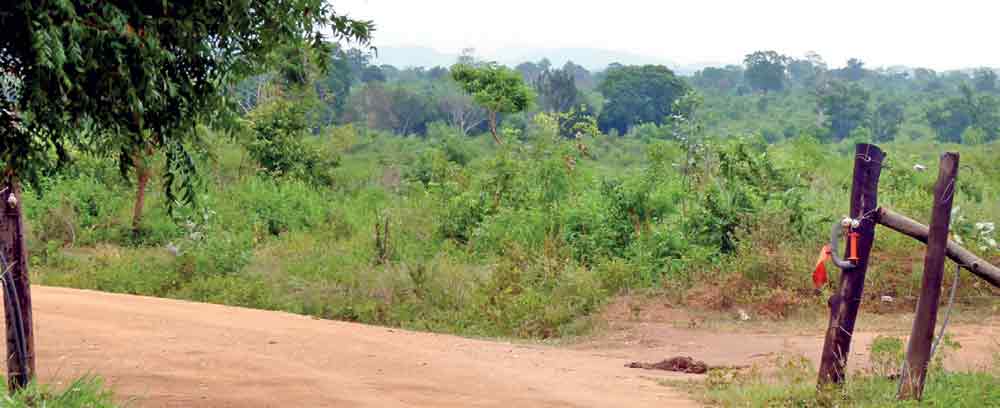
Because these elephant corridors have existed for centuries, roads and other infrastructure have sometimes been constructed across them as human development expanded. In such situations, the Department of Wildlife Conservation (DWC) has adopted practical measures to minimise conflict between elephants and motorists. One such solution is the installation of an electric fence incorporating a removable gate across the road. During daylight hours the gate remains open by disconnecting the circuit and allowing normal vehicular traffic to pass. However, shortly before dusk it was closed and the circuit re-established, temporarily preventing vehicles from crossing the corridor.
This management practice recognises the natural behaviour of elephants. Elephants generally do not undertake long-distance migrations in the strict sense, they generally make most of their movements between different parts of their home range during the cooler hours of the night. During the heat of the day they usually remain relatively inactive, resting, feeding and sheltering in one locality. Closing these road crossings at night therefore provides elephants with a safe and uninterrupted passage, while greatly reducing the risk of dangerous encounters with vehicles.
The Handapanagala and Wetahirakanda areas have always formed part of the traditional movement routes used by wild elephants, linking the Yala and Lunugamwehera National Parks with Udawalawe National Park. These are not routes that were recently conceived or designed by conservationists. They are ancient elephant pathways that have been used for generations, long before modern settlements appeared
The important point is that these are not roads built through forests; they are, in many cases, roads that have been built across ancient elephant highways. The elephants are merely continuing to use routes that long pre-date human development
Maintaining elephant corridors
It will now be apparent that establishing and maintaining an elephant corridor is far from a simple undertaking. Identifying the route is only the first step. Thereafter, the corridor has to be carefully managed to ensure that it continues to function as a safe and attractive passage for elephants.
In some cases, degraded habitats have to be restored by re-establishing natural vegetation and removing invasive plant species, while ensuring that sufficient food plants, shade and water are available along the route. This, although requiring technical expertise and sustained management, is generally the easier part of the task.
The greater challenge lies in protecting the corridor from human encroachment. Unauthorised settlements, agricultural expansion, fencing, roads and other developments can gradually narrow or completely block these ancient pathways. Once fragmented, elephants have little choice but to seek alternative routes, often bringing them into direct conflict with people.
Unfortunately, preventing such encroachments is frequently complicated by social and political realities. Illegal settlements may become established over many years and, in some instances, political pressure makes their removal extremely difficult. Balancing the legitimate needs of local communities with the equally important need to preserve these vital wildlife linkages therefore requires strong political commitment, effective law enforcement and, above all, long-term planning that extends beyond short-term electoral considerations.
The “newly” gazetted elephant corridors
To the best of my knowledge, the Handapanagala and Wetahirakanda areas have always formed part of the traditional movement routes used by wild elephants, linking the Yala and Lunugamwehera National Parks with Udawalawe National Park. These are not routes that were recently conceived or designed by conservationists. They are ancient elephant pathways that have been used for generations, long before modern settlements appeared.
Over the years, however, unplanned development, illegal encroachments and expanding human settlements gradually disrupted these traditional routes. Elephants, instinctively following pathways embedded in their social memory, suddenly found themselves confronted by villages, cultivation and roads. The inevitable result was an increase in human-elephant conflict, not because the elephants had changed their behaviour, but because the landscape around them had changed.
Viewed in this context, the recent Gazette notification should not be seen as the creation of three new elephant corridors. Rather, it represents an attempt to restore and legally recognise ancient ecological linkages that had been progressively fragmented by human activities. Formal Gazetting provides the Department of Wildlife Conservation with a stronger legal basis to regulate development, prevent further encroachment and protect these corridors from future degradation. Without such legal recognition, effective conservation becomes considerably more difficult.
However I pause to think whether legal recognition alone will be enough. Sri Lanka has no shortage of progressive environmental legislation. What has often been lacking is consistent enforcement. If illegal encroachments continue, political interference overrides scientific management, or regulations are selectively applied, there is a real danger that these corridors will exist only in paper as official gazette notifications, while corridors continue to disappear on the ground.
Sri Lanka has no shortage of progressive environmental legislation. What has often been lacking is consistent enforcement. Sri Lanka does not need elephant corridors on paper. It needs corridors that elephants can actually use
“Sri Lanka does not need elephant corridors on paper. It needs corridors that elephants can actually use.”