Wednesday Oct 21, 2026
Wednesday Oct 21, 2026
Thursday, 2 April 2026 02:13 - - {{hitsCtrl.values.hits}}
 The war in the Mideast may or may not continue for long, but the after-effects of the destruction of oil production facilities rendered already will lead to a long-term fuel crisis for the rest of the world. Especially hard hit will be debt-ridden countries like Sri Lanka.
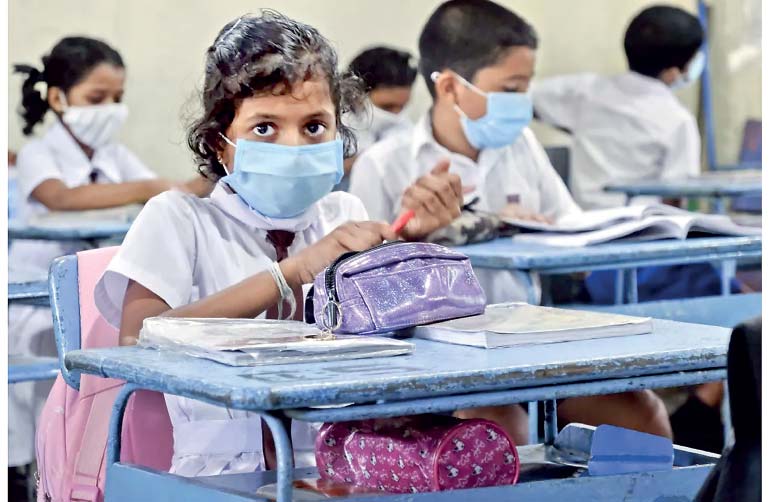
Wars and crises affect the children disproportionately. While adults may grit their teeth and wait for a crisis to pass, every moment lost is a loss of growth and development in a child’s life.
Schools were closed across the world during the 2020-2021 pandemic and UNICEF estimates that about 463 million children or 30-33% of children world-wide did not have access to remote learning (UNICEF, 2022). In Sri Lanka, the% that did not have any access is estimated at 15% (LIRNEasia, 2021).
Pictures of children trying to access the Internet from tree tops and various proclamations by the central ministry of education made headlines, but the hard work of reaching out to the most vulnerable children were carried out by dedicated teachers, principals, and peripheral administrator working outside of the lime light, optimising the universal availability of text books, a low student to teacher ratio of 8.6 in the bottom 50% of schools, and nearly 100% mobiles phone ownership in households in Sri Lanka (Gamage & Zaber, 2021).
Sri Lanka’s goal in the impending crisis should be to ensure that no child is left out of remote learning and learning is meaningful for all. The strategy I would recommend to the ministry is to immediately prepare the standards and guidelines to optimise existing resources, both offline and online, and give full power to the schools and peripheral administrators to use a mix of offline and online modes and timetables appropriate for each locality. These recommendations are based on the rich source of data and information on education during the epidemic available.
Let me elaborate on some of the evidence before detailing the recommendations.
Education during the 2020-2022 crisis period
According to UNICEF, Sri Lanka and Bangladesh had the most school closures among countries in South Asia. In Sri Lanka, Schools closed for COVID from 12 March 020 and opened and closed intermittently until the end of 2021. Then just as the country was recovering from the impact of COVID, schools had to be closed beginning 20 May 2022, due to fuel shortages. According to UNSCO, schools were fully closed for 50 weeks and partially closed for 23 weeks in Sri Lanka (Fukuma in EFSL 2020-2022, PD#20).
As the secretary to the state ministry for education reforms at that time outlined, the measures taken by authorities included TV based Gurugedara program, Radio based Gurugedara, Internet based e-Thaksalawa, NIE YouTube channel, and even the distribution of printed materials to homes, to supplement whatever distance education provided by schools (Sedere in NSF, 2021). This information represents what one might call supply side.
There is also an extensive body of demand-side studies thanks to work by UNESCO and local think tanks. A national survey on learning continuity in primary grades (2020-2021) in both public and private schools by UNESCO provides the backbone of demand-side data available. A national survey of access to services during COVID-19 in Sri Lanka, including educational services, by LIRNEasia; a survey of a purposive sample of teachers and six distance education related policy dialogues carried out by the Education Forum Sri Lanka (EFSL, 202-2022); and a volume of academic papers compiled by the National Science Foundation (NSF, 2022) add to the demand side picture.
Remote learning in primary grades – gaps in provision
A UNESCO survey of a representative sample of parents of primary age children in 2057 public schools and a oversampling 758 private schools gives valuable details on student-teacher contacts during COVID-19. Since UNICEF had oversampled private schools, we have representative data for private schools which can serve as a useful benchmark to assess public schools.
Modes of contact
Modes of contact with teachers can be online requiring access to the Internet or offline methods that do not require access to the Internet. Online access included (1) Realtime classes online learning managements systems such as Google classroom (2) Video calls or group audio calls, and (3) Notes and assignments delivered to smartphones, tabs or laptops.
Modes of Offline access included) (1) Instructions and/or short notes communicated as calls or text messages over a mobile phone (2) Printed material delivered to home or picked up from school or another designated place and (3) A voice call from a teacher over the phone.
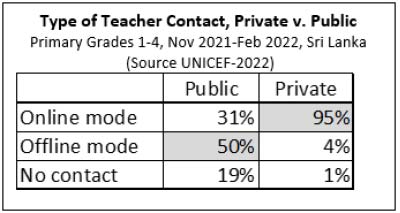
Of the parents of children attending private schools, 95% reported online contacts; only 4% reported off-line contacts; and 1% reported no contacts. (Figure 1)
In contrast, only 31% of parents of primary grade school children attending public schools reported online contacts or contacts requiring Internet access; 50% reported off-line contacts and 19% reported no contacts.
Over all parents of children attending public schools 81% reported receiving some contacts from a teacher v 99% of parents in private schools. Considering the extremes in facilities between the types, the 81% reported by parents of public-school children is a decent percentage.
Nature of online and offline contacts
Nature of contacts indicates how public schools managed to report contacts at 81%.
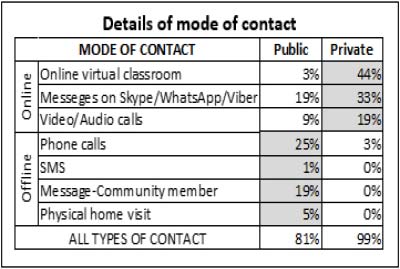
Offline modes accounted for 48% of contacts in the public sector and included Phone calls (25%); SMS (1%); Messages through community members (19%), and Physical home visits (5%).
While policymakers were making unattainable promises for more and better Internet access, it seems that the peripheral institutions rose to the occasion using the resources at their disposal.
In contrast, in private schools, online virtual classrooms were experienced by 44%; Messages on Skype/Viber/WhatsApp by 32.5%; and Video of Audio Calls by 18.5%. Their offline modes of contact were limited to 4% receiving phone calls.
It would be a difficult climb for public schools to move from 3% of virtual classroom experience to 44%. More video calls on social media would be a more realistic goal.
Regularity of contacts
The regularity of contacts points to a major lacuna in public sector efforts.
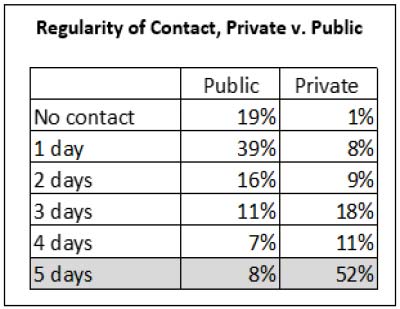
Of the families with children attending private schools 52% reported that a teacher contacted a child 5 days of the week and 81% of students were contacted 3 or more days a week.
In contrast, only 8% of the families with children attending public schools reported that the children were contacted 5 days a week. The majority of children or 74% of children were contacted less than 3 days a week or not contacted at all.
Possible to close the gaps, with commitment
If you take a glass half-full approach, the public school system managed to reach 81% of the enrolled children, though only 8% contacted all five days of the week. The public sector probably could have reached the students more regularly, if they first ensured offline modes such as Phone calls; Messages through community members; and Physical home visits were available to all the children and then topped up with online modes.
The central Government could have helped by activating mechanisms such as school attendance committees at Grama Niladhari level and conveying the importance of reaching out to every student. In
Instead, what we heard through policy dialogues held by Education Forum Sri Lanka during the 2020-2022 period is a failure to understand the roles of respective of levels of Government. EFSL held six dialogues related to COVID during the 2020-2022 period convening teachers, principals and administrators to shed further light on the ground situation during school closures mandated by the center. https://educationforum.lk/category/events/. Several governance issues came to fore in these dialogues.
Micromanagement is an issue
Once a crisis has started, the center can do little. This reality was well-demonstrated during the Ditwah cyclone that hit Sri Lanka at the end of November 2025. The national disaster management center failed both in its preparations for a cyclone hazard and providing adequate warning, the two main functions of a national body. Once the cyclone hit and the hazard became a disaster, the authorities at district and divisional levels were positioned best to respond with the assistance of tri-forces and all other national entities with a ground level presence, and they delivered.
The same applies to education as evident from the lockdown period during the COVID-19 crisis of 2020-2021. For example, a director of an education division in the Northern Province, representing a diverse community in the interior from farmers to fishermen in the coastal areas, said that during the lockdowns rural schools gained somewhat on urban schools presumably because the small rural schools were able to bring children to school under the health guidelines of local medical authorities. That was no longer possible after the Ministry of Education issued a directive for an all-encompassing closure of schools. He questioned the logic of applying equality of policies to a widely diverse set of schools. For example, policies regarding school openings are made with crowded urban schools with students from across the country in mind, when smaller schools serving a contained community could well stay open. We need school-based solutions, he emphasised. Further he noted that we need to give pride of place to teachers and expect them to take responsibility for the education of children under their charge and support the teachers to do their job.
A director of an education zone in the Western Province noted that Circular 2020/15 and a Letter dated Jan 26, 2021 from the line ministry indeed gives schools the authority to make decisions, but when the ministry makes a determination that all schools, say in the Western Province, should be closed, school-based committees cannot override such a directive. The Ministry of education should make decisions on school opening or closing with sensitivity to children attending smaller schools serving small communities.
During the crisis, some provincial and zonal authorities rose to the occasion and developed their own content management and/or student tracking systems and guidelines on remote learning, and teachers and administrators across country used these resources to learn about remote teaching and quickly adapt to the situation. The central Government was less agile in its responses for good reasons. The central Government role is policy making and monitoring and evaluation, and they are less well equipped to provide retail services. The central Government should encourage innovations by the peripheries, but we have not seen much evidence to that effect.
One of the reasons why innovations by the peripheries are not encouraged is perhaps the notion that all systems should be standardised across the provinces to ensure equity and better coordination by the center. It is a question that needs to be explored further, but at this point it may be too late for that exploration since the crisis already upon us.
Neglect of macro level responsibilities too is an issue
On the other hand, there is much the central ministry could have done to prepare for the crisis and support ground level efforts during the crisis.
Abridged curricula
For example, as the principal of a private school from Colombo noted during a policy dialogue by EFSL, our curriculum needs to be adjusted so that it can be more easily switched to online mode in case of emergencies. He also stressed the importance of providing resources and equipping our teachers with the knowledge and skills needed to switch to emergency mode when needed. In fact, as Fukuma of UNESCO argued, such curricula and blended learning should be the norm in emergencies or otherwise.
One of the key macro level responsibilities are to ensure an abridged curriculum is ready in the event of a crisis. The Royal Education Council of Bhutan, for example, released an Education in Emergency (EiE) Prioritised and Adapted Curriculum as early as July 2020. Sri Lanka’s education authorities were not able produce such until the end of 2022.
A focus on essential learning outcomes
In 2022, the World Banks estimated that 70% of 10-year-olds in low-and middle-income countries are unable to read and understand an age-appropriate text. This marks a sharp increase from 57% in 2019, reflecting the devastating impact of COVID-related school closures and disruptions on foundational learning.
Interestingly, pass rates of at the national examinations in Sri Lanka continued to increase during 2020-2022 period and beyond (DoE), but the extent of isolation imposed on children and details of how children learned (UNICEF, 2021 and LIRNEAsia, 2021) do not point to a meaningful education experience. As we might guess, the pass rates of national examination may have nothing to do with quality of schooling but everything to do with activity level of tuition providers, and that is a subject for a different column.
The learning loss from the COVID lockdown has not been quantified for Sri Lanka but an assessment of students in Grade 4 using an instrument designed to assess authentic learning (as opposed to, learning to answer model questions from past papers, for example), showed shockingly low levels of literacy and numeracy in Grade 4 children (MoE, 2023).
Social-emotional needs of students
One-on-one interactions with teachers and informal social interactions with other children are just as important as receiving educational content. The UNICEF survey of families of children in primary grades and observations of knowledgeable stakeholders show that public schools, especially less endowed rural schools and the school community, reached out to their students in a variety of offline methods due to the lack of online resources. In the process, they may have served not just the academic needs of the students but their socio-emotional needs as well. But a more concerted approach was needed.
Requiring that schools do a remote learning drill at least on one day a year is another idea that came up during our dialogues and central Government can make such a stipulation after consulting with provincial authorities.
Way forward
The Government of Sri Lanka provides basic facilities equitably to all schools according to defined guidelines. The inequity among schools is due to the capacity of each school community to top up basics provided by the Government. The quality of education provided also varies due to this reason, but with a system of schools spread across country, access to a school is not an issue during normal times.
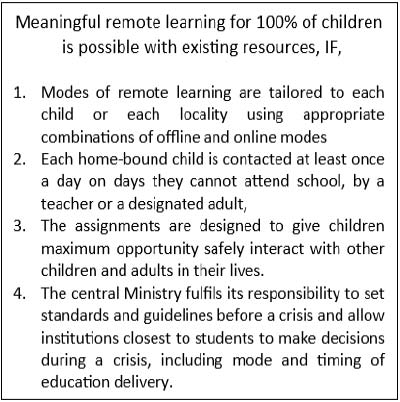
During a crisis when schools cannot be kept open, at a minimum, we should ensure that each home-bound child receives an educational experience that mirrors, to a possible extent, what he/she receives during normal times.
Going forward, the best a central ministry can do is to set guidelines to ensure that each child is reached and both their basic academic and social-emotional needs met, and empower the schools to deliver.




