Sunday Sep 27, 2026
Sunday Sep 27, 2026
Tuesday, 11 August 2026 00:00 - - {{hitsCtrl.values.hits}}
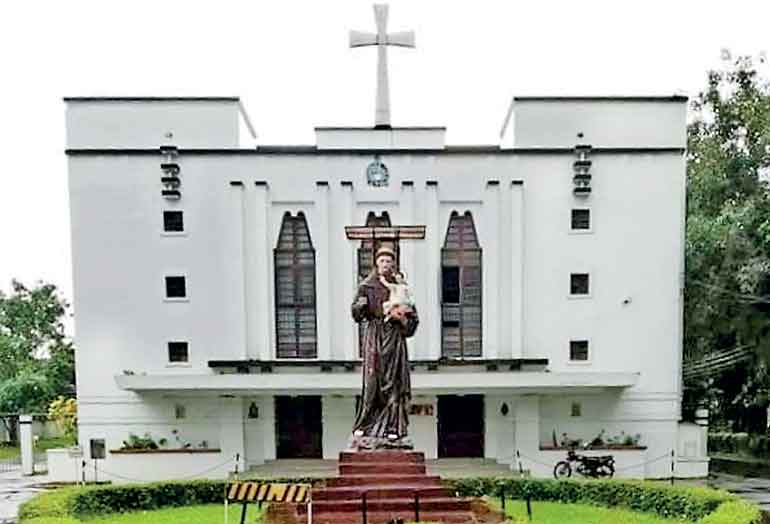
 Recently, I had the privilege of attending the centenary celebrations of the Colombo Branch of the St. Anthony’s College, Kandy Old Boys’ Association. As I met former teachers, schoolmates and fellow Antonians, I found myself revisiting a period of my life that shaped me far more profoundly than I appreciated at the time. What began as an evening of nostalgia gradually became a reflection on a much larger question: what is the true purpose of education in shaping the future of a nation?
Founded over 170 years ago, St. Anthony’s College has educated generations of Sri Lankans who have gone on to serve the nation in diverse fields. As I reflected on the College’s long history and the centenary of its Colombo Old Boys’ Association, I was reminded that the true legacy of a school is not measured by its buildings, examination results or sporting achievements alone. Its greatest legacy is the lives it shapes and the contribution those lives make to society.
Like many of my contemporaries, I entered school as a young boy with potential but little understanding of who I might become. Looking back over several decades, I can say with confidence that much of who I am today was influenced by the values, experiences and relationships I encountered at St. Anthony’s College. The lessons that mattered most were often not found in textbooks or examinations. Rather, they emerged through the people who taught us, the opportunities we were given and the standards that were expected of us.
These reflections seem particularly relevant today as Sri Lanka stands at an important educational crossroads. As the nation embraces digitalisation, artificial intelligence and educational reform, there is an understandable focus on developing future-ready skills. The reforms presently being introduced seek to create citizens prepared for the challenges of the twenty-first century through greater emphasis on digital literacy, technology, entrepreneurship, citizenship education, inclusivity and lifelong learning. Their overall aim is to prepare young people for a changing world while contributing to national development and social progress.
These efforts deserve recognition and support. The world our children will inherit will be profoundly different from the one many of us entered as students. Artificial intelligence, automation, climate challenges and rapid technological change are transforming how we live and work. Our education system must evolve accordingly. The move towards developing future-ready competencies and more relevant learning experiences is both timely and necessary.
Success of reforms
Yet the success of these reforms will ultimately depend not on policy documents but on implementation. Educational transformation happens in classrooms, laboratories, libraries, playing fields, scout camps, debating societies and countless interactions between teachers and students. The deeper aspirations of these reforms must also extend beyond a few grades or cohorts and gradually influence the entire educational experience if they are to have a lasting impact on the nation.
As we prepare students for the future of work, however, we must also ask a broader question: what kind of human beings are we helping them become?
Around the world, education systems are facing growing pressure to develop skills that can be measured, tested and certified. Academic performance, technological competence and employability understandably receive significant attention. Yet some of the most important capabilities for life remain difficult to measure. Integrity. Compassion. Resilience. Judgement. Responsibility. Self-awareness. Purpose.
This brings to mind a famous observation often attributed to Albert Einstein:”Not everything that can be counted counts, and not everything that counts can be counted.” Whether in education, business or government, there is a natural tendency to focus on what is measurable. Examination scores, qualifications, university admissions and employment statistics are relatively easy to track. Character, values, purpose, wisdom and the ability to contribute positively to society are far more difficult to quantify.
The danger is that leaders, policymakers and institutions can gradually become preoccupied with what is easy to measure while neglecting what truly matters. What gets measured attracts attention, resources and accountability. What cannot easily be measured can unintentionally become secondary. Yet it is often these less measurable qualities that determine how people use their knowledge and skills. An education system that focuses exclusively on capability risks producing technically competent individuals who lack the values, judgement and sense of responsibility needed to use their capabilities wisely
Intelligence without character
The danger is that leaders, policymakers and institutions can gradually become preoccupied with what is easy to measure while neglecting what truly matters. What gets measured attracts attention, resources and accountability. What cannot easily be measured can unintentionally become secondary. Yet it is often these less measurable qualities that determine how people use their knowledge and skills. An education system that focuses exclusively on capability risks producing technically competent individuals who lack the values, judgement and sense of responsibility needed to use their capabilities wisely.
History repeatedly reminds us that intelligence without character can be dangerous, while capability without values can be destructive.
As I reflected on my own journey, I realised that many of the qualities that enabled me to navigate life’s opportunities and challenges originated outside the formal classroom. The rugby field taught me teamwork, discipline and perseverance. Athletics taught me the pursuit of excellence. The Scout movement taught me service and self-reliance. Becoming a prefect taught me responsibility and leadership. These experiences formed my character long before I acquired professional qualifications or leadership positions.
During the celebrations, I had the pleasure of reconnecting with one of my former Mathematics teachers, R. N. A. De Silva. In a light-hearted exchange, I confessed that as a student I had modelled my signature on his. To my surprise, he told me that he had modelled his signature on that of one of our beloved principals, Rev. Fr. Dom Aiden De Silva. We both laughed, but the conversation left me reflecting on the nature of influence. Much of what shapes us is not formally taught. It is absorbed through observation, example and daily interaction. Human beings learn not only through instruction, but also through inspiration.
One individual who came to mind during the celebrations was the late Rev. Fr. Stephen Abraham, one of our most respected principals. I still remember his words when I was appointed a prefect. He explained that the word prefect originated from the Latin praefectus, referring to one entrusted with responsibility and leadership. He challenged us to become exemplary role models who would nurture the traditions, values and potential of younger Antonians. At the time, it seemed a simple message. Today, I recognise it as one of my earliest leadership lessons: leadership begins with personal example.
Looking back, I realise that none of these lessons were primarily about academic achievement. They were about character, identity and how to live well. Perhaps this is why, over the years, I have come to view education differently.
True purpose of education
The true purpose of education is not simply to prepare students for employment. It is to prepare them for life.
This includes equipping them to become responsible citizens, thoughtful leaders, caring family members and contributors to society. It involves helping them discover not only what they are capable of doing, but also who they wish to become.
This perspective aligns closely with my own work on purposefulness. Through my research and practice, I have come to see purposefulness not as a destination or a personal achievement. Rather, it is an ongoing process of aligning our actions with what contributes to the flourishing of life. It involves developing ourselves while simultaneously contributing positively to others and to the communities of which we are part.
The true purpose of education is not simply to prepare students for employment. It is to prepare them for life. If our schools can produce citizens who combine competence with character, excellence with compassion and achievement with purpose, we will not only build a stronger workforce. We will build a stronger Sri Lanka and a more flourishing society
Viewed through this lens, schools play a vital role in nation-building. Purposeful nations are built by purposeful citizens. Purposeful citizens are often shaped by purposeful educational institutions. When educators see their role merely as transmitters of knowledge, their impact is limited. When they recognise themselves as shapers of human potential, their influence can span generations.
The challenge before us is therefore not simply educational reform, but educational renewal.
We need students who can code as well as care.
We need graduates who are technologically competent and ethically grounded.
We need future leaders who can analyse data and exercise wisdom.
We need innovators who create things that amaze us but also consider what matters to us.
In short, we need an education system that develops human beings as well as human capital.
As I reflected on the celebrations, I found myself deeply grateful to St. Anthony’s College and to the many clergy, teachers, coaches and mentors who invested in our lives. Like many great schools across Sri Lanka, it provided far more than academic instruction. It created an environment where character, leadership, service and resilience could be developed.
Perhaps that is also the aspiration we should hold for education as a nation.
Not merely to produce skilled individuals for the economy, but to nurture purposeful citizens who contribute to the flourishing of life.
In a world increasingly shaped by technology, the most important task of education may not be helping young people learn how to make a living, but helping them learn why they live and how they can contribute to something greater than themselves.
If our schools can produce citizens who combine competence with character, excellence with compassion and achievement with purpose, we will not only build a stronger workforce.
We will build a stronger Sri Lanka and a more flourishing society.
(The author is the Managing Director and Chief Catalyst of Purposeful Leadership Ltd. He holds a PhD from Hult Ashridge, an MBA from the University of Sri Jayewardenepura, and is a Fellow and Gold Medallist of the Chartered Institute of Marketing, UK. He can be reached at www.ranjandesilva.com, www.ranjandesilva.blog and www.purposefulleadershipco.com)




