Saturday Oct 03, 2026
Saturday Oct 03, 2026
Friday, 1 May 2026 08:19 - - {{hitsCtrl.values.hits}}
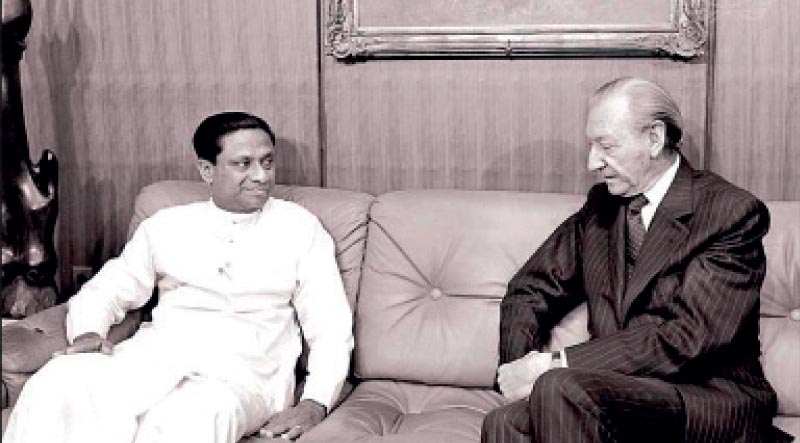
Late President Ranasinghe Premadasa with UN Secretary-General Kurt Waldheim before he addressed the 35th session of the UNGA
 Some political opponents rated Premadasa as a ‘pro-poor or poor-biased’ person, and I agree with the view, but with an extra note. Premadasa, throughout his political career from local councils to the Presidency, was pro-poor, poor-biased and poor-centric, and he was for the poor not by distributing what the rich had, but by directing and leading the rich to create opportunities for the poor to find their fortune
 For many people, the most suitable economic policy programs for the country come closer to the economic philosophy and policy program of the late President, Ranasinghe Premadasa. Premadasa often took decisions from the point of view of the poor and wanted to direct ‘have and able’ people to use their luxuries and fortunes to help create situations that generate direct and tangible benefits to the poor and the vulnerable. He never wanted to discourage the capitalists, high-income and investing class through exorbitant taxes in the name of revenue-based fiscal consolidation. Instead, he struck workable agreements with high-income capitalists and the investing class to create productive opportunities and industrial ventures that generate benefits not only for the rich but also for the poor through sustainable jobs and income streams. Some political opponents rated Premadasa as a ‘pro-poor or poor-biased’ person, and I agree with the view, but with an extra note. Premadasa, throughout his political career from local councils to the Presidency, was pro-poor, poor-biased and poor-centric, and he was for the poor not by distributing what the rich had, but by directing and leading the rich to create opportunities for the poor to find their fortune.
Premadasa in present context
At present, we have a Marxist party, JVP, in power whose members attempted to create a revolutionary Government for an equal and communist system. Keeping the past JVP ideology and its present campaign slogan ‘A rich country – A beautiful life’ at bay, the Government led by Anura Kumara Dissanayake (AKD), is blindly following IMF-backed neo-liberal and (crony) capitalistic economic policies alienating the poor and the vulnerable from the prosperity.
Taxing essential goods at historically high rates, and passing all costs of inefficiencies, irregularities, malpractices, waste and corruption to the public through price hikes have had a serious burden on the poor. The cost of mishandling the West Asian war and the unpreparedness for the energy crisis has been directly put on the poor, citing IMF directives and recommendations made by Colombo-based so-called research institutes. The current Government does not follow any tangible measures to absorb the effects of the economic crisis and energy crisis to provide some relief measures to the poor, and the vulnerable. The poor-unfriendly IMF measures have tightened the bellies so hard that the poor need little to survive. President Dissanayake who wanted to revamp the IMF agreement in the 2023/24 period is so tame now, and following the same agreement without even meagre changes. The IMF staff including its Managing Director found it easier to work with the JVP Government than any other Government and implement their policy program, irrespective of how local innocent people felt its consequences. The ‘overflowing treasuries’ of the Government can be used to prove the cruelty of the IMF policy program and the inability of the JVP government to make the lives of innocent people better.
I believe, if the late President Premadasa led the country at this very specific moment, he could have been more concerned about the IMF-led unjustifiable pickpocketing of the income of wage earners, about the burden imposed on industries that provide employment for the poor, about the hardships imposed on MSMEs, and about not driving big businessmen to expand their industries to create new jobs and output, rather than giving them unwarranted ‘hand-outs’ and offering public tenders under fraudulent procedures. Premadasa could be very upset to see his Finance Ministry Secretary, the Central Bank Governor, and officials sharing the responsibility of putting $ 2.5 million meant for loan repayment in the hands of ‘hackers’.
With the present macroeconomic situation, it is very unlikely that the Government will be in a position to start repayments of loans by 2028. The economy does not reach the set or targeted growth rate. No additional savings. No real public investments. No foreign investments to meet domestic shortage. Almost stagnant tourism and worker migration contributions. No rapid export expansions. Thus, GDP growth targets fall short of expectations. With further depreciation of the local currency and escalated import costs due to fuel price hikes the BOP position of the country leaves the fundamentals far from promising. The AKD administration has become a victim of crony capitalism as it becomes a prisoner of several business mafia including rice mill owners and Colombo-based business tycoons. The AKD administration has failed to follow even the conventional liberal capitalist market economic policies where the capitalist class invest their surpluses in further enhancing productivity, creating jobs, contributing to export earnings and finally contributing to the well-being of the poor through trickle-down effects. In his time, Premadasa opted for a social democratic policy program, where the rich and capitalist class were pushed for domestic investment and production for employment generation and productivity enhancement in rural and less advantaged sectors. Even after 18 months since the election as the President of this country, AKD has failed to initiate a local and/or foreign investment drive to generate employment and income for better lives of the poor and also to increase the national pie (GDP), thus the individual share is bigger.
Factories for villages
Among many Prime Ministers and several executive Presidents of this country, Premadasa remains an exception. Some known contributions of former Presidents are: J. R. Jayewardene introduced free market policies and various development projects, Mahinda Rajapaksa put an end to the 30-year-old civil war and war-ridden uncertainty of the economy, though not elected by the people Ranil Wickramasinghe mitigated the economic collapse, while AKD is struggling to continue the initiatives made by his predecessor forward. As I remember, Premadasa took charge of the economy when the country was burnt by two nasty forces, the JVP led so-called liberation movement and the LTTE-led separatist war in the North and the East. He had the responsibility of addressing the issues faced by the Sinhalese and Tamil youth and bringing normalcy and peace to the people with better living standards. This required establishing peace in both communities and attracting youth to the mainstream economy and the political process. Since the lack of economic opportunities was considered a main reason for the youth unrest and their involvement in terrorism and socially destructive activities, Premadasa wanted to upscale economic opportunities at the rural and grassroot level and opted to bring factories and thus jobs to the village. Jobs in their vicinity and proximity changed the minds of the rural youth to engage in the mainstream. Premadasa approached big businessmen, including foreigners and requested them to bring their factories into villages, resulting in the location of more than 200 factories in villages providing thousands of direct and indirect jobs and the use of more village-based resources, creating rural development and economic centres. This ‘factories for villages’ concept provided stimulus for the local economy absorbing the youth labour for productive means. Many factories started under the project are still in operation even though the successive governments failed to provide the required facilities for the existence of the factories after Premadasa. I would say the political hypocrisy of leaders and parties that came to power later did not want them to see the ‘success of the Premadasa’s 200 garment factories project’.
Policy reforms
Another important aspect of the Premadasa regime is the continuation of the economic liberalisation and deregulation process started in 1978. These policy reforms were to ensure competition in various sectors, reduce Government dominance, make trade free, deregulate the investment climate, remove exchange controls and eliminate fixed exchange rate regimes to facilitate trade and investment. The privatisation of public enterprises was continued to minimise the burden on the Government Budget and improve market conditions; and many inefficient public monopolies were turned to competitive market structures through this project enhancing service delivery and outcome. But these market reforms were abandoned later by successive governments, especially the Mahinda Rajapaksa administration and recreated a large public sector by increasing employment and creating many State-owned enterprises (SOEs) and public entities. Though the large public sector created now has become a burden to the entire economy, the AKD administration had no vision and practical program to correct it as done by Premadasa.
Poverty alleviation and safety nets
Premadasa was known especially for his pro-poor approach and dedication to the lives of rural and urban marginalised and asset-less communities. His career as a politician emerged with the poor and less fortunate people and thus he is better known as ‘the friend of the poor’. Soon after being sworn in as the President, he started the Janasaviya program to help the poor and asset-less people of society. Even his fellow cabinet members, high-ranking Government officers and international funding agencies viewed the program with scepticism, Premadasa went ahead with it branding it as a ‘social responsibility’ program of the ‘people who have and who are able’. When (in the 1980s) the IMF and the World Bank had no vision to fund such programs and support the lives of the poor, and recommended the governments to slash subsidies and transfers, Premadasa was visionary and had the courage to implement the Janasaviya program, as the country’s first coordinated and organised poverty alleviation program, which had a survival support component and a productivity enhancement component. During a period where the welfare state was at a crossroads under heavy critiques and objections from local business community, educated upper middle income groups, upper class politicians and public officers and international development agencies, Premadasa went ahead to introduce other helping hand programs too for poor and the vulnerable such as school midday meal program, nutritional food for pregnant mothers, support for disabled and elderly, etc.
Housing for homeless
Lack of proper housing and sanitary facilities was a major issue in urban settlements and many rural villages. Late President J. R. Jayewardene gave his Deputy, Ranasinghe Premadasa, a challenging task by assigning the Local Government, and Urban Development Ministry to him in addition to the premiership. Premadasa used the opportunity to uplift basic infrastructure and community facilities in urban and rural areas to upgrade the communities. At the same time, he initiated a massive and widely attractive project which targeted providing houses for homeless families. He constructed housing apartments for urban people living in informal settlements (shanties) and small, but attractive houses for rural homeless families. At one stage, Premadasa wanted to build 100,000 houses for the poor and soon the target was up-scaled to one million houses. This housing program was highly attractive to the poor as it made their dreams a reality. The program tagged as ‘Hisata Wahalak-Hithata Nivanak’ (roof for the head- relief for the heart) took the hearts of millions of people and provided shelter for thousands of children who did not have a proper place to dwell. Premadasa’s housing program was the focus of the 35th meeting of the United Nations General Assembly (UNGA) held in 1980 on housing needs of the poor and it actually resulted in declaring 1987 as the international year of Shelter for the homeless. This UN declaration indicated the merit of Sri Lanka’s housing program for the poor. Only his son, Sajith Premadasa, when he became the Housing Minister under the 2015 Government, was able to re-introduce the Premadasa housing program for the poor with new courage and focus. In his manifesto, AKD promised to initiate a new housing development program during his election campaign but so far it has not been materialised. Though the JVP-led propaganda mechanism tried to label the 76-year political period since independence to September 2024 (till Anura Kumara Dissanayake became the President) as a curse, a glimpse at Ranasinghe Premadasa’s political career and his service and dedication to fellow citizens and the country along give evidence against ‘the 76-year curse’.
All this evidence suggests that Ranasinghe Premadasa during his short period of Presidency and his entire political career has contributed immensely to his fellow citizens and the country in numerous and unforgettable ways. His great interest in inculcating people’s participation in the development process is one of the main ideological drivers of his success, ‘a tangible development initiative for the people will be carried forward and protected by the same people with great trust and sincerity’.
(The writer is a Professor in Economics, Department of Economics and Statistics, University of Peardeniya)



