Friday Oct 02, 2026
Friday Oct 02, 2026
Friday, 2 October 2026 00:23 - - {{hitsCtrl.values.hits}}
The remaining half of the NPP's term in Government should be an eventful period
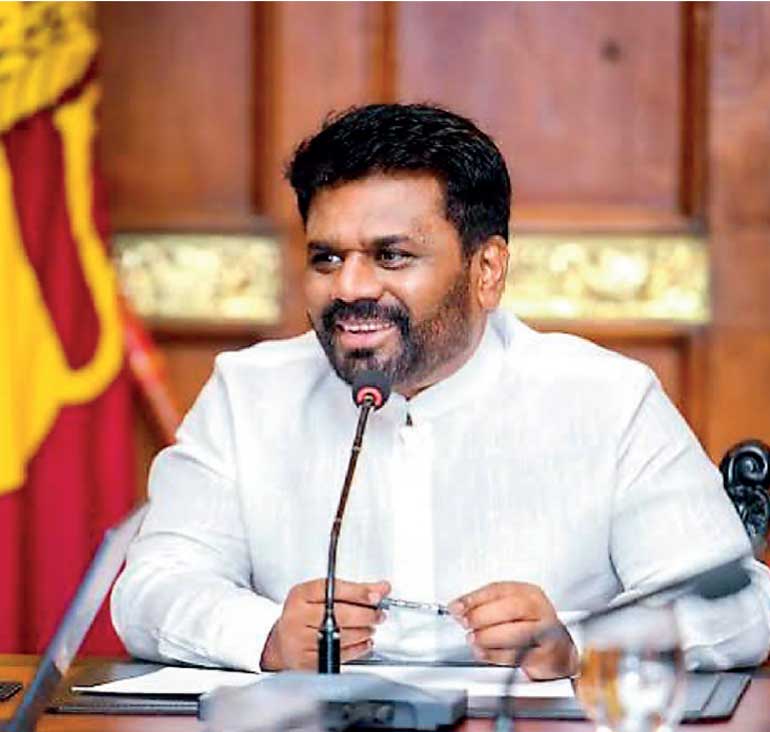
 Despite all the criticism levelled chiefly at the inexperience and dearth of talent within the AKD-led NPP Government, which was swept to power with an overwhelming mandate and without any bloodshed, that Government, with its unflinching commitment to pragmatic policies and clean governance, has performed remarkably well, not simply in arresting the economy's descent towards stagnation and financial bankruptcy but in putting it on a stronger footing towards achieving higher growth in the future.
That pragmatism has capitalist traits is not disputed. Even Lenin's NEP accommodated the market economy as a temporary measure before launching his communist model. However, in endorsing Sri Lanka's achievements, Capital Alliance Holdings (CAL), a capital market service provider, said the following in its 2025/26 annual report: "The period of 2025/26 stands as a compelling chapter in Sri Lanka's economic history, one defined not by crisis but by the disciplined pursuit of stability and the careful cultivation of growth. The nation has demonstrated that even after a sovereign default, with the right combination of institutional commitment, international partnership and policy coherence, recovery is not only possible but achievable faster than many had anticipated."
According to the Governor of the Central Bank of Sri Lanka (CBSL), even the debt-to-GDP ratio has declined, although the extent of that decline sounds a bit exaggerated. To cap it all, Fitch has raised the country's Issuer Default Rating (IDR) from CCC+ to B-. So far, so good, but the challenges that lie ahead are formidable, and the most crucial one, as CAL's report points out, is "the urgency of translating macroeconomic recovery into household-level welfare improvement". Will the forthcoming budget tackle this dire need?
Meanwhile, having acknowledged the progress made so far under the $ 3 billion EFF program, IMF Mission Chief Evan Papageorgiou reminded the Government that "the 2026 budget should be in line with program parameters to continue building fiscal space on the back of revenue measures and prudent spending execution, (which) requires sustained efforts to improve tax compliance, broaden the tax base and tackle revenue leakages by strengthening the tax exemption framework. Enhancing public financial management, avoiding the reemergence of expenditure arrears and promoting high-quality and efficient public expenditure, including by addressing capital spending under-execution, will contribute to safeguarding fiscal discipline and transparency."
Sadly, nowhere in the Mission Chief's remarks was there any reference to measures that would improve household-level welfare. Most recently, Treasury Secretary Dr. Harshana Suriyapperuma, commenting not on the 2026 but on the 2027 budget, said that it would "create (the) best environment for our fishermen, for our farmers, for our industries, businesses and service sectors to thrive". Yet the Government, strengthened by the achievements made so far, has announced that it would exit the IMF program in 2027 and would not seek another on the same conditions.
However, the nation's poverty rate still hovers around 24%, according to World Bank estimates. Poverty reduction remains the biggest challenge facing the NPP Government, and the poverty rate must be brought down not simply by raising Aswesuma payments or by cutting a few cents off the prices of certain consumer items sold through Sathosa, but by tackling the causes that led to the growth of poverty in the first place.
One indisputable fact about the economic recovery and growth experienced so far is that a substantial share of the cost of that recovery has been borne by the nation's low-income earners. The IMF's recommendation to broaden the tax base, which resulted in 18% VAT, together with inflationary pressure on prices, has hit low-income groups and made poverty reduction almost impossible.
Raising the income tax threshold from Rs. 150,000 to Rs. 200,000, which the Government is mulling for the forthcoming budget, may provide some relief to low-income earners, while the tax revenue thereby lost must be regained by changing the tax structure so that super- and upper-income earners bear the greater share of the tax burden.
Tackling systemic poverty indirectly through narrowing the tax base, and directly through rejuvenating the rural sector by resourcing its agricultural production base, should take precedence in the forthcoming budget. Even if the Government were to seek further assistance from the IMF, that assistance must be made conditional on measures aimed at poverty reduction through resourcing the rural economy.
This would not only enhance the nation's self-sufficiency in basic needs but also stem the outflow of rural labour to urban areas, which adds to urban poverty. In short, AKD's system change, with reference to the economy, needs a Gamperaliya to start with.
Maintaining monetary stability, achieving fiscal balance, investing in infrastructure development, incentivising foreign investment and managing foreign debt to maintain Sri Lanka's credibility in international financial markets have been the main objectives of the EFF-financed IMF pathway.
It is time for the AKD-NPP Government to leave its own footprint by indigenising the economic model, prioritising the issue of equity without abandoning the open economy paradigm. There are good lessons to learn in this regard from the economic experience of certain Southeast Asian countries such as Vietnam and Cambodia.
Yet there are other challenges to overcome. For example, the supply constraints and inflationary impact of the two wars, one in Europe and the other in the Middle East, and the protectionist trade policies advocated by an adventurist US President have shattered the growth prospects of practically every economy in the world. The cost-of-living crisis Sri Lanka currently faces, for instance, is part of an economic pandemic closely associated with these events.
The IMF's economic policy steering and growth strategy have no solution to ease the pain. The entire global capitalist economic order is in a state of crisis. This makes systemic change more challenging, at least in the short run, for countries like Sri Lanka. Similarly, the rising threat of the El Niño effect or climate change could ruin decades of development and make economic growth even more difficult. Sri Lanka's Ditwah this year was relatively minor compared to what happened in Nepal recently.
Decades of warnings by scientists, climatologists and economists about the dangers of unidimensional economic models based on technological arrogance and the profit motive were ignored. The same arrogance is now being displayed in relation to AI. These are formidable challenges to overcome in pursuit of the much-touted systemic change announced by the AKD-NPP duo. The remaining half of the NPP's term in Government should be an eventful period in this regard.



