Sunday Sep 13, 2026
Sunday Sep 13, 2026
Wednesday, 8 July 2026 00:25 - - {{hitsCtrl.values.hits}}
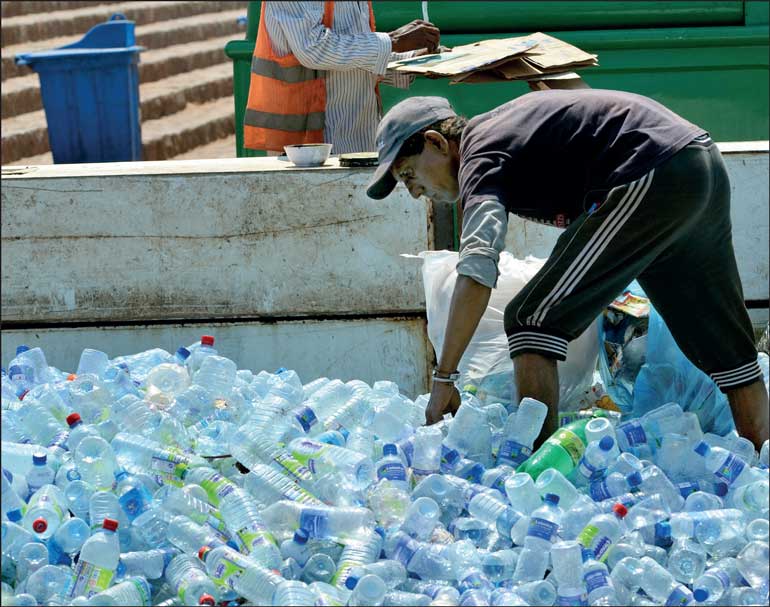
 Sri Lanka stands at a pivotal moment in its journey toward sustainable development. While the country continues to face economic recovery challenges, environmental issues such as plastic pollution remain a growing concern. Across our cities, villages, rivers, beaches, and coastal ecosystems, discarded plastic waste—particularly PET beverage bottles—has become one of the most visible signs of unsustainable consumption and inadequate waste management.
Yet hidden within this challenge lies an extraordinary opportunity.
What if every discarded PET bottle could become a source of income for citizens, a raw material for industry, and a contributor to national economic development? What if recycling was no longer viewed as an environmental obligation but as a financially rewarding activity that benefits communities, businesses, and the nation alike?
This is the vision behind the proposed EcoBonus-Driven PET Bottle Recycling Ecosystem for Sri Lanka.
From waste to wealth
Globally, the world produces over 400 million metric tons of plastic annually, with only a fraction being effectively recycled. PET bottles, commonly used for bottled water, soft drinks, juices, and , represent one of the most recyclable forms of plastic. Unfortunately, large quantities continue to end up in landfills, waterways, drainage systems, and coastal environments.
Sri Lanka is no exception.
Plastic waste contributes to blocked drainage systems, urban flooding, marine pollution, environmental degradation, and increasing municipal waste management costs. At the same time, valuable recyclable resources are being lost every day.
The traditional approach to waste management—collecting, transporting, and disposing of waste—is no longer sufficient. What is required is a transition toward a circular economy where waste becomes are source rather than a burden.
The EcoBonus solution
The EcoBonus model introduces an innovative concept that combines recycling, digital technology, and community participation.
Under the proposed system, citizens deposit PET bottles at designated collection points located in schools, universities, supermarkets, fuel stations, shopping malls, religious institutions, and municipal facilities. In return, they receive digital EcoBonus credits through a mobile-based wallet platform.
These credits can then be redeemed for goods, services, transport benefits, educational support, retail discounts, utility bill reductions, or other community rewards.
In simple terms, EcoBonus transforms environmental responsibility into economic opportunity.
Rather than relying solely on awareness campaigns and voluntary participation, the model creates a direct financial incentive for citizens to recycle. Every PET bottle acquires measurable value, encouraging households, students, businesses, and communities to participate actively in waste recovery.
Learning from international success
A particularly relevant example comes from Tajikistan, where a compact PET recycling facility was recently established with a processing capacity of approximately 800 kilograms per hour.
What makes this model remarkable is not its size but its practicality.
Operating within a relatively small facility footprint and using semi-automated technology, the plant demonstrates that effective recycling infrastructure does not necessarily require massive industrial investments. Instead, appropriately designed facilities can deliver substantial environmental and economic benefits while remaining affordable for developing economies.
This lesson is highly relevant for Sri Lanka.
Rather than investing exclusively in large centralised recycling facilities, the country could adopt a decentralised network of regional recycling hubs capable of serving local communities while reducing transportation costs and increasing operational efficiency.
Building a national recycling ecosystem
The proposed EcoBonus framework consists of three integrated stages.
The first stage focuses on community collection, where citizens deposit PET bottles and immediately receive EcoBonus rewards.
The second stage establishes Regional Aggregation Centres that sort, clean, and prepare materials for processing.
The third stage involves PET Processing Facilities that convert collected bottles into high-quality PET flakes suitable for manufacturing applications such as packaging materials, textiles, and industrial products.
This integrated model creates a complete value chain connecting citizens, local authorities, recycling operators, manufacturers, and technology providers.
More importantly, it establishes a national recycling ecosystem capable of operating as a sustainable economic sector rather than a government-funded waste disposal service.
Economic benefits for Sri Lanka
The economic potential of such a system extends far beyond waste management.
A nationwide EcoBonus ecosystem could generate employment opportunities across collection networks, centres, transportation services, processing facilities, technology platforms, equipment maintenance services, and retail partnerships.
The production of recycled PET flakes would also reduce dependence on imported raw materials, helping conserve valuable foreign exchange reserves.
Furthermore, as global demand for recycled materials continues to rise, Sri Lanka could position itself as a regional supplier of certified recycled PET products, creating new export opportunities and strengthening its green economy credentials.
In an era where sustainability increasingly influences international trade and investment decisions, developing a robust recycling sector could become a strategic economic advantage.
Environmental and social transformation
The environmental benefits are equally significant.
Increased PET recovery rates would reduce plastic pollution across rivers, beaches, urban areas, and coastal ecosystems. Cleaner waterways would reduce flood risks associated with blocked drainage systems. Marine ecosystems would experience reduced plastic leakage, benefiting fisheries, tourism, and biodiversity.
At a social level, the model promotes community engagement, environmental awareness, and behavioural change.
Schools and universities can become centres of sustainability education. Youth participation can be enhanced through digital engagement and gamified reward systems. Low-income households can benefit from supplementary income opportunities created through recycling activities.
In essence, the EcoBonus framework encourages citizens to become active contributors to environmental protection while simultaneously benefiting from their participation.
A national opportunity
The proposed EcoBonus Recycling Ecosystem aligns strongly with Sri Lanka’s national development priorities, including circular economy development, digital transformation, climate resilience, green industry promotion, and sustainable urban management.
It also supports multiple United Nations Sustainable Development Goals, including Sustainable Cities and Communities (SDG 11), Responsible Consumption and Production (SDG 12), Climate Action (SDG 13), LifeBelow Water (SDG 14), and Life on Land (SDG 15).
For policymakers, investors, and business leaders, the message is clear.
Plastic waste should no longer be viewed solely as an environmental problem. It should be recognised as an economic resource capable of generating employment, supporting industrial development, conserving foreign exchange, and strengthening environmental resilience.
Sri Lanka has an opportunity to become a regional leader in circular economy innovation by combining modern recycling infrastructure with digital incentive technologies that actively engage citizens.
The future of sustainable waste management is not simply about collecting waste.
It is about creating value from waste.
The EcoBonus model offers a practical pathway toward achieving that vision.
(The author is a researcher and sustainability advocate specialising in circular economy development, environmental management, digital innovation, and sustainable business Transformation)




