Friday Sep 25, 2026
Friday Sep 25, 2026
Friday, 25 September 2026 00:25 - - {{hitsCtrl.values.hits}}
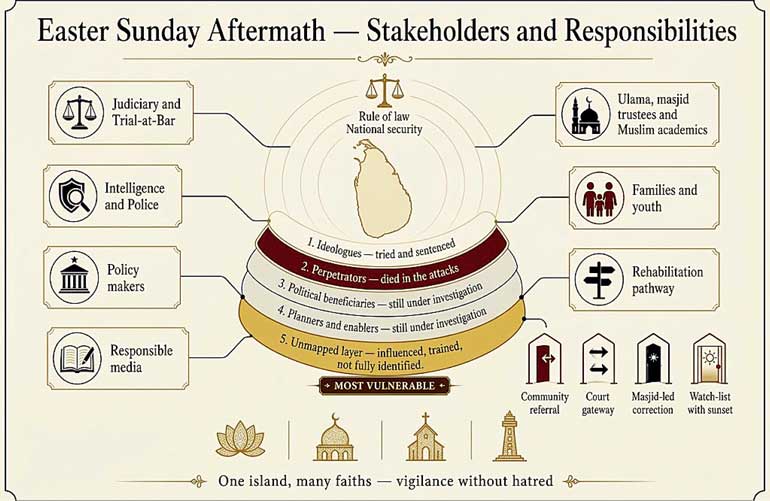
Five layers of the aftermath, and the institutions that still carry a duty. The amber band is the unmapped fifth layer — the most vulnerable
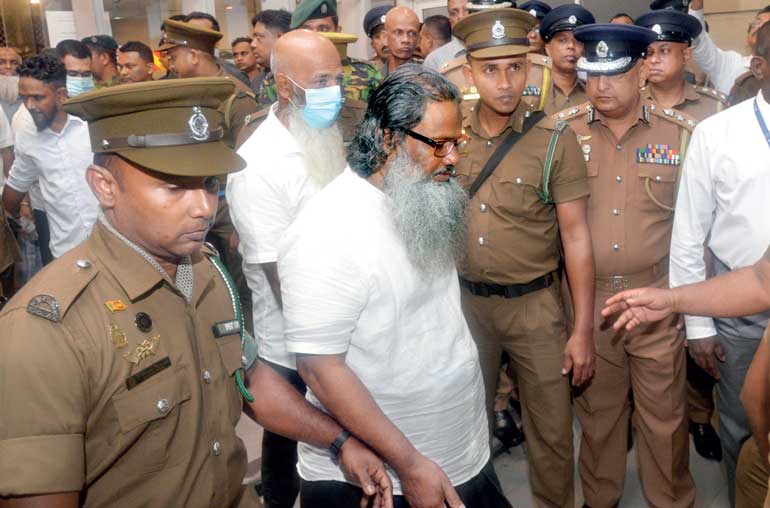
Two of the 15 suspects sentenced to imprisonment of 220 years being escorted by the Police on Tuesday - Pic by Jayamal Chandrasiri

The Colombo Permanent High Court Trial-at-Bar has spoken. After nearly five years, 23,270 charges and more than two thousand witnesses, fifteen men have been convicted of conspiracy, aiding and abetting and related offences arising from the Easter Sunday attacks of 21 April 2019. Nine others have been acquitted because the charges were not proved beyond reasonable doubt. The convicted have been sentenced to 200 to 260 years of rigorous imprisonment, and their property is to be confiscated. Appeals will follow. That is the right of every accused.
The judgement is necessary justice for the families who lost more than 270 loved ones, children at prayer, visitors who came to this island in trust, and for the hundreds who still carry wounds. It is not the closing of the chapter. A courtroom outcome is not a national security settlement. The bombers are dead. Some who sold an alien, violent narrative in the name of Islam have been tried. What remains is harder: political beneficiaries, alleged planners who still walk free, and above all those who absorbed the ideology, passed through stages of radicalisation, and in some cases received training, yet have never been fully identified.
Five layers, only two are closed
Confusing these layers is how conspiracy theories and official complacency both thrive.
First, the idolators of a foreign death-cult. They imported the ISIS narrative, a political ideology dressed in religious language, distorted scripture, glorified suicide and treated citizens of other faiths as targets. The main prosecution has now reached them. Among those convicted is Mohamed Naufar Moulavi, identified by the prosecution as a principal organiser. Wrongdoers face consequences. That principle is not optional.
Second, the perpetrators. The suicide cadres died in the churches and hotels they attacked. Others died days later at Sainthamaruthu, when remaining members of the network, including close relatives of Zahran Hashim, detonated explosives rather than surrender, killing their own family members, among them children. That ending was the logic of an ideology that consumes its own.
Third, political interest and those who benefited. Fear was monetised. Communities were collectively blamed. Careers and campaigns were built on the claim of being the only force that could keep the country safe. Whether that was opportunism after the fact, or something darker before it, is not a matter for social media. It is a matter for investigation. That investigation is not complete.
Fourth, the planners and those who may have enabled, ignored or exploited the operation. Ordinary citizens who are not on YouTube keep asking: what happened to the planners? The question is legitimate. A separate inquiry, including the arrest earlier this year of former State Intelligence Service Director Major General (retd.) Tuan Suresh Sallay on allegations he denies, remains before investigators and the courts. In July, former Inspector General of Police Pujith Jayasundara and former Defence Secretary Hemasiri Fernando were convicted of criminal negligence for failing to act on prior intelligence. Those cases will travel through appeal. Layers three and four are open.
Fifth, and the most vulnerable, those influenced, radicalised or trained and never fully mapped. This layer is not a dock of named accused. It is a scatter of people who sat in lectures, shared encrypted channels, attended weapons or explosives instruction, or absorbed enough of the ISIS syllabus to be changed. Some were arrested in the wide net after April 2019 and later released without charge. Some were never identified. They are the unfinished human inventory of the attack.
The unmapped staircase
Radicalisation is not a switch. It is a staircase. At the bottom are the curious. A step above are those who accepted the takfiri claim that other Muslims were deficient and other faiths were fair game. Higher still are those who took an oath, swapped SIM cards and sat through multi-day military-style instruction. At the top are those who walked into churches. The Trial-at-Bar dealt with people near the top. The staircase below them has never been fully surveyed.
The inner circle was larger than eight or nine suicide cadres. Estimates put the NTJ core at around a hundred to a hundred and fifty; Zahran’s open sermons drew thousands. Training sites later identified in Kattankudy, Nuwara Eliya, Hambantota and elsewhere were used for firearms and explosives instruction. An American affidavit described multi-day military-type training and a recovered ISIS curriculum.
After the attacks the State cast a wide net. Parliament was later told that hundreds were detained under detention orders; the great majority were released without charge. That figure cuts two ways. Many people should never have been treated as terrorists, kinship, a shared mosque or communal panic was enough. It also means that the picture of who was merely adjacent and who had walked part of the way up the staircase was never clean. Release without charge is not a closed intelligence file. An acquittal is not deradicalisation.
Sri Lankan law does not permit compelled rehabilitation merely because a person is suspected of holding extremist views. That protection of liberty is not a defect. But it leaves a gap: people who may have trained or been groomed, who cannot be lawfully warehoused, and who have not been offered a pathway off the staircase. Networks regenerate from that unmapped middle, not from men already serving two-hundred-year sentences.
Faith is not the accused. Extremism is
Islam, as lived by the overwhelming majority of Sri Lankan Muslims, is a faith of tawhid, mercy, restraint and neighbourliness. It is not a licence to impose a political reading of Sharia as state law on a country of Buddhists, Hindus, Christians and Muslims. Any ideology that claims a divine right to coerce a diverse population is not the Islam of our parents. It is a political project that hijacked religious language.
The ethic that should have been heard is ‘adl, justice, and sabr, patience that is not passivity. Justice means the guilty are punished after a fair trial and the innocent are not held hostage to the crimes of a few. Patience means refusing both invitations after 2019: for Muslims to close ranks around the indefensible, and for others to treat two million citizens as a security problem. Tolerance is not a slogan. It is a security doctrine.
Six years in the same jail is not a neutral fact
For more than six years, men later found guilty and men later acquitted occupied the same custodial space. Prisons are places where ideas travel-hardline ideas especially. What influence did the committed ideologues exert on those who entered as moderates, family men or peripheral accused?
The courtroom displayed the full human range: pleas for mercy citing family, silence wrapped in what some called Islamic values, claims of innocence, and fingers pointed at others walking free. The law has sorted the convicted from the acquitted. It cannot repair the minds shaped in those years. Whoever is released should not walk from the prison gate into the same grievance networks. Motivational factors remain plentiful: economic despair, online echo chambers and the industry of “us versus them”.
Once bitten, twice shy
The Muslim community cannot outsource this moment to the Attorney General. Academics, professionals, trustees and the religious leadership have a duty to stop another generation being lost to a death-cult wearing our faith as a mask. Masjid administrations must know who is teaching. Parents must treat unexplained isolation, contempt for other communities and secretive online networks as warning signs, not private piety. The claim that “this cannot happen among us” is how it happens among us. Saying that a political Sharia project has no place in multi-religious Sri Lanka is not a betrayal of Islam. It is a defence of it.
Policy makers and law enforcement have an equal duty. They must distinguish the extremist from the ordinary believer, or they will manufacture the alienation recruiters need. Collective punishment and the theatrical raid that produces pictures but no intelligence are not security. They are recruitment material. Division is a business. National security is the cost the rest of us pay.
A lawful way to reach the fifth layer
Where evidence of training or preparation exists, due process must follow. Where the threshold for prosecution is not met but the risk is real, the answer is neither a second PTA dragnet nor a pretence that the file is closed. It is a four-door mechanism that can sit inside existing law.
1. Community referral, not denunciation. Families, trustees and principals use a confidential district panel, a police officer who understands source protection, a psychologist, and an alim who rejects takfir. The panel assesses. It has no power of arrest. Most cases should end as pastoral work.
2. A court gateway when the risk is real. Weapons training, an oath or preparation short of a completed offence goes to a Magistrate, not an executive camp. The judge may decline, make a time-bound rehabilitation order, or commit for prosecution. Liberty stays with the court.
3. Masjid-led correction with a professional spine. The ideology was religiously coded; the exit must be better scholarship, not a government lecture. Ulama, psychologists and vocational officers; fixed duration; written progress; families in the room. A certificate without a changed mind is theatre.
4. A watch-list with a sunset, not a blacklist. A closed, graded list — high, medium, residual — of persons assessed as trained or still ideologically live. Not public. Not a licence to harass a family at a checkpoint. Every name has a review date and a named officer. After a fixed period with no new adverse information, the name falls off.
Two rules must sit on the face of the scheme or it will rot. A trustee’s anxiety is a reason to look, not a reason to lock. And the scheme is only for the fifth layer, not a second punishment for the convicted, and not a net over every young Muslim man in the East. Aftercare must run at least a year after any formal order: a case officer, a masjid mentor, an employer who will take a risk. A man returned to the same encrypted group and the same unemployed street has not been rehabilitated. He has been given a pause.
The information war after the verdict
The race among YouTubers to be first with a fragment of the judgement has produced more heat than light. Speed is not the truth. Many citizens who are not on social media have already concluded that “the Easter Sunday case is over,” because they saw convicts in prison buses and acquitted men walking free. They then ask what became of the planners. If the State and responsible media do not say that layers three and four remain under investigation, and that the fifth layer has barely been mapped, the vacuum will be filled by the loudest voice. Misinformation is a security vulnerability.
National security is the through-line
Intelligence received and not acted upon is paperwork. A community that will not police its own extremes will be policed by others, clumsily. A political class that treats terror as a ladder will find the ladder still standing. A prison that warehouses ideologues with the uncommitted is an unplanned academy.
The Trial-at-Bar has done its part on the first layer. The suicide cadres closed the second with their own hands. Layers three and four belong to investigators and other benches. The fifth layer belongs to all of us at once: intelligence that must map without persecuting, a legal system that holds the line on liberty without abandoning prevention, and a Muslim leadership that can reach people the State will never see until it is too late.
Once bitten, twice shy. That does not mean fear of our neighbours. It means vigilance without hatred; faith without political coercion; justice without collective blame; and rehabilitation that is real. Wrongdoers must face the consequences. Those who maintain their innocence must have the protection of the law. Those who return to society, and those who never entered a courtroom, must be helped, and where necessary watched, onto the right path. The planners must still answer. So must the quieter question: who was trained, who was only influenced, who is still reachable, and who is still waiting for a new instruction. Until that accounting is complete, Easter Sunday is not a closed file. It is an open national security obligation. ( 26 sources).
(This analysis is offered in the interest of national security, institutional reform, and public safety)
(The author is a retired Senior Superintendent of Police who served as Deputy Director in charge of the Counter Terrorism Desk of the State Intelligence Service (2005–2009) and later as Intelligence Coordinator to the Inspector General of Police. He is the author of Security Beyond Enforcement: Practical Approaches for a Safer Nation. Email- [email protected])




