Friday Sep 25, 2026
Friday Sep 25, 2026
Thursday, 11 December 2025 04:59 - - {{hitsCtrl.values.hits}}
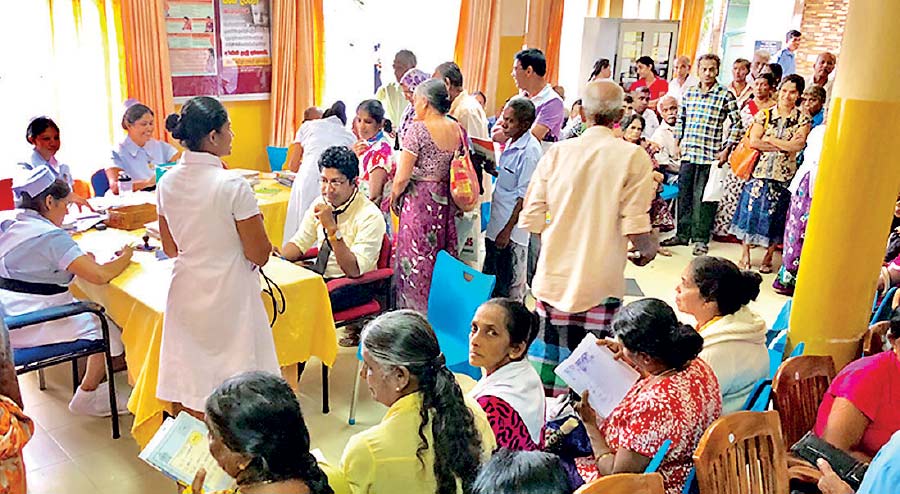
 Sri Lanka’s healthcare system has tremendous potential. But to move forward, we must openly discuss these challenges and encourage accountability. Patients deserve respect, timely service, and clear communication—qualities that should be non-negotiable in any healthcare environment. Only through collective effort and genuine commitment can we rebuild a system that truly serves the people
As a citizen of this country, I am increasingly troubled by an issue that affects every one of us, yet remains insufficiently discussed and poorly addressed by those in positions of authority. The relationship between doctors, patients, and hospitals—once built on trust, respect, and responsibility—has slowly developed serious faults that now burden the people of Sri Lanka. What was once considered a noble service appears to have shifted into a system strained by inefficiency, profit-driven motives, and a lack of accountability.
Every profession operates within a framework of rules, regulations, and ethical standards. The medical profession is no exception. Doctors, nurses, and other allied health professionals carry the immense responsibility of safeguarding human life—a responsibility that demands discipline, compassion, and respect for the people they serve. With scientific and technological advancements, modern healthcare has evolved dramatically, and people across the world depend on competent medical professionals and well-managed hospitals.
Sri Lanka’s free public healthcare system has been a cornerstone of our society for decades. It has supported millions, especially in times of crisis. Alongside it, private healthcare has expanded rapidly since the establishment of the first private hospital in 1905. Today, private medical institutions—large and small—operate across the country, forming a significant part of the healthcare landscape. This growth, however, has brought with it a shift in priorities. What should fundamentally be a service-oriented sector now functions increasingly as a profit-driven industry.
Sri Lanka currently maintains a doctor-to-population ratio of 1.192 per 1,000 people. While this is close to the World Health Organisation’s guideline of 1:1,000, the real-world experience of patients paints a different picture. Delays, long waiting times, and questionable service quality raise an important question: Are we truly receiving care that enhances the quality of life, or are we merely meeting minimum numbers without ensuring meaningful service?
Sri Lanka currently maintains a doctor-to-population ratio of 1.192 per 1,000 people. While this is close to the World Health Organisation’s guideline of 1:1,000, the real-world experience of patients paints a different picture. Delays, long waiting times, and questionable service quality raise an important question: Are we truly receiving care that enhances the quality of life, or are we merely meeting minimum numbers without ensuring meaningful service?
Private hospitals, despite charging high consultation and service fees, often fall short in providing a satisfactory patient experience. A common frustration among patients is the long delay in meeting doctors—even when appointments have been pre-booked and paid for. It is not uncommon for doctors to arrive 30 minutes to 90 minutes late. Hospital staff often seem untrained in basic patient communication, offering little to no information about delays. This leaves patients anxious, confused, and helpless, with no one to turn to for clarification.
Many individuals travel long distances to consult specialists, only to end up waiting late into the night, struggling to find transportation home. What is often forgotten is that people do not visit hospitals for leisure—they come seeking relief from discomfort, pain, and uncertainty. Respecting their time and emotional state is a fundamental part of patient care.
Hospital management must take proactive measures to enforce punctuality, implement transparent communication systems, and prioritise patient comfort. If institutions fail to acknowledge and rectify these problems, patients will continue to shift toward smaller community-level hospitals that offer more predictable and humane service. Those who address this long-standing issue will ultimately earn the trust and loyalty of the people.
It is important to remember that the medical profession is guided by powerful ethical principles. From the ancient Hippocratic Oath to the modern World Medical Association’s Declaration of Geneva, doctors vow to serve humanity, prioritise patient well-being, maintain confidentiality, and uphold dignity and compassion. These principles should remain at the heart of medical practice, regardless of the institution or setting.
Sri Lanka’s healthcare system has tremendous potential. But to move forward, we must openly discuss these challenges and encourage accountability. Patients deserve respect, timely service, and clear communication—qualities that should be non-negotiable in any healthcare environment.
Only through collective effort and genuine commitment can we rebuild a system that truly serves the people.
(The author is a senior executive at a leading insurance broking firm)




