Wednesday Oct 21, 2026
Wednesday Oct 21, 2026
Thursday, 2 April 2026 02:30 - - {{hitsCtrl.values.hits}}
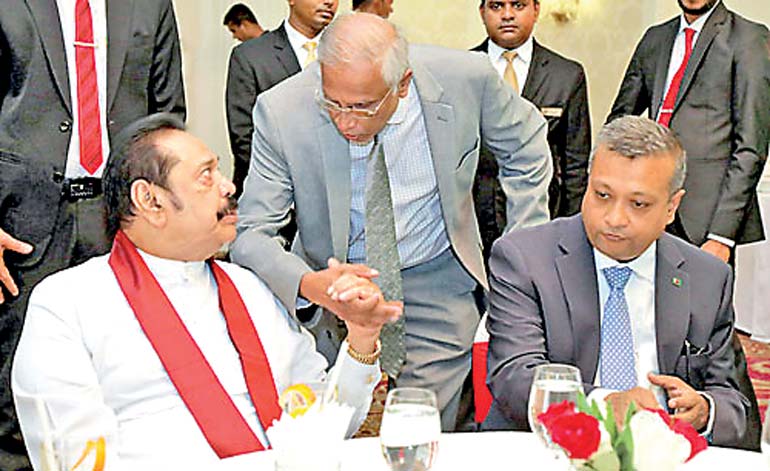
M.A. Sumanthiran and former President Mahinda Rajapaksa (left) exchange warm greetings
 The JVP-NPP has signed a slew of utterly opaque agreements with India, unlike the Indo-Sri Lanka Accord which was absolutely transparent. But the party remains hostile to devolution and the Provincial Councils. This validates the stand taken in the mid-late 1980s by those of us on the anti-racist, internationalist Left. We held that the JVP was opposed not only to Indian imposition, but also and even more so, to the very principle of the devolution of power to elected Provincial Councils
 Speaking to the Jaffna Monitor, moderate ethnic nationalist, leading liberal democrat and senior lawyer M.A. Sumanthiran dropped a bombshell which strangely has been ignored. He warned unambiguously of a most dangerous possibility, namely the establishment of a one-party State by the JVP.
Sumanthiran’s warning wasn’t voiced while rhetorically rousing a local or Diaspora audience, but in an interview given to MR Narayan Swamy, a senior Indian journalist who deservedly earned a high reputation specialising in the decades-long study of Prabhakaran, the Tigers and Sri Lanka’s conflict about which he authored several books.
Here’s Narayan Swamy relaying Sumanthiran:
‘…“The greatest danger facing the country—not just the Tamils—is that the JVP will move towards a one-party State,” Sumanthiran said in an interview with me during a brief visit to New Delhi. “It is a very serious situation.”…’
(https://www.jaffnamonitor.com/jvp-may-move-towards-one-party-rule-says-tamil-leader/)
Narayan Swamy continues:
‘…According to Sumanthiran, 62, the Government’s anti-poverty program, called Praja Shakthi, was being used at the lowest level of the development structure, with handpicked representatives to bypass existing institutions and elected political players.
Also, civil society actors, professional groups, lawyers, and community organisers in the Tamil-majority Northern Province allege that the JVP was not allowing any major civic initiative outside its influence or oversight.
“Sumanthiran added that the Government had imposed five MPs from the region to act as shadow ministers, usurping the powers of the Northern Provincial Council, for which elections have not been held for years…
…Sumanthiran visited India as part of an official delegation of the Sri Lanka Bar Association at the invitation of the Bar Association of India. In the Supreme Court, India’s Chief Justice welcomed and interacted with the Sri Lankan delegation. He spoke to this writer at his hotel after the official event concluded.’ (ibid)
Though Sri Lanka’s Opposition party leaders including Sajith Premadasa and Namal Rajapaksa have signed a petition to international organisations about dangerous trends, it has been limited to perceived threats to the independence of the judiciary, the legal fraternity and the judicial process.
The ‘ostrich’ Opposition should realise that moves towards a one-party State would freeze national elections in 2029, without which Opposition party leaders’ Presidential dreams will evaporate.
History knows no example ranging from Adolf Hitler to Augusto Pinochet, of a one-party State project being successfully defeated without the broadest united front of national, democratic and progressive forces—after which coalition members may go their own way or regroup into more like-minded blocs.
|
Vijaya Kumaratunga fought for devolution and Provincial Councils, and was killed for it
|
Derailing devolution
There are some subject areas in some countries which only the most irresponsible leader or Government would tamper with. In Sri Lanka, that would be Constitutional reforms concerning the ethnonationalities question, which have stood the test of time and turbulence.
The Provincial Council system issuing from the 13th Amendment, itself the product of the Indo-Sri Lanka accord, is a bridge astride the ethno-regional fault-line. If in disrepair, it should be expeditiously fixed. The Jaffna Monitor reports the AKD administration’s conduct to the contrary.
‘Sri Lanka’s long-delayed Provincial Council elections appear set for further postponement, with a Parliamentary panel now expected to submit only an initial report within three months.
The select committee, chaired by Foreign Minister Vijitha Herath, had originally been tasked with producing a report within that timeframe. But at its first meeting last week, Vijitha Herath indicated that only a preliminary report would be delivered, suggesting that further stages of review will follow, with no clear end in sight.
…The select committee is scheduled to meet again on 7 April, when it is expected to consult the attorney general and the chairman of the Election Commission — another step in what critics describe as an increasingly drawn-out process.
…Political observers also point to a noticeable shift in tone from Janatha Vimukthi Peramuna (JVP) General Secretary Tilvin Silva following a visit to India in late February.
In a recent interview, Tilvin Silva questioned the effectiveness of the Provincial Council system itself, while stopping short of advocating its abolition.
“Provincial Councils have not served the purpose. We should look for a better solution,” he said, adding that they would not be scrapped without an alternative framework.
He acknowledged that the Government had intended to hold elections this year but cited legal barriers, the need for electoral delimitation, and disruptions caused by Cyclone Ditwah as reasons for the delay.
Taken together, these signals point to a Government recalibrating its position — from an earlier commitment to early elections to a more open-ended timeline shaped by political risk and procedural complexity.
For now, political observers say the direction is clear: provincial council elections are unlikely in the near term, with some analysts warning that delays could extend even beyond 2027.’
Sri Lanka’s failure to adequately address the ethnonational question gestated a thirty years war, cost untold lives, caused immense misery and wasted huge opportunities to be another Malaysia. With the war along the North-South axis over in 2009 and the South-South civil war in which devolution was also a bloody bone of contention concluded two decades before, what has remained standing—thereby demonstrating durability—is a reform which produced a third tier of the State: the system of elected Provincial Councils to which a measure of power has been devolved.
Provincial Councils in all parts of the country, North, East and South have had elected administrations. Despite pressure from powerful anti-devolution hawks in his own ranks, President Mahinda Rajapaksa held elections to the Eastern Province even in wartime, and to the North in the postwar period. By contrast, the AKD administration is open-endedly delaying the holding of elections to the Provincial Councils, thereby keeping them comatose.
If the JVP-NPP is kicking the can of Provincial Council elections way down the road for fear of losing them, that lends weight to M.A. Sumanthiran’s warning about transition to a one-party State. If the JVP-NPP is quite so averse to losing an election at the periphery and the intermediate tier of the State, what measures of postponement will it not resort to or attempt; what will it not ride roughshod over; who will it not seek to frame, so as to avoid losing political power at the center, i.e., the Presidency and Parliament?
Sumanthiran must bring Sajith Premadasa and Namal Rajapaksa together to resist the JVP’s one-party rule propensity.
JVP unchanged
The JVP’s negative position on the Provincial Councils gives the lie to the tale that the party violently opposed devolution in the 1980s and slaughtered hundreds of leftists (e.g., Vijaya Kumaratunga, Nandana Marasinghe) who supported devolution solely because it issued from Indian intervention. The JVP’s first political kill was student leader Daya Pathirana, a half-year before the Indian airdrop and the Indo-Lanka Accord.
Today there is no intervention. The JVP-NPP has signed a slew of utterly opaque agreements with India, unlike the Indo-Sri Lanka Accord which was absolutely transparent. But the party remains hostile to devolution and the Provincial Councils.
This validates the stand taken in the mid-late 1980s by those of us on the anti-racist, internationalist Left. We held that the JVP was opposed not only to Indian imposition, but also and even more so, to the very principle of the devolution of power to elected Provincial Councils, which was the most progressive democratising reform of the State since Independence in 1948. A partial corrective to the hegemonism of ‘Sinhala Only’ in 1956 and the hyper-centralisation of the State in the 1972 and 1978 Constitutions, Provincial Councils were on a continuum with the tragically abortive progressive-democratic striving of 30 years before—the Bandaranaike-Chelvanayakam Pact of 1957.
Despite pressure from powerful anti-devolution hawks in his own ranks, President Mahinda Rajapaksa held elections to the Eastern Province even in wartime, and to the North in the post-war period. By contrast, the AKD administration is open-endedly delaying the holding of elections to the Provincial Councils, thereby keeping them comatose
Paradigm shift on devolution
What ideas and logic may underlie the stand of the AKD administration and the fate of devolution? The answer could reside in a long interview given to the Jaffna Monitor by the most senior academic among those openly and strongly sympathetic to/supportive of the JVP-NPP, Prof. Emeritus of Political Science at the University of Colombo Jayadeva Uyangoda, himself a leading JVP cadre in 1971. He says:
“Let me offer one example of the limitations of the much-venerated devolution framework as a starting point for fresh thinking about a democratic solution to what has long been understood as Sri Lanka’s ethnic problem. It is time to recognise, even if belatedly, that ethnic problems do not necessarily have purely ethnic solutions, as Tamil nationalist politics has often assumed for decades. This is a fundamental lesson drawn from the experiences of many other societies. What is required instead are democratic solutions capable of reconciling nationalist aspirations for regional autonomy with the demands for political, social, and class emancipation of ethnic minority communities.
In Sri Lanka, a democratic solution to minority ethnic grievances has often been imagined as one that enables regional minority elites to emerge as regional ruling classes. This approach overlooks the aspirations for political recognition, representation, and self-rule among smaller regional and local minorities. Almost all Provinces—including the Northern, Eastern, Central, and Western Provinces—contain not only regional majorities but also regional and local minorities, whose identities are shaped by both ethnic and social differences.
Viewed from this perspective, conventional models of devolution appear increasingly inadequate, as they fail to address the sovereign rights to political equality and representation of smaller and dispersed minority communities within Provinces and Districts. In other words, a genuinely democratic solution to Sri Lanka’s ethnic question requires deep democratic alternatives. This calls for revising our political vocabulary itself: moving from federalism to deep federalisation, from devolution to deep power-sharing, and from decentralisation to genuine local democracy. Empowering local communities of ordinary citizens is as important as elevating regional elites to positions of authority.”
Uyangoda’s argument is not only an assault on “the much-venerated devolution framework”. It is also a misdirection and whitewash.
Let’s leave the specious claim of “ the experiences of many other societies” aside, noting that he provides no examples.
While it can be allowed as a general statement that “ethnic problems do not necessarily have purely ethnic solutions”, Prof Uyangoda has not observed the crucial distinction between ‘purely’ and ‘principally’ or ‘primarily’.
While ethnic problems do not ‘necessarily’ have ‘purely’ ethnic solutions, ethnic problems do ‘necessarily’ have fundamentally, basically, primarily, principally, mainly, chiefly, and centrally ethnic solutions.
Ethnic problems are primarily sourced in collective ethnonational and territorial identity, resulting in claims for irreducible political space, sometimes extending to an independent State. In Sri Lanka, a thirty years war was fought over the claim to a separate independent State; a slogan which has not yet died and remains emotive in the Diaspora as well as in pockets of the island’s North and East.
In almost all cases of a sustained secessionist or independentist (Northern Ireland) striving, its outcome, solution, settlement or management displays the following models/types:
(1) Independence (Eritrea).
(2) Full and formal federalism (Canada).
(3) Quasi-federalism (India).
(4) Non-federal territorial autonomy and self-rule through the devolution of power from the center.
The autonomy/devolution model (No 4) reveals two variants or options:
(a) Within a unitary State (Vietnam, Sri Lanka).
(b) Within a State which remains silent on the form of State but is non-federal (South Africa).
Sri Lanka has firmly and consistently resisted federalism as dangerously centrifugal, given the extreme proximity of the North’s ethnic kinstate Tamil Nadu.
All these are fundamentally ethno-lingual/ethnonational/ethno-regional solutions. They are by no means other than primarily ethnic solutions. They remain on an ethnic/ethnonational continuum at one end of which lies independence; the other, hyper-centralism; and in the middle, forms of federalism or regional autonomy.
This doesn’t mean there shouldn’t or can’t be other social, economic-developmental, gender, or general democratic components in any reform package. But they cannot substitute for the ethnic core of the political solution (federalism or autonomy/devolution), and can only be supplementary, i.e., secondary.
Prof. Uyangoda attempts to counterpose and substitute a ‘democratic’ solution for an ‘ethnic’ solution to the ethnic problem and ‘conventional models of devolution’. This is misplaced, for three reasons.
I. Ethnic autonomy which enables the people of a distinct collective identity in a roughly contiguous area to enjoy a measure of self-administration and self-rule, is an intrinsically democratic solution which also deepens the democratic character of the State and broadens democracy overall.
II. The attempt to shift focus at this moment from an “ethnic solution” and the “much venerated devolution framework” to a “democratic” one which incorporates a multiplicity of other actors and factors, only serves to pitch small ‘local’ minorities within the larger semi-autonomous territorial space—the Province—against the majority of that area which is usually the main/large national minority (or minority nationality). A delaying tactic, it also amounts to ‘divide and rule’.
III. The criticism that existing ethnic-based devolution “has been imagined” as a mechanism enabling regional elites to become regional ruling classes, is ridiculous. Nothing prevents elections to Provincial Councils producing Kerala-type leftist administrations representing subaltern classes and castes rather than regional elites aspiring to become regional ruling classes. Nothing structural compelled the leftwing EPRLF administration of the first North-East Provincial Council (1988-1990) to blunder into confrontation with the newly-elected President in Colombo, provoking its dissolution and dismissal. Nothing structurally prevents the NPP from winning any Provincial Council including in the North and East.
Uyangoda recommends “deep democracy” “deep federalisation” and “deep power-sharing”. I’m confused as to whether “deep federalisation” is deeper or shallower than federalism, but why quibble?
What’s actually happening that’s ‘deep’, is the ‘deep freezing’ of devolution and the Provincial Councils by Anura Dissanayake. As Sri Lanka’s sole elected President who failed to clear the 50% mark and secured only 42% of the vote, his structural and systemic counter-reformation against provincial devolution lacks legitimacy.
What’s actually happening…is the ‘deep freezing’ of devolution and the Provincial Councils by Anura Dissanayake. As Sri Lanka’s sole elected President who failed to clear the 50% mark and secured only 42% of the vote, his structural and systemic counter-reformation against provincial devolution lacks legitimacy
Subverting Sri Lanka
Tamil Eelamist sentiment is more manifest than ever before in the postwar North and East, as evidenced by the several demonstrations denouncing and rejecting Ceylon/Sri Lanka’s entirely peaceful, inclusive, multiethnic Independence of 4 February 1948.
Post-2009, this has happened only on AKD’s watch.
The world over, radical or extremist nationalism is political marginalised by autonomous/semi-autonomous legislatures in the areas concerned. Elections to such legislatures strengthen moderate nationalists at the expense of extremists, leaving the latter a fringe phenomenon. This option is blocked in Sri Lanka today. There isn’t even a time-horizon within which elections will be held.
Given the deep-freeze of devolution and ‘deep disuse’ of the intermediate political tier (Provincial Councils), there is no structural let alone systemic check under Anura’s presidency on the growth of separatist ultranationalism.
When and where minority political extremism grows, a majoritarian ultranationalist backlash follows.
The 13th Amendment and Provincial Councils have broad international endorsement. The call is for implementation—which is negotiable. Sri Lanka has always been able to avoid or resist demands for federalism and beyond, and hold the line at the 13th Amendment/PCs. Anura is depriving Sri Lanka of that reformist alternative, and therefore, that credible defensive response. Diplomatically, we won’t have a political ‘forward defense line’ to hold.
None of what I’ve written here is rocket science. But it is Political Science.
[The writer was the youngest Minister in the Provincial Council system in 1988.]