Thursday Oct 22, 2026
Thursday Oct 22, 2026
Tuesday, 16 December 2025 00:02 - - {{hitsCtrl.values.hits}}
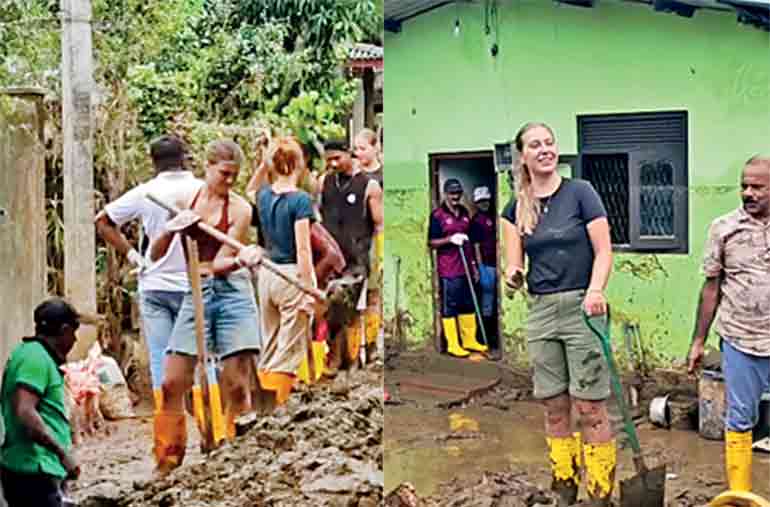
Spirited tourists engaged in relief work voluntarily in some of the Ditwah cyclone impacted areas

Multifaceted and uneven climate vulnerabilities in Sri Lanka tourism
Climate risks to Sri Lankan tourism are multifaceted and uneven, demanding tailored financial solutions that address the specific vulnerabilities of different industry segments rather than a one-size-fits-all approach.
Interconnected climate vulnerabilities in Sri Lanka tourism
The vulnerability of the tourism sector in Sri Lanka is also not monolithic and uniform. It faces compounded risks stemming from interconnected geographic, structural and economic factors that create systemic financial risks requiring coordinated intervention across all scales.
As a result, this situation underscores the need for a coordinated and inclusive risk management solution. It also demands a systemic approach against possible climate change impact to develop resilience through financial viability and long-term business development, more specifically against climate change impact affecting the operations of small local businesses besides the well-established national and international tourism business chains.
Furthermore, the impact of climate change on the tourism industry can be more severe to the industry or specific segments of it due to factors beyond geographical and weather changes.
Geographic concentration in high-risk zones
Infrastructure of Sri Lanka tourism is mainly concentrated in two vulnerable areas:
Coastal regions: Approximately 70% of tourism assets lie along the 1,600km coastline, particularly in the southwest (Colombo, Galle, Bentota). These areas face rising sea levels (projected 0.3-0.5m by 2050), accelerating beach erosion, and intensifying cyclones. The 2004 Tsunami caused $250 million in tourism losses, demonstrating catastrophic vulnerability. Over 1,000 coastal hotels, beaches and coral reefs that attract visitors are directly threatened.
Central highlands: Popular hill country destinations (Nuwara Eliya, Ella, Kandy) face increasing landslide risk from changing monsoon patterns.
The 2016-2017 landslides killed over 200 people and damaged critical tourism infrastructure including the scenic railway and access roads. Projected temperature increases of 1-2°C may alter the region’s signature cool climate and tea landscapes.
Currently, Sri Lanka is facing the worst flooding disaster in over two decades due to the climate change of the world.
Protecting the tourism sector from climate disasters should be seen as a necessary investment, not an optional expense. It is a basic responsibility to investors and stakeholders. Waiting until after disasters for actions is both inefficient and too expensive to continue. Reacting only after disasters happen costs more and it doesn’t work long-term, but places immense burdens on public funds while making a crippling recovery. This is why pre-disaster investment strategies are powered by modern financial instruments
Estimated costs of 2025 flooding and landslides (Cyclone Ditwah)
Human toll (as of December 1, 2025):
Deaths: 334-390 (numbers still rising)
Missing: 218-370 people
Affected: nearly 1 million people across all 25 districts
Displaced: approximately 180,000 people in 1,094 Government shelters
Economic damage estimates:
1. Preliminary estimates: initial assessments exceed $500 million
2. Early Government assessment: preliminary Government estimates placed economic losses at over $800 million, with the full cost expected to rise
3.Immediate Government response: President Dissanayake announced 30 billion rupees (approximately $100 million USD) available for immediate disaster response
4.Ongoing assessment: The World Bank is conducting a Global Rapid Post-Disaster Damage Estimation (GRADE) to determine the full financial scope required for reconstruction
Infrastructure damage:
Over 15,000 homes destroyed
206 roads impassable, 10 bridges damaged
Rail network and power grid severely disrupted
Telecommunications infrastructure damaged
Sectoral impacts:
Agriculture/tea industry: Extensive damage to tea plantations (part of Sri Lanka’s $1.3-1.4 billion tea industry)
Paddy fields across Central and North-Central provinces submerged
Tourism sector significantly impacted during recovery period
Source: AI Data
This geographic concentration in hazard-prone zones creates systemic risk, amplified by structural and economic vulnerabilities.
Parametric insurance represents a groundbreaking solution that is particularly relevant for a nature-dependent tourism economy like Sri Lanka. This innovative instrument can provide rapid and targeted financing to protect the ecosystems of tourism industry.
Parametric insurance revolutionises post-disaster liquidity by basing payouts on objective, pre-defined event triggers rather than slow, subjective on-the-ground damage assessments
Structural and economic fragility
Beyond its physical location, the intrinsic structure of Sri Lanka tourism contains fragilities that amplify potential damage from disaster events.
Dominance of SMEs: Small and Medium-sized Enterprises (SMEs) are the backbone of the tourism industry, generating most of its employment. These SMEs are disproportionately located within the vulnerable coastal and mountainous zones, yet they possess limited financial resources to invest in essential resilience measures. They often lack the capital for structural upgrades and struggle to implement formal business continuity planning (BCP) or access affordable post-disaster finance, leaving them exceptionally exposed to operational disruptions.
Dependence on natural and cultural assets: the competitiveness of the tourism industry is inextricably linked to the health of its natural assets (e.g., coral reefs, beaches, wildlife) and the integrity of its cultural heritage (e.g., historical sites).
The degradation of these assets in coastal and mountainous regions directly threatens the viability of the SMEs that depend on them. Rising sea surface temperatures cause coral bleaching, destroying marine ecosystems vital for tourism, while coastal erosion threatens both beaches and seaside heritage sites.
The devastating impact of the 2004 Indian Ocean Tsunami serves as a stark reminder of the sector’s vulnerability. An estimated 25 percent of registered hotels in Sri Lanka were affected, a figure that significantly overlooks the impact on the many informal and unregistered establishments that constitute a large part of the tourism ecosystem, highlighting the cascading economic consequences from such kinds of disasters in future.
Most disaster losses are not covered by insurance. This “insurance gap” hits small and medium businesses hardest. These are the very businesses that make up most of the tourism sector. Standard insurance policies typically do not cover things like lost income during closures, which often forces businesses to shut down permanently.
Therefore, the real damage from disasters is not just broken buildings. It is lost business, tourists who have been frightened away and no financial help to recover. Small tourism businesses suffer most because insurance rarely covers these hidden costs
Proactive risk financing and discretionary cost
Protecting the tourism sector from climate disasters should be seen as a necessary investment, not an optional expense. It is a basic responsibility to investors and stakeholders. Waiting until after disasters for actions is both inefficient and too expensive to continue. In other words, reacting only after disasters happen costs more and it doesn’t work long-term, but places immense burdens on public funds while making a crippling recovery. This is why pre-disaster investment strategies are powered by modern financial instruments.
The biggest problems often come after the initial disaster is over. When Sri Lanka experienced the 2004 Tsunami, the tourism industry lost approximately $ 250 million, mostly of which was not from damaged buildings, but from:
Businesses unable to operate for extended periods
Broken supply chains
Damaged reputation that frightened tourists away
Difficulty getting loans because businesses looked financially weak
The insurance problem
Most disaster losses are not covered by insurance. This “insurance gap” hits small and medium businesses hardest. These are the very businesses that make up most of the tourism sector. Standard insurance policies typically do not cover things like lost income during closures, which often forces businesses to shut down permanently.
Therefore, the real damage from disasters is not just broken buildings. It is lost business, tourists who have been frightened away and no financial help to recover. Small tourism businesses suffer most because insurance rarely covers these hidden costs.
The need of the hour is to emphasise that specialised disaster risk financing tools such as climate insurance and an industry security scheme are urgently required to safeguard the economically vital tourism sector from intensifying climate threats like floods, coastal erosion, and extreme weather. This sector currently contributes 10% to GDP and employs more than 450,000 people
Innovative instruments for tourism resilience
Traditional financial and insurance products have proven inadequate for addressing the unique, systemic risks confronting the tourism sector. Their limitations, particularly for SMEs and in covering nature-based assets have created a necessity for a shift towards modern financial instruments designed to overcome these barriers and build systemic resilience from the ground up.
Tourism businesses, especially SMEs, face significant financial hurdles that prevent them from investing in resilience and securing adequate protection against disasters due to several reasons:
Affordability to prepare: Small tourism businesses don’t have the money upfront to protect themselves from disasters. Things like strengthening buildings, creating backup plans, or buying emergency equipment are simply too expensive.
Unwillingness of insurance organisations: Regular insurance does not work for most tourism businesses because:
Premiums are too expensive, especially in coastal and hilly areas where disasters are more likely
Policies only cover damaged property, but not lost income when businesses have to close and
Many disaster types are not covered at all.
As a result, small businesses are left vulnerable with no way to prepare and no safety net when disasters strike. However, these small tourism businesses face a dialectic problem. One is that they cannot afford to prepare for disasters and insurance does not cover what they need when disasters happen.
Potential of parametric insurance for tourism
Parametric insurance represents a groundbreaking solution that is particularly relevant for a nature-dependent tourism economy like Sri Lanka. This innovative instrument can provide rapid and targeted financing to protect the ecosystems of tourism industry.
Parametric insurance revolutionises post-disaster liquidity by basing payouts on objective, pre-defined event triggers rather than slow, subjective on-the-ground damage assessments.
This model provides a direct and powerful blueprint for protecting the vital natural assets of Sri Lanka. A similar parametric insurance facility could be developed to secure immediate post-disaster funding for the restoration of beaches, the rehabilitation of coral reefs or the repair of infrastructure in national parks, thereby underwriting the very natural capital upon which the tourism product of the country is built.
A collaborative framework for action
Realising the full benefits of innovative disaster risk financing and insurance requires a coordinated and strategic policy environment. Success depends on a collaborative effort between Government bodies, which set the regulatory framework and the private financial sector must develop and deploy the necessary products for both to work in concert to build a resilient tourism industry in Sri Lanka.
Realising the full benefits of innovative disaster risk financing and insurance requires a coordinated and strategic policy environment. Success depends on a collaborative effort between Government bodies, which set the regulatory framework and the private financial sector must develop and deploy the necessary products for both to work in concert to build a resilient tourism industry in Sri Lanka
Recommendations for Government bodies
Integrate tourism into national strategy: Mandate the explicit inclusion of the tourism sector’s unique vulnerabilities and financial needs within the country’s overarching national disaster risk management and climate adaptation plans. This ensures that tourism resilience is treated as a national economic security priority.
Incentivise private sector resilience: Develop and implement policy incentives to encourage risk reduction such as tax credits for structural retrofitting and preferential access to public financing for businesses with certified continuity plans or conditioning tourism operator licenses on holding adequate coverage, with a special focus on supporting SMEs.
Foster public-private partnerships (PPPs): Actively facilitate and co-invest in partnerships between the tourism industry, insurers and financial institutions. The Government can play a crucial role as a convener and enabler to pilot, de-risk and scale up innovative risk-sharing and insurance products, including parametric solutions for critical natural assets.
Recommendations for financial institutions and insurers
Develop tailored insurance products: Collaborate directly with tourism industry associations to design markets and distribute accessible and affordable insurance products. These must meet the specific needs of tourism SMEs, including comprehensive coverage for business interruption and developing bundled microinsurance products that are affordable for small-scale operators.
Pioneer innovative risk transfer mechanisms: Invest in technical expertise, data analytics and risk modelling required to develop and underwrite innovative instruments like parametric insurance. This should cover not only physical infrastructure but also natural assets, beaches and protected areas that are critical to the value proposition of the tourism industry in Sri Lanka.
Integrate climate risk into financial decisions: Systematically incorporate climate and disaster risk assessments into all lending, investment and underwriting criteria for the tourism industry. This will allow for more accurate pricing of risk and create market-based incentives for resilience-building investments by tourism businesses and reduce the financial sector’s own exposure to climate-related losses.
The continued growth and global competitiveness of Sri Lanka tourism must be contingent on its ability to proactively manage the escalating risks posed by natural disasters and climate change.
Most importantly, a reactive stance is no longer viable. A proactive and collaborative approach along with leveraging innovative disaster risk financing and insurance is not merely a defensive measure but a strategic necessity to protect livelihoods, secure economic returns and build a truly sustainable future.
Finally, this is not a choice between cost and resilience, but an investment for competitiveness, market stability and the sustainable growth of the tourism industry in Sri Lanka.
(The author is Professor in Tourism Economics, University of Colombo, Sri Lanka. He can be reached via email at [email protected]; [email protected])




