Thursday Oct 22, 2026
Thursday Oct 22, 2026
Thursday, 22 October 2026 00:25 - - {{hitsCtrl.values.hits}}
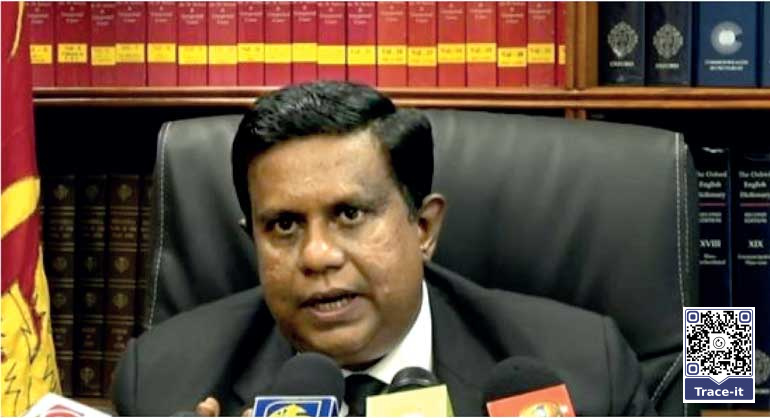
ASG Dileepa Peiris, PC
 Why does the AKD administration want peacetime ‘anti-terrorism’ legislation (PSTA) far wider in scope than JR Jayewardene’s wartime PTA?
Because in a pre-emptive strike, it is constructing a matrix of new repressive legislation to shut the system, constricting democratic space and suffocating critical social expression, while:
The evening of the confrontation outside the Secretariat between Buddhist monks and presidential staff plus Police, TV news showed senior JVP personality, Minister K.D. Lal Kantha addressing a public meeting, declaring:
“…they think that we are going to leave after the next three years. I can tell you we are not going to leave after the next three years!”
The PSTA segues into the ‘Organised Crime’ Bill (POCA) which is an organised crime itself. If the terrible triptych of PSTA-POCA-NGO legislation is erected, Sri Lanka will no longer be a functioning democracy.
But, as Nietzsche said about God, if democracy is dead, the Government having killed it, “then everything is permitted”. From Locke to Lenin, that means ‘all forms of struggle’ become legitimate.
Dileepa dictum
The Colombo Chief Magistrate Asanga S. Bodaragama did the cause of justice and social peace a service when he ruled that former First Lady Shiranthi Rajapaksa be granted bail on the basis of the special circumstances that had been drawn to his notice—the report of medical doctors of the Colombo National Hospital, signed by the hospital’s Director that Madam Rajapaksa required a coronary bypass surgery soon.
In contradistinction, as the TV news showed that evening, ASG Dileepa Peiris, PC, representing the State, contended that despite the medical report which recommended a bypass operation, Shiranthi Rajapaksa should not be released on bail because the need did not arise as she was already warded at the National Hospital.
This illustrates the thinking of State apparatchiks in the time of AKD Chinthanaya. Though there was an exit ramp offered in a fraught situation by the possibility of bail, ASG Peiris thought it should not be taken because it need not be. He didn’t regard the medically confirmed need for cardiac surgery to constitute a sufficiently special circumstance for the 73-year-old former First Lady—hardly accused of murder—to be released from custody on bail. He didn’t have the heart to agree that a heart bypass should warrant being able to go home to her husband and family before the invasive surgery.
Dileepa Peiris also seemed to assume that the former First Lady would automatically opt to undergo surgery at the National Hospital or should not have the right to opt for a private hospital and surgeon of her choice.
The high-profile, hard-charging representative of the AG’s Department obviously wasn’t anxious to park this hot potato of an issue somewhere safe, and buy time. Had the AG’s Department stand carried the day, the 73-year-old former First Lady would have incurred all the risks of heart surgery while remaining a prisoner in the custody of the State. If something untoward happened, it would have been on the State’s watch. Dileepa Peiris’ recommendation was hardly an exemplary calculus of the risk to the larger interests of the State which he serves. 
Luckily for all concerned, Colombo Chief Magistrate Bodaragama held the balance and ruled wisely, deftly steering clear of a possible human tragedy with wide-ranging moral, ethical, social and political ramifications for legitimacy and stability. But not before we had televised confirmation of the unreasonable, reckless argumentation of ASG Dileepa Peiris, which exemplified the polarising, de-stabilising brutalisation of thought and discourse within the institutions of the State during the Dissanayake Presidency and JVP-NPP rule.
Sinhala-Buddhist network
The fairly sizeable knot of Bhikkhus and lay persons gathered outside the Presidential Secretariat could not be compared to the crowds that swarmed the Galle Face Green ‘Gota Go Gama’ sit-down, let alone the double-tap ‘tsunami’ waves of the Aragalaya.
Cost-of-living pressures, student/education grievances and democracy/governance issues generate far vaster multitudes than religio-cultural issues—the evidence is clear from Paris, Marseilles, Lyon, Madrid, Milan, Turin, Tunis and Tirana. Half-a-million demonstrated in France.
That said, the Bhikkhu-led mobilisation and the Government’s zero-tolerance eviction showed that the administration now faces a new front of discontent, which can grow.
The Bhikkhu demonstration was far more impressive upstream, coming into Colombo from Kandy through the towns and suburbs, than it was at nightfall at Galle Face or later at Vihara Maha Devi Park. The response of the nodal Buddhist temples along the way and the supportive laity showed a strong vein of religio-cultural and perhaps ultranationalist discontent at the President and Government, outside Colombo city. The march and the reception at the temples showed an actual or potential social network of religio-cultural dissent and mobilisation.
The Government has lost the Sinhala-Buddhist middle classes, largely suburban, preponderating in what Prof. Kumar David dubbed ‘the Dharmapala Belt’. It is the stratum that broke from Ranil’s UNP and voted for the Hela Urumaya variants led by S.L. Gunasekara and Champika Ranawake. Together with the MEP constituency of Dinesh Gunawardena, they constitute the Sinhala-Buddhist intermediate strata which may split unevenly between Namal’s SLPP (probably backed by Weerawansa-Gammanpila), Dilith Jayaweera’s Sarvajana, and Champika Ranawake, but are decidedly alienated from AKD-JVP-NPP.
SLPP dilemmas
The SLPP is in better shape—more spirited, efficient, determined—than anyone would think, given that its young leader is in jail and several other personalities are being hauled up before the courts. It has not been reduced to a residue of hardcore voters, and is capable of attracting new young professional talent including in the Colombo District. It is more flexible and open than the larger SJB.
What the SLPP really has going for it—unlike the SJB—is a narrative, a coherent ‘story’ which is at the core of soft power, and which it holds the franchise for: the heroic narrative of Mahinda Rajapaksa, the war and post-war development; the pathos of the persecution of Mahinda, his family and the war-winning military brass by an unpatriotic, incompetent ruler and administration; the hope centred on the cool courage of the imprisoned affable young Namal Rajapaksa.
That said, the SLPP has a political dilemma to resolve, namely how to retrieve its progressive centre-left character, return to the Rajapaksa middle path legacy, and focus on winning back the rural peasant base lost by the fertilizer fiasco, while retaining the Sinhala-Buddhist nationalist constituency.
When Sirimavo Bandaranaike and her coalition swept to a landslide victory in 1970, she won the Catholic belt which she had lost in the early 1960s. She always had a sizeable Muslim vote (through personalities like Badiuddin Muhamed, Halim Ishak, Alavi Moulana). Chandrika won the minority vote in 1994 and 1999. Mahinda won in 2005 and 2010 with the Catholic and Muslim vote. However, MR lost in 2015 because he lost both minorities, Muslim and Christian—not due to him, but to an ultranationalist deviation in the State, Government and party. 
If the SLPP runs on its 2019 agenda and discourse, fails to rebalance and retrieve MR’s minority vote of 2005 and 2010, it runs a huge risk in a three-way split in the majority vote, making the minority vote a decisive variable.
Before his incarceration, Namal Rajapaksa was successfully rebuilding the party’s rural peasant base—which may explain the timing of his arrest. The SLPP must wisely navigate the Ven. Gnanasara issue and the agitation around it, while never forgetting the top priority of winning back:
The real dilemma for the SLPP will be the 13th Amendment and Provincial Councils.
MR was always for PCs and held elections even under conditions unfavourable to him in and out of wartime. Unlike MR’s SLFP, the SLPP has hawks around and within it who are anti-13A/PCs.
What if the AKD administration plays the card of a new Constitution or legislation which entrenches itself in power by extending its term of office, while dropping the 13th Amendment and PCs? What if it comes to a referendum? Would the SLPP campaign for a ‘NO’ vote as it should—or will it, its allies and voters be confused by 13A abolition, and thereby unwittingly help the Government win?
SJB’s ‘thin’ narrative
The SJB has declared that it is for the full implementation of the 13th Amendment including powers over land and the Police. It hasn’t drawn the distinction between full implementation and immediate implementation. This problematic, contentious pair of powers should be devolved incrementally and conditionally.
Sajith and the SJB could lose the election only on this issue alone— the unconditional pledge of land and Police powers—just as Sir John Kotelawela lost on the language issue, and Dudley Senanayake was besieged, his 7-party coalition Government split and utterly defeated in 1970 also because of the opaque Dudley-Chelvanayakam ‘District Councils’ agreement.
The SJB has also been for the abolition of the executive Presidency. How is that compatible with its recent commemoration of JR Jayewardene? JR’s Open Economy cannot be commended while simultaneously opposing the Executive Presidency because JR himself made explicit that the Presidency was a political prerequisite for the Open Economy; they were two sides of one paradigm.
More perplexing is how the SJB intends to support and implement 13A in full, without the executive Presidency which acts as both over-watch and guardrail, and in the absence of which 13A flips the character of the Constitution over into federalism.
If AKD produces a draft Constitution which removes 13A, dilutes the system of proportional representation to a mixed system, substitutes an executive Prime Ministership (as in Israel or Germany’s Chancellorship) for the current Presidency, insists that the Government’s term of office commences with the promulgation of the new Constitution (as Madam Bandaranaike’s Government did, stretching two years beyond its mandate), how would the SJB campaign at the referendum? For an unambiguous NO vote as it should, or will its confusion send mixed signals which enable the Government to win the referendum and remain beyond 2029?
Having inexplicably failed to commemorate President Premadasa’s birth centenary—with its utterly compelling narrative potential—in the crucial election year 2024, the SJB has no unique ‘origin story’ or identity. Its narrative reckons its parentage/ lineage from Ranil’s UNP, not Premadasa’s. It is ambivalent and ambiguous as to what, why, and how far it opposes AKD’s economic model which is an extreme extension of Ranil’s. However, if the SJB followed President Premadasa’s economic paradigm, it would be frontally opposing AKD’s.
It is silent on the crudity and coarseness of the treatment of the Rajapaksas, exultantly exclaiming ‘these are cases initiated against crooks by our Government’. That insensitivity will ensure the SJB doesn’t secure a fraction of the Rajapaksa ‘patriotic-populist’ vote which went JVP-NPP in 2024.
The SJB lacks the realism to discern that the vote—mainly centre-left nationalist Rajapaksa/SLPP—which swung to AKD-JVP-NPP in 2024, cannot be won over by the SJB or SJB-UNP as they stand, but needs a radical pivot to (Ranasinghe) Premadasa’s progressive-populism by which he beat Mrs. Bandaranaike in 1988 by attracting the poorer voters from the SLFP and JVP constituencies.
The SJB is trapped between:
So far the SJB hasn’t done or said anything about the incoming draconian legislation, the PSTA, POCA etc. Currently, the main Opposition party is irresponsibly inactive, exhibiting inertia. It makes marginal intervention in the national crisis and exercises little attraction on the public imagination.
The SJB should stop behaving as if the rival Rajapaksa-led SLPP rather than the ruling JVP-NPP is its main adversary.
While the rest of the Opposition must recognise that the SJB is the largest Opposition shareholder and is indispensable, the SJB must realise that while it is the largest single Opposition shareholder and as such is indispensable, it is also utterly inadequate in and of itself.
Vasu’s whitewash
Emeritus leftist Vasudeva Nanayakkara launched a memoir recently, and has repeatedly extended his support to the present Government, urging others to follow suit. This is ironic because Vasudeva was best known and respected as a leftist dissident within the United Front Government of 1970-1977, rather than as a conformist supporter of it.
Vasu has suppressed the lesson of his own experience. He was swept away together with the entire left leadership in 1977 because he supported and stayed with the Government while dissenting. But he was re-elected to parliament relatively soon, as was Sarath Muttetuwegama, and unlike the LSSP-CPSL leaders who died exiled from Parliament, because he, like Sarath, had conspicuously dissented.
The lesson is: with mounting mass economic hardship, quit the Government and form/join a left alternative such as the CPI-M constituted in India, or if you stay, rebel, otherwise you’ll sink like the LSSP-CPSL in 1977.
FSP-PSA filling the vacuum
While the Bhikkhu mobilisation was attracting attention, there was an entirely different type of protest on the streets that week. Most significant was a demonstration on a rainy night by a large number of spirited medical students who came up against a police presence.
The Inter-University Students Federation (IUSF), historically a JVP stronghold, had been supportive of the Frontline Socialist Party (FSP) for many years. The IUSF’s zenith was under the leadership of Wasantha Mudalige, when it was the decisive driving force of the Aragalaya which overthrew Gotabaya Rajapaksa.
After the 2024 victory the JVP dented the IUSF by co-opting the Peradeniya University medical students. Now, the medical students (or a majority) have returned to the revitalised FSP’s sphere of ideological influence. Days before the medical students the IUSF too was back on the streets.
With the SJB’s inactivity outside Parliament, the only forces on the streets are the religio-cultural nationalists and the FSP and its partner, the People’s Struggle Alliance (Jana Aragala Vyaparaya). If not for the FSP-PSA, it would only be the religio-cultural resistance of a ‘retro’ character, which would be unhealthy.
When the JVP-NPP Governmentt inevitably suffers its own ‘1977’ defeat, sincere supporters can evacuate to the FSP, undergo ideological rectification, consolidating a Left Opposition whichever mainstream party forms the Government.
With the SJB and the SLPP hamstrung by their intersection with this or that subset of AKD-JVP-NPP policy (economic ‘reform’, 13A abolition respectively), we are nearing the type of exceptional ‘portal’ through which a left alternative can grow exponentially, if it incorporates and fulfils the oppositional roles and tasks that the mainstream ‘bourgeois’ parties have historically undertaken but have now abandoned.
This ‘leap’ requires a ‘national-popular’ (Gramsci) bloc and strategy drawn from the left realism of the communist tradition’s ‘central current’: Lenin, Gramsci, Dimitrov, Togliatti, Mao and Ho Chi Minh.
(https://dayanjayatilleka.webflow.io/)



