Thursday Oct 15, 2026
Thursday Oct 15, 2026
Saturday, 23 May 2026 04:40 - - {{hitsCtrl.values.hits}}
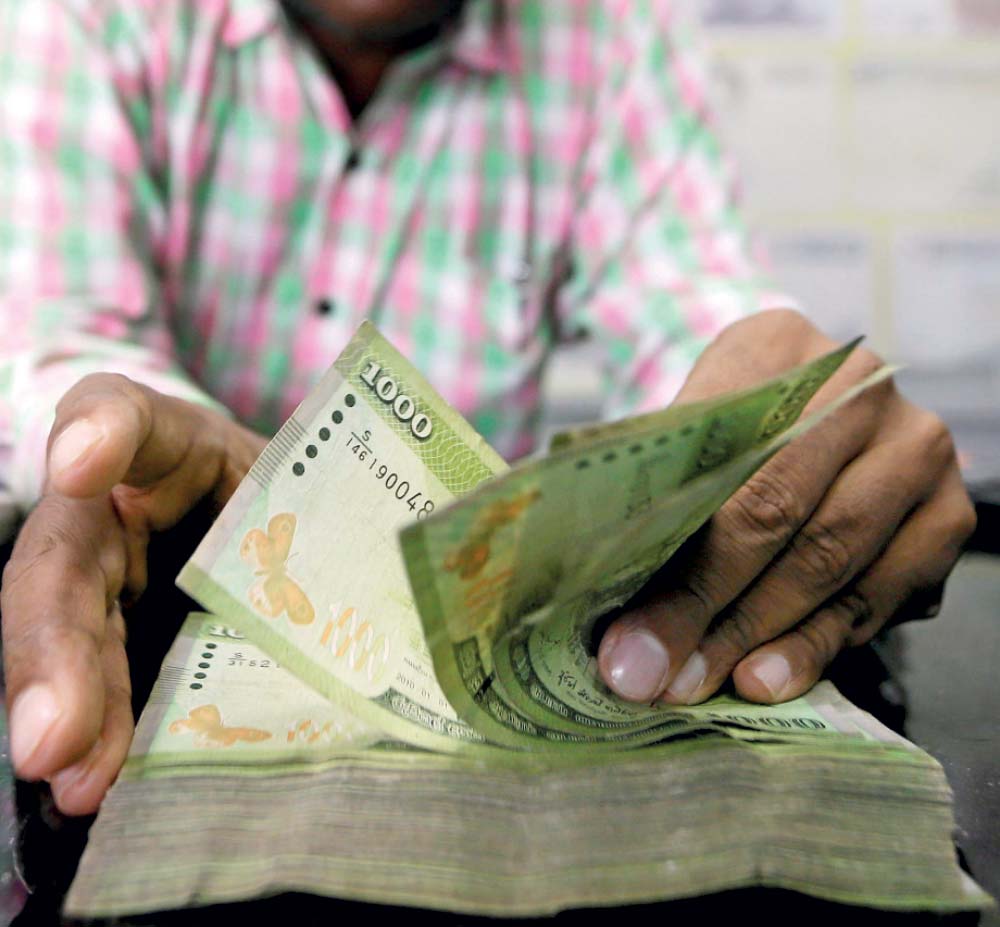
 The depreciation of the rupee is not merely a decline in the value of money. It is a mirror that reflects the economic strength, political quality, and social confidence of the nation.
Protecting the rupee does not mean artificially controlling the exchange rate. It means rebuilding the country’s productive strength, institutional credibility, fiscal discipline, export capacity, and the future hopes of its people. Sri Lanka’s real challenge lies there
 The gradual depreciation of the Sri Lankan rupee is one of the most serious economic signals facing the country today. It is not merely a change in the exchange rate. It is a powerful reflection of a nation’s economic strength, fiscal discipline, investor confidence, political stability, and the future hopes of its people.
When a country’s currency loses value, it indicates deeper weaknesses in production capacity, foreign exchange earnings, economic management, and institutional credibility. In this sense, the depreciation of the rupee is not an isolated financial issue. It is a factor that further deepens Sri Lanka’s already fragile economic, social, and political crisis.
Only a few years ago, around Rs. 130 or Rs. 150 was sufficient to buy one US dollar. However, during the 2022 economic crisis, the exchange rate exceeded Rs. 360 per dollar at certain points. Although some stability has returned since then, it would be misleading to say that the real strength of the rupee has been fully restored. The simple meaning is this: Sri Lanka now needs far more rupees than before to import essential goods such as fuel, medicine, food, machinery, and raw materials.
Inflationary pressure in an import-dependent economy
The first and most direct consequence of rupee depreciation is the increase in the general price level of goods and services. In other words, it fuels inflation. Sri Lanka remains an economy that depends significantly on imports. According to World Bank data, in 2024, imports of goods and services accounted for around 22.5% of Sri Lanka’s Gross Domestic Product.
Therefore, whenever the rupee weakens, the cost of imports rises. Fuel prices increase. Transport costs go up. Industrial production costs become higher. Eventually, this burden falls directly on the daily lives of ordinary people.
In September 2022, inflation in Sri Lanka, measured by the Colombo Consumer Price Index, reached 69.8%, while food inflation climbed to 94.9%. These were not just numbers. They represented real suffering in family food budgets, children’s education, healthcare expenses, and the living standards of the middle class.
As a result, poverty also increased. According to World Bank estimates, urban poverty rose to 15% in 2022, while rural poverty increased to 26%. The data also showed that more than half of the population in estate communities lived below the poverty line.
The silent crisis of fixed-income earners
Those most affected by rupee depreciation are people who depend on fixed salaries. Their income may remain the same in numerical terms, but its real purchasing power continues to decline.
A person earning Rs. 100,000 per month today finds it extremely difficult to maintain the same standard of living that was possible a few years ago. The rising cost of food, housing, education, healthcare, and transport has weakened the middle class at an alarming rate.
This situation can be described as “working poverty.” A person may be employed, yet unable to maintain a dignified standard of living from that income. This is a serious threat to social stability, because in any country, a strong middle class is one of the main foundations of social balance and national resilience.
The collapse of youth hope and the outflow of human capital
This economic pressure also damages the hopes of the younger generation. When young people begin to lose faith in the idea that education, effort, and talent can help them build a future within their own country, they naturally begin to think of leaving the country instead of helping to rebuild it.
According to the Sri Lanka Bureau of Foreign Employment, 310,948 people left for foreign employment in 2022. By December 13, 2024, the number had again risen to 300,162. In the first six months of 2025 alone, 144,379 people had left for foreign employment.
In the short term, this may increase foreign exchange earnings through remittances. However, in the long term, it creates a serious challenge for the country. When skilled doctors, engineers, IT professionals, technicians, professionals, and graduates leave in large numbers, Sri Lanka’s human capital, innovation capacity, and productive strength are weakened.
External debt and the fiscal crisis
The depreciation of the rupee also has a serious impact on public finance. A large share of Sri Lanka’s external debt is denominated in US dollars. Therefore, when the rupee weakens, the amount of rupees required to repay the same dollar debt automatically increases.
For example, when the exchange rate is Rs. 200 per dollar, a debt of $ 1 billion
is equal to Rs. 200 billion. But if the dollar rises to Rs. 300, the same debt becomes Rs. 300 billion. This shows how the debt burden can increase even without taking new loans, simply because the rupee has weakened.
According to Treasury debt data at the end of 2024, Sri Lanka’s total external debt was around $ 36.7 billion. IMF data also shows that Sri Lanka’s public debt stood at 125.8% of GDP in 2022. Although it declined to 105.7% in 2024, it still remains at a very high level.
In such a situation, the government is often forced to increase taxes, reduce public expenditure, and limit essential services. This again weakens living standards, increases the cost of doing business, and reduces confidence in the economy.
From economic crisis to political crisis
People often see the collapse of a currency as a symbol of government failure. When the cost of living cannot be controlled, when the tax burden rises, when job opportunities decline, and when uncertainty about the future grows, public confidence begins to collapse.
The 2022 “Aragalaya” is a powerful example of this. It was not merely a political protest. It was a moment when an economic crisis transformed into a social and political crisis. When economic pressure increases, people are often drawn towards populist politics that promise quick and simple solutions. In such an environment, short-term popular decisions can easily take priority over long-term reforms.
The root problem: A weak economic structure
It is not enough to understand the depreciation of the rupee merely as an event in the foreign exchange market. It is a warning sign of deep structural weaknesses in Sri Lanka’s economy.
For decades, the country has depended more on consumption than production, more on imports than exports, and more on borrowing than income generation. Political decisions were often shaped by short-term popularity rather than sound economic reasoning. The result is the structural crisis Sri Lanka faces today.
What should policymakers do?
This problem cannot be solved through temporary monetary controls alone. Spending foreign reserves to artificially defend the rupee is not a sustainable long-term solution. What Sri Lanka needs is to give the rupee a real economic foundation.
For that, policymakers must focus on increasing export earnings, strengthening import-substitution industries, maintaining fiscal discipline, broadening the tax base in a fair manner, and creating a stable policy environment for foreign investment.
Sri Lanka should not continue to depend only on tea, garments, tourism, foreign employment, and traditional service exports. The country must build new sources of foreign exchange through information technology, professional services, value-added agriculture, pharmaceutical production, light manufacturing, higher education services, and innovation-driven enterprises.
At the same time, corruption must be controlled, public institutions must regain credibility, policy consistency must be protected, and the business environment must be simplified. The stability of the rupee cannot be secured through Central Bank interest rate policy alone. It requires rebuilding the productive economy, export capacity, fiscal credibility, and public confidence.
The depreciation of the rupee is not merely a decline in the value of money. It is a mirror that reflects the economic strength, political quality, and social confidence of the nation.
Protecting the rupee does not mean artificially controlling the exchange rate. It means rebuilding the country’s productive strength, institutional credibility, fiscal discipline, export capacity, and the future hopes of its people.
Sri Lanka’s real challenge lies there. The rupee becomes strong when the economy becomes strong. The economy becomes strong when the country produces. The country produces when people, businesses, and investors have confidence in the future. Rebuilding that confidence must become one of Sri Lanka’s most urgent national priorities.




