Saturday Oct 03, 2026
Saturday Oct 03, 2026
Thursday, 28 May 2026 00:15 - - {{hitsCtrl.values.hits}}
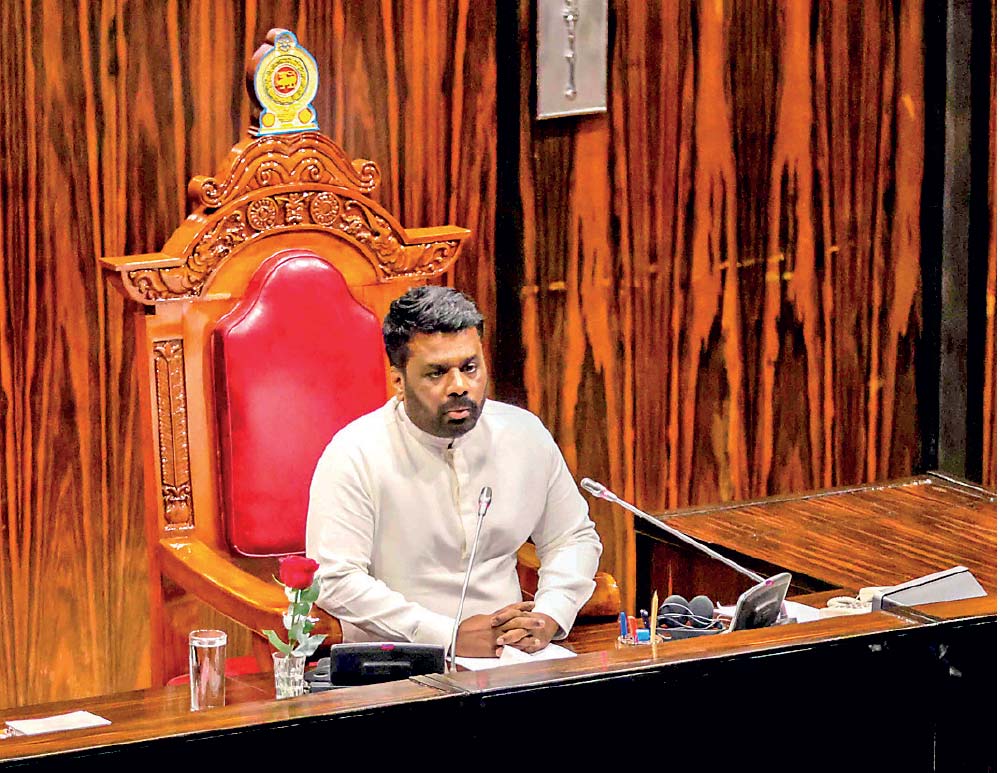
President Anura Kumara Dissanayake
 The National People’s Power campaigned in 2024 on a platform of democratic reform and institutional accountability, pledging to abolish “all oppressive acts including the Prevention of Terrorism Act (PTA)” and to safeguard civil rights nationwide. Instead, what appears to be unfolding is the continuation—and, in some respects, the refinement—of the centralised legal culture associated with previous administrations
 Sri Lanka’s recent legislative trajectory raises serious concerns about the consolidation of executive power at the expense of democratic accountability and civil liberties.
Rather than dismantling structures that enabled past authoritarianism, the incumbent administration appears to be strengthening them through new legal and administrative frameworks.
In March alone, the Government advanced five major measures: the Microfinance and Credit Regulatory Authority Act, the Inland Revenue (Amendment) Bill 2026, the Suppression of Terrorist Financing (Amendment) Bill, the Financial Transactions Reporting (Amendment) Bill, and the Money Laundering (Amendment) Bill. While their titles suggest aims such as financial accountability, national security, and public protection, many provisions pull in a different direction.
Collectively, they expand executive authority over citizens’ financial and personal affairs, weaken judicial oversight, increase surveillance powers, broaden administrative control mechanisms, and create new criminal offences and penalties for non-compliance.
These provisions cannot be viewed in isolation. They reflect a broader pattern in which narratives of national security, economic stability, anti-corruption, and crime prevention are invoked to justify the expansion of State power while limiting public scrutiny.
History shows that when extraordinary powers become normalised, democratic safeguards are steadily eroded.
Backsliding across the triad of democracy
The rule of law, and human rights are closely interconnected. Erosion in one realm destabilises the others. Authoritarian-minded leaders often exploit legal loopholes and pliant courts to weaken checks and balances, silence opposition, and restrict civil liberties.
The mechanics of interconnected backsliding.
Rule of law to democracy: Autocratic actors typically begin by targeting internal checks and balances, weakening judicial independence, and reshaping electoral laws. This legally consolidates executive power and tilts the playing field, making free and fair elections increasingly difficult.
Democracy to human rights: With opposition muted and courts captured, the State is empowered to violate fundamental rights by stifling free speech, restricting the press, and constraining civil society—undermining the core of liberal democracy.
Human rights backsliding: Suppressing rights defenders and restricting assembly are direct indicators of democratic decay, creating a cycle in which rights cannot be enforced because courts and democratic processes are no longer independent.
Judicial pushback—and its limits
The judiciary remains one of the few institutional checks on parliamentary and executive excess. Notably, the Supreme Court has already flagged constitutional inconsistencies in some of the new proposals.
Regarding the Inland Revenue (Amendment) Bill 2026, the Court found Clause 31(4) inconsistent with the Constitution because it permitted imprisonment of a taxpayer despite an administrative review or appeal pending before the Tax Appeals Commission.
It also held Clause 34(1) unconstitutional, prompting revisions after multiple petitions challenged the Bill.
Yet despite judicial intervention, the Government has shown little willingness to reconsider the broader punitive and coercive character of these laws. Opposition parties and legal experts have criticised the administration for persisting with provisions that impose criminal liability, heavy fines, and imprisonment for matters traditionally treated as civil or administrative non-compliance.
President’s Counsel and Opposition MP Faiszer Musthapha has warned that the criminalisation of administrative lapses marks a dangerous shift in the relationship between the State and the citizen.
Critics argue such measures are emblematic of a governance model that is increasingly “dictatorial,” “oppressive,” and “draconian.”
A Government elected with a strong mandate does not acquire unlimited authority to curtail freedoms, criminalise dissent, or weaken institutional oversight. The measure of democratic governance is not how easily a Government can pass laws, but whether it exercises power with restraint, transparency, and respect for the rights and freedoms of its citizens
Promises made—and unmade
This trajectory is especially concerning given the gap between the Government’s current conduct and its electoral promises. The National People’s Power campaigned in 2024 on a platform of democratic reform and institutional accountability, pledging to abolish “all oppressive acts including the Prevention of Terrorism Act (PTA)” and to safeguard civil rights nationwide. Instead, what appears to be unfolding is the continuation—and, in some respects, the refinement—of the centralised legal culture associated with previous administrations.
Laws proposed earlier are now being amended and enacted with minimal public consultation and without serious evaluation of their long-term social and constitutional implications.
The new microfinance legislation is a case in point.
Although originally introduced under the previous Government, it was modified rather than fundamentally reconsidered. Insufficient attention appears to have been paid to its broader social consequences—particularly for vulnerable rural communities and women, many already trapped in cycles of debt and economic hardship.
Democratic restraint over majoritarian power
Democracy cannot survive on parliamentary majorities alone.
A Government elected with a strong mandate does not acquire unlimited authority to curtail freedoms, criminalise dissent, or weaken institutional oversight.
Parliamentary majorities must operate within constitutional limits and democratic principles. For citizens, silence in the face of such developments carries its own consequences. Failing to critically scrutinise and oppose laws that concentrate unchecked executive power risks normalising a legal and political culture that undermines democracy, weakens civil liberties, and erodes popular sovereignty.
The measure of democratic governance is not how easily a Government can pass laws, but whether it exercises power with restraint, transparency, and respect for the rights and freedoms of its citizens.
(The author is communications professional with an academic background spanning leading international institutions. A graduate of RMIT University in Australia, and postgraduate studies at Bournemouth University in the United Kingdom)



