Friday Aug 07, 2026
Friday Aug 07, 2026
Friday, 7 August 2026 00:23 - - {{hitsCtrl.values.hits}}
 Sri Lanka has climbed more than 65 places in Startup Genome’s ranking of emerging startup ecosystems, the largest improvement recorded by any country! It is an achievement worth celebrating.
But for me, the more important story is not the ranking itself. It is what happened before the ranking.
During Sri Lanka’s financial crisis, I shared a short message on LinkedIn: Delay is not denial. Keep believing.
At the time, those words were easier to write than to live.
Hatch had an investor willing to invest $ 2.5 million. We had spent months building the relationship, explaining the opportunity, and working through the process. We had a term sheet signed and believed the investment would help us scale what we had spent years building.
Then the crisis happened.
The investor pulled out.
Nothing about our mission had changed overnight. The team was still there. The entrepreneurs we supported still needed us. The potential we saw in Sri Lanka had not disappeared.
But the environment had changed, and something that had felt almost certain was suddenly gone. At the time, it did not feel like resilience. It felt like rejection.
We often celebrate resilience after the breakthrough, but while we are living through it, resilience often looks like failure. It looks like returning to work after losing an investment you believed was secured. It looks like supporting founders when your own future feels uncertain. It looks like continuing to build while almost every external signal tells you that the timing is wrong.
During the crisis many founders spoke to me personally and asked if they should quit. And while it’s different for each founder, most we advised that their time will come and delay is not denial.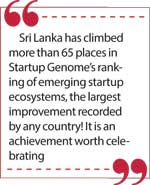
From the outside, consistency can look like momentum.
From the inside, it often feels like doing the same work repeatedly without knowing whether it is making a difference. But ecosystems, like startups, are rarely built through one investment, one policy decision, or one extraordinary year.
They are built through founders who continue when capital is scarce. Investors who remain engaged when exits are limited. Mentors who give their time without recognition. Teams who return to work after disappointment. Institutions that keep creating opportunities when progress is difficult to see.
Hatch continued. Sri Lanka’s founders continued. Investors, mentors, policymakers, and ecosystem builders continued.
And now, years later, the world is beginning to recognise what had been compounding quietly beneath the surface.
The ranking did not create Sri Lanka’s progress. It revealed it. There is a lesson here for every entrepreneur.
We often imagine success as a decisive moment: the investor who says yes, the customer who transforms the business, or the product that suddenly takes off. But success is often less dramatic.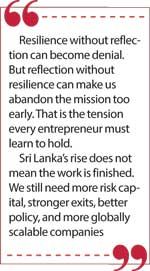
Sometimes it is the accumulated result of staying in the game, learning, adapting, and remaining faithful to the mission long enough for the opportunity to catch up with you. Of course, resilience does not mean refusing to change. There is a difference between staying committed to the mission and becoming trapped by the model.
Resilience without reflection can become denial. But reflection without resilience can make us abandon the mission too early. That is the tension every entrepreneur must learn to hold.
Sri Lanka’s rise does not mean the work is finished. We still need more risk capital, stronger exits, better policy, and more globally scalable companies.
But it reminds me of what I wrote during one of the most difficult periods in our journey.
Delay is not denial.
The $ 2.5 million investment did not happen. The crisis delayed many of the ambitions we had for Hatch and for Sri Lanka’s startup ecosystem. But it did not deny the possibility.
Sometimes resilience is simply refusing to mistake a difficult chapter for the end of the story.
Keep believing. Keep building.




