Monday Oct 12, 2026
Monday Oct 12, 2026
Friday, 22 May 2026 00:25 - - {{hitsCtrl.values.hits}}
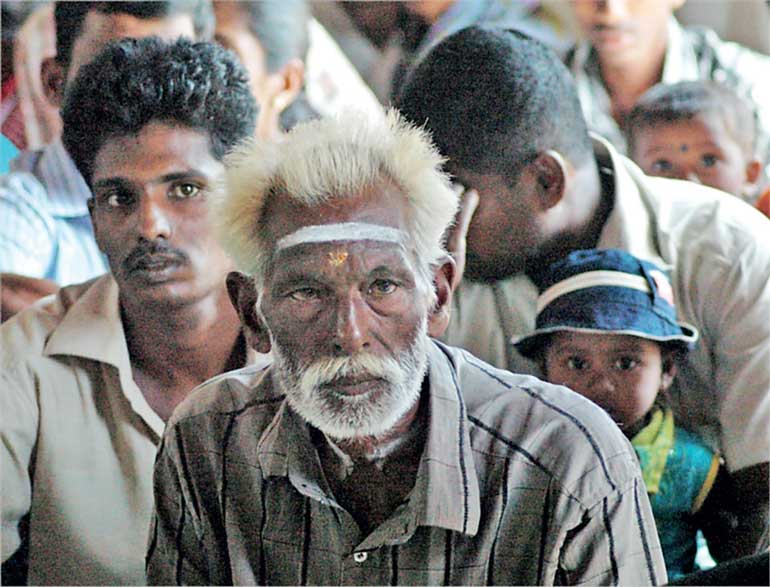
 This year marks a key anniversary in the Tamil community’s long struggle for political rights. Tamil nationalists are commemorating the 50th anniversary of the Vaddukoddai Resolution. The resolution was moved 50 years ago by the Tamil United Liberation Front as a first step towards creating a separate Tamil State in the Northern and Eastern regions of Sri Lanka. Though predicated on imagined historical claims to Tamil nationhood, the Resolution emerged in a context of repeated failures on the part of successive post-independence Sri Lankan governments to address the longstanding grievances of the Tamils, who had been facing systemic marginalisation and violence under a Sinhala-Buddhist ethno-nationalist/ethnocratic State.
A section of the English version of the Resolution underlines the ways in which Tamils were pushed to the margins of the state after independence. These include the Sinhala-Buddhistisation of predominantly Tamil-speaking areas, ethnic violence against Tamil people with the active participation of the State, and the denial of equality in education and employment. The Resolution calls for the abolition of the caste system among Tamils and offers a redistribution of resources and a socialist economic program for the people of the future State of Tamil Eelam.
Between the 1950s and mid-1970s, Tamil political leaders attempted to find solutions to the grievances of their community through dialogue and negotiations within frameworks of power-sharing, including but not restricted to federalism. However, the intransigence of Sinhala political leadership was always a barrier to any negotiated settlement. Even when leaders showed a modicum of interest in addressing some of the problems they themselves had created, they came under pressure from the Buddhist establishment and Sinhala nationalist groups and had to tear up agreements they had entered into with Tamil leaders. The country’s Left leaders, who initially stood in solidarity with Tamils, got co-opted over the years by Sinhala nationalist politics and became complicit in the continuing discrimination against ethno-religious minorities. This is when the idea of a separate state was floated.
One could argue that the Vaddukoddai Resolution emerged as a last resort of sorts. There are critics who see the Resolution as mere rhetoric, put forward to win elections by political leaders who were defeated in the general elections of 1970. They observe that the political parties behind the Resolution had no clear strategy to achieve their goals. It is also possible that the political leadership was aware that a separate state was unviable but used the Resolution as a way of putting pressure on the government to offer a reasonable solution within an undivided country. However, Tamil youth took the Resolution seriously and began to mobilise the community towards achieving the goals in the Resolution. Amid worsening state violence, Tamil militancy emerged as a powerful force in the aftermath of the Resolution, even superseding the political resistance that came from established Tamil nationalist parties.
 Even as we try to understand the context that gave birth to this Resolution, one has to scrutinise the vision of the future that informs its pronouncements. This is because the foundational arguments enshrined in the Resolution in defense of Tamil nationalism continue to dominate Tamil politics. It is often claimed by Tamil political leaders and Tamil nationalist activists, even today, that these fundamentals are non-negotiable.
History of the Tamil Nation
The very opening of the Resolution frames the existence of the Tamil nation in an ahistorical manner, without focusing on the ways in which the nation as a form of social or political imaginary emerged in the Tamil context. Like many other nationalisms observed in both Europe and the formerly colonised world, this Resolution frames the nation as a timeless entity. The longer English version of the Resolution traces the origins of the Tamil nation to “the dawn of history.” As historians have observed, the ethnic identities and ethnic consciousness that we observe in Sri Lanka and many parts of the world today took shape and consolidated into political formations during the colonial era. Assigning ethnic markers to the pre-colonial past and indigenous kingdoms with porous boundaries is a deeply ahistorical practice.
The Vaddukoddai Resolution claims that the Tamils had their own sovereign kingdom till Portuguese occupation and lost it to European rulers. It frames the modern nationalist project as a way of reclaiming their lost sovereignty. The attempt to expand the territorial borders of Jaffna kingdom, which operated within a limited territory in the northern part of the island, to the entire Northern and Eastern provinces, and then rebrand that artificially bloated territory as a Tamil kingdom when a strong Tamil political consciousness did not even exist, is an act of political and intellectual skullduggery.
Euro-centric framework
Treating nationalism as a framing logic of the state is a practice that we inherited from Europe via colonial and neo-colonial processes. In the European context, since early modern times, the nation has represented an entity imagined around a culturally and linguistically cohesive community with a common territory. The nation-states that emerged during the modern phase of Europe’s history were built on the idea of territorialised nationhood. The process of nation-making resulted in the creation of, as Mahmood Mamdani puts it, “permanent majorities” and “permanent minorities”. However, during the anti-colonial era in the Global South, in regions like India, the nation was imagined differently by some anti-colonial leaders, without having at its center a unifying identity rooted in language, religion or culture. Instead, the nation was forged through a shared commitment to liberation from colonial rule and a socio-economic program for the future of its people. The Tamil nationalism that appears in the Vaddukoddai Resolution is akin to the exclusivist European nationalisms that arose as part of modernity.
Critics have written extensively about the othering and violence European nationalisms have caused. From the expulsion of Jews and Moors from Spain in 1492 to the Holocaust in the 20th century to the ongoing persecution of Muslims, immigrants, migrant workers, and minorities in many European states today, we witness the violence of nationalism on a daily basis. Its postcolonial manifestations include the genocidal violence that we have seen in places like Rwanda and Uganda, during the partition of the Indian sub-continent and now in Gaza. 
Nationalists may claim that some nationalisms, especially the nationalism of communities that face state oppression, are benign or that ethno-nationalism takes different forms and shades depending on the forces and systems that nurture them. However, the territorial logic of framing a certain community as belonging to a demarcated land, or having superior claims to that land over others, or rebranding a given landmass as the homeland of a particular community or nation, based on real or imagined histories, is clearly an act of discrimination and a form of symbolic/discursive violence. It is an attempt to institutionalise and constitutionalise a genocidal idea. This process may not lead to violence immediately, but it is always pregnant with violence. The framers of the Vaddukoddai Resolution in 1976 would not have thought that, fourteen years down the line, there would be an ethnic cleansing of Muslims presided over by a Tamil nationalist militant group. When a hierarchical imaginary about territory is normalised and institutionalised, violence is always a possibility, a monster awaiting its birth.
Muslims and Malaiyaha Tamils
At an event held in Jaffna to mark the fiftieth anniversary of the Vaddukoddai Resolution, a prominent Tamil nationalist leader made a veiled criticism of the Muslims and their political leaders for not supporting the Resolution (it should be noted that M. H. M. Ashraff was a key supporter of the Resolution in 1976 and even campaigned on the basis of it during the 1977 general elections). Instead of introspecting into the exclusivist thrust of this Tamil-centric Resolution and how it might have alienated the Muslims, the speaker seems to expect a minority community that inhabits the North-East to accept the view that the North-East is the homeland of the Tamil nation. How is this expectation different from the dominant Sinhala-Buddhist view that all minorities should accept Sinhala-Buddhists and their nation as the legitimate social group to which the island belongs?
The Resolution is unable to address, within its territorial framework, the challenges of Tamil-speaking people who live outside the North-East, like the Malaiyaha Tamils. It invites such Tamils to move to the future state of Tamil Eelam instead of pushing for a solution in places where they currently live and work. Would it have been possible for Malaiyaha Tamils to migrate to the North-East, severing their connection to the plantation economy of the central hills that provided them with a livelihood, however meagre it was?
In short, the Vaddukoddai Resolution and its assumptions about nation, territory, and the relationship between nation and state are steeped in a political logic that marked European modernity. The Resolution is a clear imitation of a model of the nation-state that has caused bloodshed all over the world. Sadly, this model has been normalised by liberal, left-wing, and anti-colonial thinkers of self-determination all over the world since the early decades of the twentieth-century. It is not just ironic but also tragic to call such a model a vision of liberation.
The need for a new imaginary
Writing critically about Tamil nationalism may land you in zones of danger in Jaffna and Twitter. Tamil nationalism continues to demand loyalty from Tamils. Critics are quickly branded as pro-state, liberal, and treacherous. Yet one should not fear. Fear prevents us from imagining aloud. The exclusivist vision of Tamil nationalism that informs the Vaddukoddai Resolution should be called out, even as many seem to glorify the Resolution as a radical milestone in the Tamil struggle and even call on Tamils to re-affirm this “vision.”
The Vaddukoddai Resolution was followed (and preceded) by many tragedies driven by ethno-nationalist ideologies. The thirty-year civil war culminated in a genocide of Tamils in Mullivaikal. The period also saw the ethnic cleansing of Muslims from the Northern Province. The first is a violent manifestation of Sinhala-Buddhist nationalism, which the Vaddukoddai Resolution and its future iterations seem to respond to, whereas the second should be seen as an outcome of the kind of nationalist thinking that informs the Vaddukoddai Resolution. If there are lessons that we can learn from these two tragedies, the chief among them is the need to purge the Sri Lankan state of ethno-nationalism (or de-Sinhala-Buddhisise the state) and reimagine Tamil liberation through a lens that eschews ethno-nationalism. The two tragedies underline that the nationalism of the oppressor and the nationalism of the oppressed are driven by the same ethnic logic of territory and community.
The Northern and Eastern provinces, where Tamils and Muslims form the majority population in Sri Lanka, are still under siege. These are highly militarised regions subjected to deep Sinhala-Buddhistisation. The state has unleashed its apparatuses, such as the Departments of Archaeology, Wildlife Protection, Forests, and the Mahaweli Authority, to disfigure and distort the cultural and demographic makeup of these two regions. The two communities constantly face the threat of systemic minoritisation in these areas. Hence, a united opposition to the state from this region is necessary. However, Tamil nationalism and its pronouncements, such as the Vaddukoddai Resolution and the Thimpu Principles, cannot be the basis for such opposition.
What we need is a vision that brings the people of the North and East together across ethnic, religious, cultural, and linguistic lines as people of a region under siege and occupation. As Mahmood Mamdani and Nandita Sharma observe in their work, we have to decolonise the notion of liberation and imagine liberation outside frameworks that emerged as part of European modernity. The Vaddukoddai Resolution offers a colonial, Euro-centric, exclusivist model of nationhood that can only produce new cycles of violence in the guise of emancipation. Therefore, from nation, we have to shift our language of political imagination to region; from ethnicity, we have to move towards exploring the possibilities of residence as the basis for the formation of a new political imaginary and political community.
Contrary to the Vaddukoddai Resolution, I wish to recall the Freedom Charter of the African National Congress, which framed South Africa as a country that belonged to all its people. In the Freedom Charter, residency rather than membership in a particular community or nation became the central logic of the new resistant political imaginary of the anti-apartheid movement. The ANC was able to rise above the Euro-modern nationalist logic of ethnic/racial/religious/linguistic territorialisation in its broader vision for post-apartheid South Africa. It was able to offer multi-racial democracy (as opposed to black nation-state) as an alternative to apartheid. We need a similar imaginary in the North-East. It should not be based on any real or imagined histories of the region’s past. It should reject hierarchies of communities and ethnicities and their relationship to land. What is needed is a vision that prioritises the wellbeing of the people who inhabit the region and their coexistence as equal communities and people. Such a vision should be strengthened by a socio-economic program that ensures re-distribution, social justice, gender justice and abolition of caste.
(The author is a senior lecturer attached to the Department of Linguistics and English at the University of Jaffna)




