Monday Oct 12, 2026
Monday Oct 12, 2026
Thursday, 28 May 2026 00:33 - - {{hitsCtrl.values.hits}}
 Sri Lanka needs both US and China, as key and seminal in all spheres ranging from economics, commerce, trade, military, diplomacy, assistance to investments. Since Sri Lanka exercises non-alignment policy and concept to the letter and spirit, Sri Lanka now has even a more comfortable route to engage, especially, with China without antagonising or upsetting the US or major neighbors of South Asia. Yet again, Sri Lanka, at this critical economic cross-road and juncture, could engage with both these economies, mostly with China, to accrue commercial and investment utility
 Introduction of the Summit/Meeting and global scenario
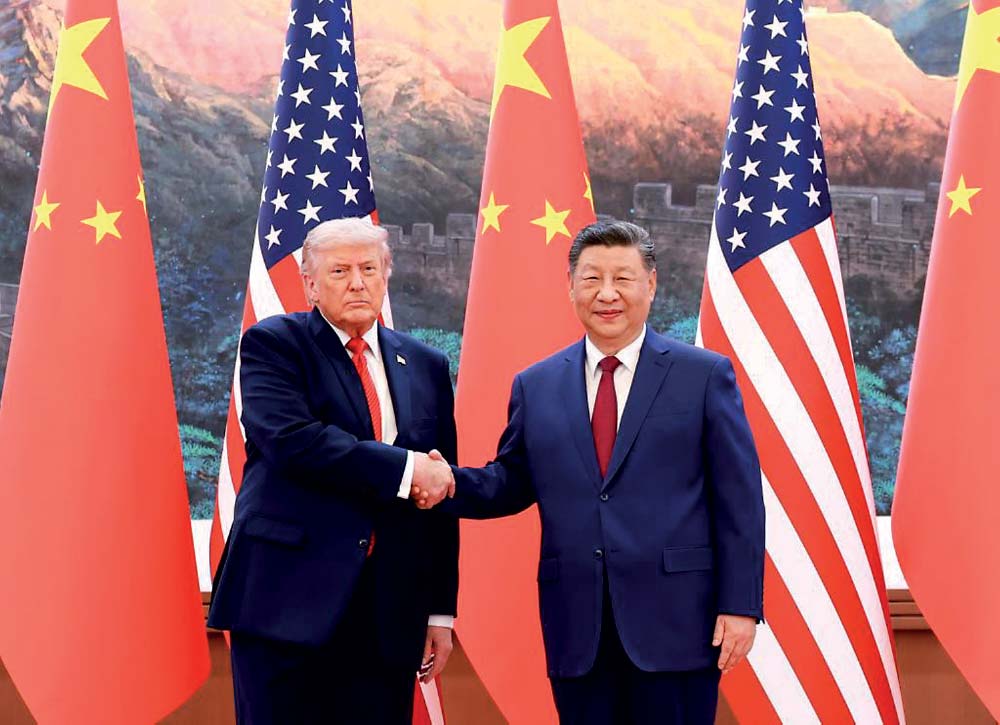
Interestingly, on the second week of May 2026, the world witnessed, what could be described as, the most consequential bilateral meeting of the world. This was none other than the meeting of the two Heads of State of the US and China. The last occasion a such high-profile summit/meeting between these two leaders was held in 2017. During 2017, three months after been sworn in as the President of the US, Trump hosted Chinese President Xi Jinping in April 2017 at Mar-a-Lago in Florida. On the same year, Trump paid a State visit to Beijing and was hosted by Xi.
The year 2017 was, perceptibly, not a peaceful or sanguine year but far better year than 2026. This is stated in the context that there were no major or cogent global threats or economic turbulences except the rise of nationalism such as Brexit, Syrian civil conflict and presence of ISIS and of course the pugnacity of North Korea firing nuclear and ballistic missiles in the Peninsula. The year 2017, could be described as the beginning of the “Geo-political Recession” with the US focused on “America First” notion and a rapidly rising China. This scenario could be called the “Kindleberger Trap”, popularised by globally noted geo-political analyst and Harvard professor, Joseph Nye. It fundamentally means the inability or the trepidation of the most powerful nation to provide global public good whilst the emerging power/nation is reluctant to extend global leadership, order, stability and direction. It is interesting to observe that a geo-political recession is almost always more perilous or dangerous than an economic recession since it would invariably lead to an economic recession and global volatility. This situation was witnessed nearly a century ago when after WWI, the UK, the then foremost imperialist power, had declined in stature and global profile whilst the emerging power, the US, was hesitant to provide leadership. The end result was geo-political recession leading to Great Depression and WW II.
The meeting/summit held in the middle of May 2026 in Beijing between the two leaders i.e. the US and China, was contrastingly different global landscape to year 2017 with major global conflicts including Ukraine/Russia, Palestine/Israel and Iran conflict leading to unparalleled economic crisis with prices of oil and gas as well as commodities surging, thus engendering reverberations across the world from Busan, Bangalore to Baltimore and deep angst and apprehension of stagflation (high inflation, slower growth and high unemployment) amongst others. Author wishes to place on record, with qualified satisfaction, that the aforesaid meeting between these two leaders under these global vicissitudes and circumstances was decidedly encouraging and optimistic to the world geo-politically, geo-economically and geo-strategically.
Stature and profile of countries and unprecedented rise of China
What is startling is that even in 1990, the GDP of China was less than $400 billion, slightly larger than that of India, whilst the GDP of the US was over $6 trillion ($6,000 billion) or over 15 times of the GDP of China. This was, as a matter of fact, over a decade after China liberalised or opened the economy in 1978/1979 under Deng Xiaoping. Even in year 2000, the GDP of China was around $1.25 trillion whilst the US was well over $10 trillion or over 8 times of the GDP of China and Japan was $4.8 trillion or nearly four times of the economy of China. In the beginning of the century, literally and figuratively, no major country considered China as a serious or potent global player nor anticipated that it would become the 2nd largest economy in a decade surpassing Germany in 2008 and Japan in around 2010 respectively. As storied Singaporean diplomat, Kishore Mahbubani, famously stated that “When a cat was seated next to you, you would feel comfortable but when it turned into a tiger, you would be terrified and excessively apprehensive.”
Around 1990, China had over 75% of the populace living in poverty and three decades later this figure was almost zero. Today, China has the largest foreign reserves in excess of $4.1 trillion or nearly three times as large as the second largest holder of foreign reserves, which is Japan ($1.4 trillion). China succeeded in recording double digit GDP growth, consistently, for three decades, which no major country has ever attained in the recorded history except Singapore, South Korea and Japan. In 1990s, the largest 10 banks in the world in terms of assets used to be predominantly Japanese banks and a couple of US banks but today, top four banks are Chinese. Further, China is the largest trading nation in the world accounting over $8 trillion in 2025 as well as the largest exporter of goods and services amounting to around $4.5 trillion whilst the US is the largest importer and second largest trading nation. Also, the iconic Belt and Road Initiative (BRI) launched in 2013, known as the largest infrastructural project, connecting around 70 nations in three continents at an estimated cost between $4 to 6 trillion.
Yet again, the US still maintains the status of the largest economy ($32 trillion) by far and contributes 25% to the global economy ($126 trillion) since 1980s with only 4.2% of global population. These two countries could be characterised as engaged in a “Tectonic Geo-political and Geo-economic Contest” but is quite unlikely that China would surpass the GDP of the US in foreseeable future despite having over four times of the population. Also, the GDP per capita of the US (over $90,000) is well over six times that of China.
Key issues of the Summit/Meeting could be summarised as “10 Ts”:
Trump and Xi meeting could be delineated or examined as “10 Ts”, meaning 10 issues deliberated, discussed, broached or ruminated, either directly or indirectly. These 10 issues, beginning with letter ‘T’, encompass the entire spectrum of the visit/discussions. Author wishes to list them, not in any specific order with brief description of each of the 10 issues.
Trade: China was one of the very few countries if not the only country to retaliate the US in April of 2025, when Trump announced the “Liberation Day” imposing far-reaching measures on countries that enjoyed trade surpluses including China. The US-China total trade was around $660 billion in 2024 with a significant trade surplus in favor of China. But in 2025, total trade has diminished to around $420 billion. Trump has been most vocal on these issues. Trade, also, consisted Rare Earth Elements (REE) exports from China to US which are critical to the US economy in all provinces, US products be bought by China including agricultural and technological products as Boeing aircraft and China to commit investments, amongst others.
Tariffs: On “Liberation Day”, Trump announced tariffs on all trading partners having a trade surplus, thus imposing as much as 145% on China. China did not relent as total exports of China to the US was around 11%, probably the largest. China is the largest trading partner of over 120 countries surpassing the US, Germany and Japan and is by far the largest exporter of goods and services in the world.
Technology: This was a key issue to both the countries with the dawn of the 5th Industrial Revolution (5th IR) including AI, ML, Big Data, micro-chips and quantum computing, amongst others. It was of no surprise that the Trump’s delegation included almost all the CEOs of “Mag-7” corporates ranging from NVIDIA, Apple to Tesla. Both the countries were well cognizant of the fact that the future progress would significantly depend on technology as well as innovation and research.
Trade Blocs: This would focus, primarily, on BRICS, since those countries have begun to transact and trade in their own currencies without relying on USD. Further, BRICS have expanded by six more countries, thus increasing to 11 members. As Nobel Laureate, Robert Mundell stated “Great Powers have great Currencies”. This was true in the world during the last millennium beginning with Portugal in 13th Century. The five founding members have, the so-called, “5R Currencies”, denoting Real (Brazil), Rubel (Russia), Rupee (India), Renminbi (China) and Rand (South Africa). However, still $is the principal reserve currency since the end of WWI and has lasted well over a century. It is most likely would continue to be the global currency, currently, consisting 58% of all currencies. This issue is one of the top most priorities of the US.
Thucydides Trap: This term was stated, unequivocally, by Xi, which means in geo-politics that an existing power is challenged by an emerging power. As Xi stated cooperation and collaboration would benefit both the countries opposed to rivalry. Both the WW I and WW II could be traced to Thucydides Trap. As Richard Nixon stated during his momentous visit to China in February of 1972 “Let us move from the era of Confrontation to the era of Negotiation”. Both the leaders recognised this issue and was conscious to navigate their relations with caution and with mutually beneficial manner, to the extent possible.
Thalassocracy: This is also a geo-political term which means sea dominance and rule of the sea. In other words, power and influence are derived by naval supremacy, commerce and colonisation leading to domination of the two major oceans i.e. Pacific and Indian. No wonder, the QUAD was birthed in 2007 and re-vitalised in 2017 with the US and three other major countries. China, noticeably, does not feel comfortable of QUAD and used to call it “Asian NATO”. The intrinsic and inherent implicit objective of QUAD is the containment of China, as articulated by US diplomat and political scientist, George F Kennan, at the peak of the Cold War, amongst others.
Taiwan: China considers, unreservedly and unconditionally, as a renegade province of China, which was non-negotiable. Of course, in 1979, the US recognised China as the legitimate state but also maintained unofficial engagement with Taiwan. This is, probably, the most contested and seminal issue for China vis- a-vis the US. The US needs Taiwan as the largest corporate, TSMC, has specialised in IT, micro-chips and high-tech devices pivotal for the US as well as the US has a pact US - Taiwan Act of 1979, which states that the US would defend Taiwan. The TSMC, today, is one of the largest corporates in the world having a market cap. of over $2 trillion or twice the GDP of Taiwan. Further, the US has been selling armament to Taiwan and $14 billion package of state-of-the-art defense material is yet to be approved. China does not feel pleased of these arrangements and considers Taiwan issue and internal and central matter, only, for China to address and manage.
Teheran: Of course, the Iran war began on the 28th February 2026 and has become a divisive and controversial issue domestically as well as a geo-political quagmire for the US. The US wished China to intervene and intercede in attaining an ‘amiable’ resolution but the lacuna or gulf of the US and Iran is substantial to say the least. It appears that the facilitation, mediation and negotiation of Pakistan are not as efficacious as anticipated. It is imperative not only for the US but to the entire world to have an acceptable resolution to the Iran-US-Israel conflict on an exigent basis as it impinges the entire global economy, including Sri Lanka.
Transit Corridor: This is none other than the ‘infamous’ Hormuz Strait. Since the globally critical chokepoint has been impeded for navigation and movement of oil and gas and other commodities, it has disrupted not only the US allies in the Middle East but, fundamentally, the entire world including the US since 20% of all energy sources move through this Strait. The prices of oil, gas, fertiliser and commodities have risen dramatically, thus diminishing the global growth. The US would wish China to intervene as China maintains congenial and affable relations with Iran.
Trust: Since there has been a conspicuous trust deficit between Washington and Beijing, thus affecting the global economy in all spheres, the US and China both wished to restore some degree of trust, predictability, sanguinity and cooperation. Since the combined GDP of these two countries amount to around $52 trillion or 40% of the global GDP as well as the two largest economies. This would be advantageous not only for these two countries but to the entire world since the defense spending by most of the countries have increased, markedly, since the beginning of the Ukraine conflict in 2022. The US expends well over $one trillion for defense whilst China expends $280 billion in 2025. The global defense spending now has increased to an unprecedented $2.8 trillion as the nations have, reluctantly, compelled to engage in an arms race, similar to the era of Cold War, primarily due to lack of trust amongst each other.
How Sri Lanka should re-position given the dynamic consequential international order
Sri Lanka needs both these major economies i.e. US and China, as key and seminal in all spheres ranging from economics, commerce, trade, military, diplomacy, assistance to investments. Since Sri Lanka exercises non-alignment policy and concept to the letter and spirit, Sri Lanka now has even a more comfortable route to engage, especially, with China without antagonising or upsetting the US or major neighbors of South Asia. Yet again, Sri Lanka, at this critical economic cross-road and juncture, could engage with both these economies, mostly with China, to accrue commercial and investment utility. Since Sri Lanka crossed the psychologically noteworthy GDP per Capita of $5,000, a major milestone to achieve, if Sri Lanka records a GDP growth of 6% to 7% consistently, it could have a GDP per Capita of $10,000 by the middle of next decade. Currently, given the global instability and energy crisis, it would be almost ardous to attain the aforesaid economic growth, but as any policymaker or political leader recognises that crisis could unfold hidden opportunities as never before.
Sri Lanka could leverage and unleash its strategic location, particularly in the context of maritime and navigational realm. This is well comprehended by the global community as scarcely visible passage on the world map in the Middle East i.e. Strait of Hormuz, could criple and strangulate the global economy. In Sri Lanka, currently, one of the most debated and discussed issues is none other than the depreciation of the currency but if managed with financial discipline and economic sagacity, could accrue benefits from key economic pivots as exports, remittances, tourism and FDI, amongst others.
As most would be aware that competitively managed exchange rate, with relatively low in value to major currencies, could be a competitive pivot in global trade and commerce as one could witness in both China and Japan in 1960s and 1970s. Japan was devastated in 1945 with the end of WW II but in only 23 years, less than a generation, in 1968 it emerged as the second largest economy only behind that of the US. It could maintain this accolade till 2010 until China surpassed. It may be noted that Japan attributes its economic miracle, of course, for manufacturing and technology but more notably the depreciated and well managed Japanese Yen until mid-1980s. In 1985, the notable “Plaza Accord” increased the parity value of Japanese Yen against mostly the USD, thus leading to slower growth, which many, today, attributes Plaza Accord to the “Lost Decades” of Japan.
The 21st Century could be described as the “Asian Century” similar to that of the 20th Century as the “American Century” and the 19th Century as the “British Century”. The 15th to 18th Centuries were described as the “European Centuries” dominated by Britian, France, Spain, Netherlands and Portugal. It is most evident that the fulcrum of political and economic activity is shifting or pivoting in an inexorable manner towards Asia and away from the traditional growth centres of North America and Europe. This particular Summit/Meeting, unambiguously, manifests and affirms the aforesaid thesis and proposition. That said, Sri Lanka is, literally and emblematically, located in the very centre of Asia and “Asian Century”. As Nobel Laureate in Economics, Paul Krugman, stated “The raw fact is that every successful example of economic development in the past century, has taken place via globalisation”.
(The author is a former career Ambassador including to Bahrain, Vietnam and South Korea and Additional Secretary of Economic Affairs, Visiting Professor and Examiner of International Economics with specialisation on Geo-politics and Negotiations, Board Member and Corporate Advisor. He earned PhD from Indian Institute of Technology (IIT) Delhi and is a Senior Fellow and former Speaker/Guest Lecturer at Harvard. He could be reached on [email protected])




