Saturday Oct 24, 2026
Saturday Oct 24, 2026
Tuesday, 8 September 2026 04:12 - - {{hitsCtrl.values.hits}}

Mahinda Rajapaksa, Maithripala Sirisena, Ranil Wickremesinghe, Gotabaya Rajapaksa, President Anura Kumara Dissanayake
 Sri Lanka now spends more to pay interest on its debt than it spends running the country. In 2025, the Government's interest bill absorbed somewhere between 89% and 127% of total revenue and 89–108% of total expenditure — meaning that, on paper, the State has stopped functioning as a normal fiscal entity and become a mechanism for servicing what it already owes. Every rupee collected in tax, and then some, goes straight back out to creditors before a single hospital, school or road is funded.
This did not happen in one budget cycle, and it did not happen under one Government. It is the cumulative result of two decades of borrowing decisions — made by five very different administrations, for five very different reasons — that all pointed in the same direction: away from investment and toward survival. Understanding how Sri Lanka arrived here, and what it is now costing ordinary consumers and businesses, matters more than any single year's number.
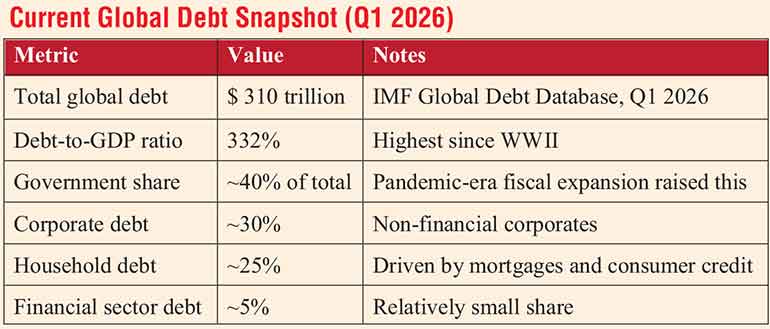
It also is not happening in isolation. Sri Lanka's crisis is the sharpest local expression of a pattern playing out across the global economy. According to the IMF's Global Debt Database, total global debt reached $ 310 trillion in the first quarter of 2026, pushing the global debt-to-GDP ratio to 332% — the highest since the Second World War. Global interest payments have risen from roughly 2% to nearly 3% of GDP in just four years, as governments everywhere roll over debt issued cheaply a decade ago into a far more expensive rate environment. The United States runs a deficit of 7–8% of GDP despite near-full employment; China has widened its own deficit to close to 8% of GDP to prop up domestic demand. Geopolitical shocks, ageing populations, climate adaptation costs and a widespread reluctance to raise taxes have combined to push interest payments to an estimated 15% of Government revenue worldwide.
Sri Lanka did not invent this problem. But it shows, with unusual clarity, what happens when every one of these global pressures lands on a country with the least fiscal space to absorb them.
Why Sri Lanka borrowed
Six factors, layered on top of one another over two decades, explain how the country arrived here.
The foundation is low tax revenue. Sri Lanka's tax-to-GDP ratio fell to just 8% in 2022, down from 18% in the 1990s — one of the lowest ratios in the world. A Government that cannot raise enough from its own economy to fund basic operations has only one lever left to pull, and it pulled it repeatedly.
Infrastructure spending in 2005–2015 was the first major draw on that lever — ports, highways, airports, and power projects, much of it on concessional terms. But concessional does not mean cost-free: several of these projects were overpriced or chronically under-utilised, turning investment debt into dead weight rather than an income-generating asset.
Restructuring under the IMF program has bought time and modestly lower rates — the 2025–2027 trajectory in these pages is real and should be acknowledged as progress. It has not bought a way out. That requires something none of the five regimes in this ledger managed for long: a tax base broad enough to fund the country without borrowing to do it, and a Government disciplined enough to spend within what that base actually raises
That was compounded, from 2015–2019, by a shift to high-interest commercial borrowing. $ 17–18 billion raised through International Sovereign Bonds financed the State in the short term but created exactly the kind of repayment spikes and refinancing risk that concessional loans avoid — debt that comes due all at once, at rates that assume nothing will go wrong.
Then several things did. External shocks arrived back-to-back: the 2019 Easter bombings gutted tourism revenue just as it was recovering, and COVID-19 then collapsed exports and remittances entirely, forcing emergency borrowing simply to pay for fuel, food and medicine. Underneath these shocks sat a slower-moving problem: exchange rate mismanagement, in which an artificially strong rupee encouraged imports while eroding export competitiveness, widening the balance-of-payments gap that further borrowing had to fill.
Finally, geopolitical and energy shocks — rising global oil prices and Middle East instability — pushed up the import bill for a country with no domestic energy production of consequence, forcing yet more borrowing to finance subsidies and essential imports.
None of these six causes acted alone. A country with adequate tax revenue could have absorbed the shocks; a country without back-to-back shocks could have serviced the ISBs; a country with a realistic exchange rate could have avoided compounding the trade deficit. Sri Lanka had all six at once.
Deficit's deeper root
The six causes above explain the borrowing of the last two decades. But the trade deficit that borrowing has spent fifty years financing goes back further still — to a policy turn in 1977 that is rarely put in the same frame as today's debt numbers, but arguably should be.
For most of the previous three decades, Sri Lanka ran a tightly controlled, largely closed economy under successive governments, including Sirimavo Bandaranaike's administrations. That model had real costs — chronic shortages, sluggish growth, unemployment near 20% by the mid-1970s — but it also kept the country's external accounts closer to balance. Sri Lanka posted a trade surplus in 1977, its first since 1956, as import controls held spending on foreign goods well below export earnings.
That surplus arrived just months before J.R. Jayewardene's United National Party swept to power in July 1977 and opened the economy: unifying and devaluing the exchange rate, dismantling import and price controls, and shifting Government spending from consumer subsidies toward capital investment. The reforms delivered what they promised on growth — GNP rose 8.2% in 1978 alone, the fastest pace in a decade — but they also reopened the door to imports at a scale the economy had not run in the previous 20 years. Since then, with only brief and partial exceptions, Sri Lanka has run a trade deficit in nearly every year for close to five decades, financed overwhelmingly by external borrowing.
This is not an argument for the closed economy of the pre-1977 years, which carried its own well-documented costs and was never fiscally free of its own kind of strain. It is a reminder that the trade deficit driving today's borrowing did not begin with Hambantota, or with the 2015 Eurobonds, or with COVID-19. It began with a deliberate policy choice to open the economy faster than the country's export base or tax system could support it — and every Government since 1977 has borrowed to cover the resulting gap between what Sri Lanka earns abroad and what it spends abroad, rather than closing it.
Five regimes, one trajectory
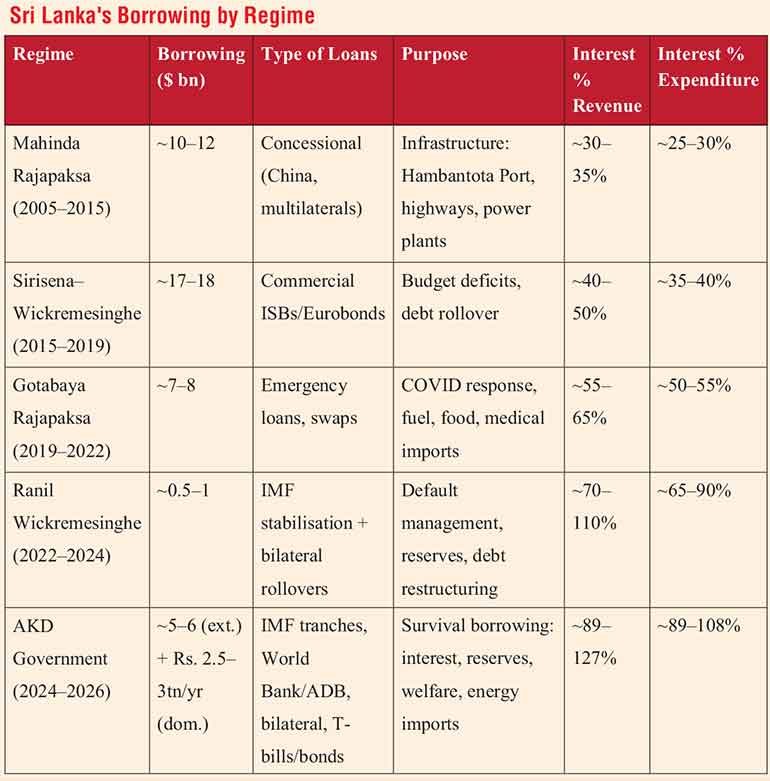
Sri Lanka's external borrowing has changed character with almost every Government of the last two decades, but the direction has been consistent: away from productive investment and toward survival.
Under Mahinda Rajapaksa (2005–2015), the country borrowed $ 10–12 billion, largely on concessional terms from China and multilateral lenders, to fund visible infrastructure — the Hambantota Port, highways, power plants. Interest consumed roughly 25–30% of expenditure. It was expensive borrowing by the standards of the time, but it built something.
The Sirisena–Wickremesinghe Government (2015–2019) borrowed more — $ 17–18 billion — but on markedly worse terms: commercial International Sovereign Bonds and Eurobonds, used largely to plug budget deficits and roll over existing debt rather than to invest. Interest as a share of expenditure climbed to 35–40%.
Gotabaya Rajapaksa's Government (2019–2022) added a further $ 7–8 billion in emergency loans and currency swaps, driven by COVID-19 response, fuel and food imports, and medical supplies — borrowing for survival rather than growth, as interest costs pushed past 50% of expenditure for the first time.
By the time Ranil Wickremesinghe took over in 2022, the country had defaulted. His Government's $ 0.5–1 billion in new borrowing was almost incidental to the real task: an IMF stabilisation program and bilateral rollovers aimed purely at debt restructuring and reserve-building. Interest as a share of expenditure reached an extraordinary 65–90%.
The current AKD Government (2024–2026) has borrowed roughly $ 5–6 billion externally, plus Rs. 2.5–3 trillion annually in domestic debt, through IMF tranches, World Bank and ADB financing, bilateral support, and Treasury bills and bonds. The purpose, according to the numbers, is stark: interest payments, reserve accumulation, welfare and energy imports. Interest now absorbs an estimated 89–108% of total Government expenditure — meaning that, in effect, the Government is borrowing to pay the interest on what it has already borrowed.
Anatomy of 2025
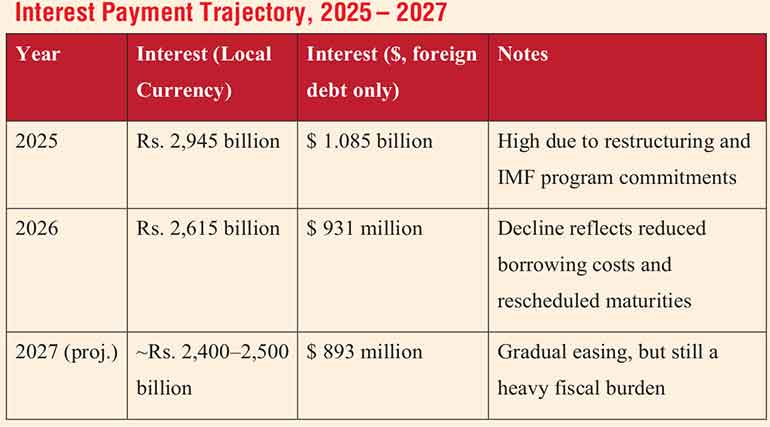
In 2025, Sri Lanka's total foreign debt service came to $ 2.454 billion — $ 1.369 billion in principal and $ 1.085 billion in interest. Most of the Government's overall interest bill, however, is not foreign at all: the Appropriation Bill shows the bulk is rupee-denominated domestic debt, with foreign interest a smaller but still material share.
Every rupee and every dollar that goes to interest is a rupee and a dollar that does not go to a classroom, a hospital bed, or a functioning grid. Sri Lanka is not dying of debt in the dramatic sense. It is being slowly, methodically starved by it — and the bill is being paid, every month, by the people who had no say in running it up
The trajectory across 2025–2027 shows the debt-restructuring dividend finally arriving, but slowly. Local-currency interest is projected to fall from Rs. 2,945 billion in 2025 to Rs. 2,615 billion in 2026, and to roughly Rs. 2,400–2,500 billion in 2027 — a decline the Treasury attributes to reduced borrowing costs and rescheduled maturities. In dollar terms, foreign debt interest is projected to fall from $ 1.085 billion in 2025 to $ 931 million in 2026 and $ 893 million in 2027.
These are genuine improvements. They are also nowhere near enough. Even on the improving trajectory, interest costs remain over one-third of total Government expenditure and consume more than 10% of GDP — a level that leaves minimal fiscal space for health, education or infrastructure, regardless of what the headline growth numbers say. Sri Lanka spends nearly Rs. 3 trillion annually just to service interest — more than it spends on education and health combined. Even with IMF-backed restructuring, foreign debt interest alone exceeds $ 900 million a year, a steady drain on reserves and a persistent source of pressure on the rupee.
Risks ahead
Three risks sit on top of this already narrow path. Exchange rate volatility remains the most dangerous: rupee depreciation of around 15% in 2025 alone magnified the real burden of every dollar of foreign interest, and any renewed currency weakness would erase much of the restructuring gain overnight. Inflation risk follows closely: heavy interest payments push governments toward higher taxation and, when that proves politically or practically insufficient, toward monetary financing — both of which are inflationary by design or by consequence. And there is a credibility gap in the official numbers themselves: a forecast inflation rate of 7% may significantly understate the real impact on households once energy price adjustments and the knock-on effects of debt servicing are factored in.
Who actually pays?
Debt-service statistics are abstract until they are translated into what a household or a small business actually experiences. In Sri Lanka's case, that translation is direct and immediate.
For consumers, it runs on four tracks. With so much revenue swallowed by interest, the State turns to indirect taxes and money printing to make up the gap — which shows up as higher VAT, fuel levies, and food inflation rather than as a line item labelled “debt service.” Social spending is the next casualty: with close to 90% of revenue going to debt service, health, education and welfare budgets are squeezed, and families absorb the difference through higher out-of-pocket costs for essentials that used to be subsidised. Foreign-currency borrowing weakens the rupee, which makes every imported input — fuel, medicine, food — more expensive at the checkout. And as interest payments crowd out the subsidy budget itself, households face higher electricity, transport and LPG prices directly, not just through the general price level.
SMEs face a parallel squeeze, structurally different but equally binding. Government borrowing of Rs. 2.5–3 trillion annually absorbs the bulk of domestic credit, leaving SMEs to compete for what remains at high interest rates and with limited access to financing — a textbook case of crowding out. To raise the revenue that borrowing alone cannot provide, the State also leans on SMEs directly, through higher corporate taxes and compliance costs that erode competitiveness at the exact moment firms can least absorb it. Currency depreciation raises the cost of imported raw materials for anyone manufacturing locally, while weak trade facilitation limits the export opportunities that might otherwise offset it. And SMEs supplying Government contracts frequently face payment arrears, as available funds are diverted to debt service ahead of supplier obligations.
Middle-income illusion
The World Bank classifies Sri Lanka as a lower-middle-income country, with per-capita income of roughly $ 4,000 — nominally ahead of India's approximately $ 2,700. On paper, this looks like progress.
It is closer to a statistical illusion. Sri Lanka's middle-income classification sits alongside high inequality, active debt distress, and a poverty rate of roughly 24% in 2025. India, despite a lower per-capita figure, has the scale, growth trajectory and fiscal space that Sri Lanka currently lacks. Per-capita income measures the size of the economic pie divided evenly; it says nothing about who is actually eating, or about the Government's capacity to invest in the next harvest.
Sri Lanka wears the badge of a middle-income country, but its consumers and SMEs live under a debt-driven austerity. Interest payments crowd out social spending, credit is swallowed by Government borrowing, and households face inflation without relief. Middle-income in name, debt-trap in reality.
Real cost
Sri Lanka did not arrive at an interest bill approaching the size of its own budget through a single bad decision, or under a single Government. Five administrations, five borrowing strategies, one unbroken climb: from interest as the cost of Hambantota-era infrastructure, to interest as the price of rolling over Eurobonds, to interest as the near-totality of what the State collects. Each Government inherited a worse starting position than the last and made borrowing choices that, in hindsight, narrowed the room for the next one still further.
Restructuring under the IMF program has bought time and modestly lower rates — the 2025–2027 trajectory in these pages is real and should be acknowledged as progress. It has not bought a way out. That requires something none of the five regimes in this ledger managed for long: a tax base broad enough to fund the country without borrowing to do it, and a Government disciplined enough to spend within what that base actually raises.
Until then, the arithmetic is simple and unforgiving, and it is Sri Lankans who feel it first — at the pump, in the electricity bill, in the SME loan that never gets approved. Every rupee and every dollar that goes to interest is a rupee and a dollar that does not go to a classroom, a hospital bed, or a functioning grid. Sri Lanka is not dying of debt in the dramatic sense. It is being slowly, methodically starved by it — and the bill is being paid, every month, by the people who had no say in running it up.
(The writer is a business coach, author, and columnist on economic and education policy. He can be reached via Business Athletes Ltd.)




