Tuesday Oct 06, 2026
Tuesday Oct 06, 2026
Tuesday, 6 October 2026 06:16 - - {{hitsCtrl.values.hits}}
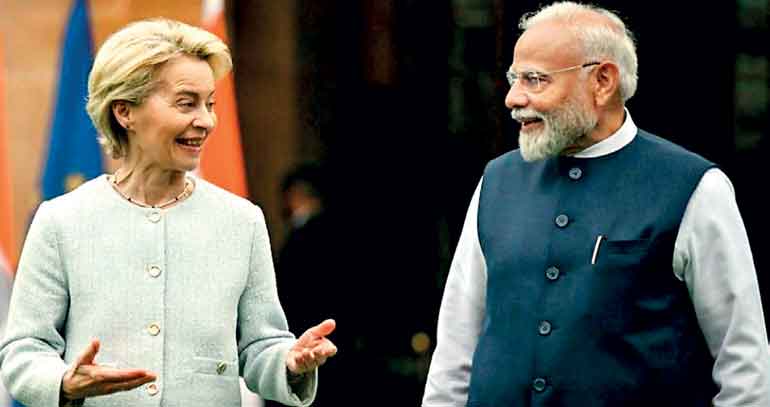
European Commission President Ursula von der Leyen (left) and India's Prime Minister Narendra Modi
 On 27 January 2026, the European Union and India announced that they had finalised negotiations on a landmark Free Trade Agreement (FTA). During her visit to New Delhi, European Commission President Ursula von der Leyen quickly dubbed it the “mother of all deals”, underscoring the political significance Brussels attaches to the agreement for both bilateral relations and international trade.
New type of deal
Economically, the EU-India trade deal is without a doubt substantial, as tariffs are set to be reduced or eliminated for 97% of all EU goods exports. The deal constitutes the first major bilateral trade agreement between two of the world’s largest economic entities and is expected to double exports from the EU to India by 2032.
Yet, strikingly, it is more a “trade” than a “free trade” agreement. The trade deal only partially liberalises sensitive sectors like agriculture, excludes Government procurement, and leaves many non-tariff barriers in place. In some areas like the automobile sector, tariff reductions will be phased in over a period of ten years, raising questions about how quickly some of the agreement’s economic effects will materialise.
This apparent gap between political ambition and limited liberalisation should not simply be understood as a shortcoming of the trade deal. Rather, the nature of the agreement illustrates a defining feature of the emerging EU-India relationship.
Unlike many of Europe’s traditional partnerships, the EU’s approach to India is not driven by normative like-mindedness, similar strategic cultures, or long-established trust. Instead, it is a strategic partnership that both sides increasingly pursue out of necessity. At a time when major international disruptions put Europe’s and India’s economic models under pressure, both actors recognise a growing need to diversify trade relations, reduce geo-economic risks, and cultivate new partnerships.
Global events as catalysts for bilateral cooperation
Until recently, Europe relied on its security partnership with the United States, the Chinese export market, and cheap fossil energy imports from Russia. Within a few years, all three dependencies turned into liabilities. An emerging threat perception toward China provided the initial EU-India momentum. The EU’s joint communication on China in 2019 prominently labelled Beijing as a partner, competitor, and rival; the subsequent Indo-Pacific Strategy emphasised the importance of the EU’s relations with New Delhi.
India’s strategic community increasingly perceived a convergence of interests with Europe after the country experienced the first deadly border clashes with China in decades. Yet, India also realised an economic opportunity in positioning itself as a China+1 partner for European countries.
The beginning of Russia’s war in Ukraine, on the other hand, provided further momentum for the EU to double down on its partnership with India. That European Commission President von der Leyen and Indian Prime Minister Modi announced the resumption of bilateral FTA talks two months after the launch of the Ukraine invasion underlined the political intent to engage India.
While many experts remained sceptical about a successful conclusion of a trade agreement, it was ultimately US President Trump’s tariff demands that created a sense of urgency in both Brussels and New Delhi. Decision-makers in both capitals came to realise that the finalisation of the agreement would send an important signal at a time of increasingly weaponised interdependence.
Trade deal as key to forging broader convergence
The negotiations and the content of the EU-India FTA reflect the emerging political approach that Brussels is adopting on trade agreements. In contrast to many earlier trade deals, the agreement between the EU and India is not the result of strategic convergence, but designed to facilitate a broader interest alignment in the future. In multilateral contexts like the World Trade Organisation, for instance, Europe and India have long been at loggerheads over many issues ranging from patent rights to agricultural subsidies.
In the area of economic security, India is viewed as an increasingly relevant partner for broader cooperation on issues such as supply chain resilience, AI governance, and the green transition. All these issues are deeply linked to trade and investment, and the new trade deal is supposed to serve as a starting point to seek convergence. In Brussels, this calculus includes the hope that compromises between the EU and India can help to generate common positions that bridge Global North and Global South economic interests more broadly.
The conclusion of the trade talks is also remarkable because the two partners continue to pursue different priorities in key areas. Germany views India as an increasingly important export market for machinery, cars, and other industrial products. India, on the other hand, wants to attract more European investment to strengthen local innovation and manufacturing and to create more jobs.
Contrasting elements of the FTA debate in Europe and India further illustrate these different perspectives: European actors continue to highlight that India, in contrast to the EU, remains a high-tariff country, urging New Delhi to lower its tariffs more generally. At the same time, Indian policy elites regularly criticise the EU’s use of regulatory means to create what Indian actors describe as non-tariff barriers.
The FTA is hence both less comprehensive than previous EU trade agreements in its overall breadth and depth, and a highly ambitious political project to forge a partnership that is likely to evolve further in areas such as security, trade, and skilled-labour migration. What brings both actors together now is a similar understanding of the risks posed by disruptions to the international order and global challenges such as climate change. What political leaders on both sides hope for now is that the trade deal, which itself results from this increasingly aligned assessment, will produce greater convergence in the future. The trade agreement is thus an important political signal that India is a priority for the EU, intended to serve as a catalyst for further cooperation
Measures like the Carbon Border Adjustment Mechanism (CBAM), India argues, are creating new market access hurdles for Indian companies in the European market. When New Delhi raises CBAM, European officials, however, point in turn to India’s Quality Control Orders (QCOs), which are equally seen as protectionist measures. These fault-lines underscore the obstacles that the two partners had to overcome when finding common ground on trade during the negotiations.
India is a key partner for the EU in addressing several of the structural challenges it currently faces. In concluding the FTA, EU negotiators have been far more willing to make compromises and depart from the EU’s traditional approach to FTA negotiations.
The FTA is hence both less comprehensive than previous EU trade agreements in its overall breadth and depth, and a highly ambitious political project to forge a partnership that is likely to evolve further in areas such as security, trade, and skilled-labour migration.
What brings both actors together now is a similar understanding of the risks posed by disruptions to the international order and global challenges such as climate change. What political leaders on both sides hope for now is that the trade deal, which itself results from this increasingly aligned assessment, will produce greater convergence in the future. The trade agreement is thus an important political signal that India is a priority for the EU, intended to serve as a catalyst for further cooperation.
(The author is the South Asia Researcher at the German Institute for International and Security Affairs (SWP) in Berlin and a Research Fellow at Verité Research)



