Friday Oct 02, 2026
Friday Oct 02, 2026
Thursday, 18 June 2026 00:30 - - {{hitsCtrl.values.hits}}
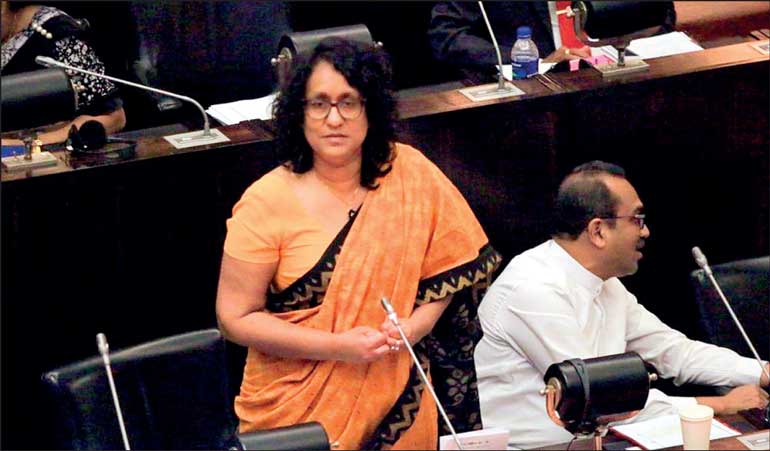
Prime Minister Dr. Harini Amarasuriya declares no PC elections without new electoral law, gives no timeframe
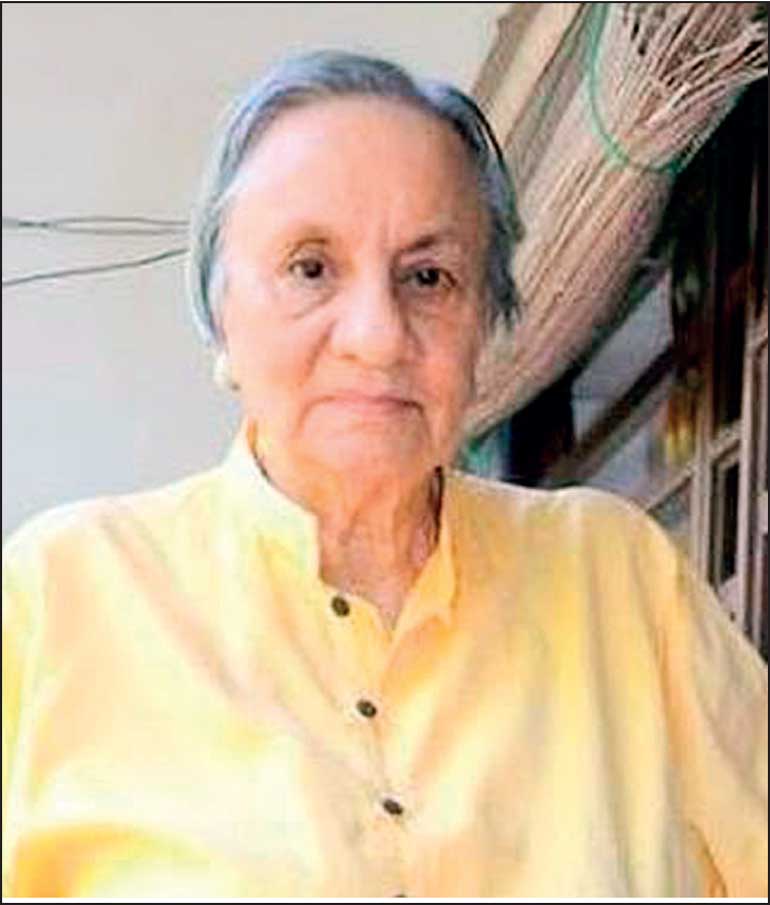
Prof. Kumari Jayawardena, doyenne of independent, critical left intelligentsia during the United Front Government
 "The PR system, which has contributed to corruption within the country's political culture, must be changed. There is little point in merely holding elections if the necessary criteria for democracy are absent within the electoral system."
- Prime Minister Harini Amarasuriya, 10 June 2026
The assertion in Parliament by the Prime Minister, Dr. Harini Amarasuriya, that “There is little point in merely holding elections if the necessary criteria for democracy are absent within the electoral system" is sinister and can be recycled in the foreseeable future by the JVP-NPP’s steamroller Parliamentary majority to attempt deferment of the Presidential and Parliamentary elections too, reloading the excuse that "The PR system, which has contributed to corruption within the country's political culture, must be changed.”
The quote is from the PM’s authoritative reply to a question raised by Ravi Karunanayake, MP, on the holding of the long-delayed Provincial Council election. His query came in the wake of the Attorney-General presenting a menu of possible options to hold the election, among them a one-time-only election under the pre-existing system of undiluted Proportional Representation, which would be the most expeditious, kick-starting the PC system back into life, while permitting the parallel formulation and passage of a new electoral law by Parliament.
Brusquely rejecting this option, Prime Minister Amarasuriya kicked the can down the road as far as it could possibly go and further than we can glimpse. She specified the need for a new election law which would dilute the existing system of Proportional Representation (PR), introducing ‘constituency-based representation’—which inevitably entails delimitation—and inserting quotas for youth and women. English-language dailies reported it pithily: ‘PM declares PC polls only under New Electoral System’.
‘Prime Minister Dr. Harini Amarasuriya on Wednesday (10) said Provincial Council elections will be held only after a Parliamentary Select Committee (PSC) on electoral reforms submits its recommendations, arguing that conducting polls under the existing electoral system would perpetuate structural flaws and administrative challenges.
Responding to questions raised by New Democratic Front MP Ravi Karunanayake during Parliament’s Question Hour, the Prime Minister said the Government was committed to holding elections but wanted to ensure they were conducted under a reformed and more representative electoral framework.
“We cannot adapt democracy according to our needs. Elections will be held once the Parliamentary Select Committee on electoral matters submits its recommendations and draft report,” she said.
Amarasuriya noted that the electoral system under which Provincial Council elections should be conducted remains a contentious issue and warned that proceeding under the old framework could create governance and administrative difficulties.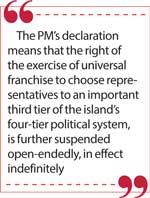
She said the existing system fails to ensure adequate representation for women and youth, does not allow for the election of constituency-based representatives, and retains the preferential voting mechanism, which she described as a contributor to corruption within the political system.
“If Provincial Council elections are conducted under the old electoral system, we will be unable to address longstanding concerns regarding representation and electoral integrity,” she said.
…Amarasuriya called for cross-party support for electoral reforms, saying Sri Lanka needed a modern electoral system that reflects current democratic requirements and strengthens public confidence in the political process.’ (https://dailyexpress.lk/comments/35160/)
No timeline is stipulated.
Great counter-reformation
The AKD-JVP-NPP Government’s decision rolled-out by the Prime Minister, constitutes a systemic danger for three reasons which exist in combination.
The PM’s declaration means that the right of the exercise of universal franchise to choose representatives to an important third tier of the island’s four-tier political system, is further suspended open-endedly, in effect indefinitely.
The most important structural reform of the Sri Lankan State, decentralising to some degree the over-concentration of power in an executive Presidential system—which, though superior to the previous Westminster model, lacks the separation and balance of power afforded by the US Constitution—stands suspended or reversed. The Sri Lankan political system is back to the hyper-centralisation of power that existed before provincial-level devolution in 1988. 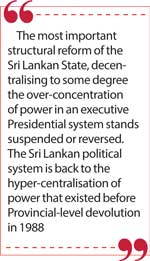
Worse still is the impact on the island’s oldest political problem which goes back before Independence to the early decades of the 20th century. That is the issue of nation-building, also known as the ‘ethnic issue’. The system of Provincial Councils is the application of the principle of devolution of power from the centre to the periphery, thereby affording a measure of self- administration as a solution to or melioration of the Tamil ethnonational question. The open-ended delay in holding elections to the Provincial Councils continues to keep in suspended animation the popularly elected provincial legislatures and therefore reduces the devolution of power to the provinces and their people, to zero.
The answer of devolution/autonomy to the Tamil National Question, given through the All-Parties Conference (APC) of 1984, the Political Parties Conference (PPC) of mid-1986 and the Indo-Sri Lanka Accord plus the 13th Amendment of 1987, has been silenced, de-activated. Devolution survived a Thirty Years War and a second Southern Civil War as a structural-reformist solution which also widened and deepened democracy. Unless and until Provincial elections are held, the actual existence of devolved Provincial Councils with elected representatives dating back to 1988, ceases. The entire discussion regarding devolution within the Sri Lankan State and with the Sri Lankan State by India and the international community which dates back to late-1983/1984, has ceased.
The non-existence of the elected Provincial Councils creates a political vacuum which is particularly dangerous given the sentiments expressed on Sri Lanka and its Tamil citizens by a mercurial Chief Minister across a strip of water in Tamil Nadu.
Given the prolonged absence of elected Provincial Councils with democratic Tamil representation, it is little wonder that we are witnessing many more street demonstrations on grievances, and manifestations of pro-Prabhakaran, pro-Tamil Eelam sentiments that have been marginal in the post-war years until Anura’s Presidency.
At a time when the Tamil Diaspora in Western democracies is making significant political advances of a pro-secessionist, anti-Sri Lankan character, the AKD administration has deprived the State of the ‘shield’ of counter-argument that Sri Lanka already has significant Provincial-level devolution to elected legislative bodies.
Open-ended deferment takes us back decades to a more constricted political and State system: the combination of an unchecked, unbalanced Presidency (unlike the USA) and a unitary State minus devolution. How then to address and alleviate long-standing identity-based collective Tamil sentiments?
In terms of democracy/authoritarianism, it also returns us to the 1970s when the United Front Government, possessing a two-thirds Parliamentary majority (as does the JVP-NPP administration), decided not to hold elections to Municipal and other local authorities, appointing a Special Commissioner instead for years. Currently the de facto suspension is not of the elected Municipal bodies but elected Provincial bodies (which didn’t exist in the 1970s). The principle is the same, and so will be the political, electoral and civic-legal consequences down the road. No Government in Sri Lanka or anywhere in the world is known to have benefited by shutting down or keeping shut the system’s electoral safety-valves. The longer the shut-down, the greater the blowback.
Secessionist-federalism
Writing in these pages, independent researcher Praharshini Dias has convincingly argued that my critique of SJV Chelvanayakam’s declaration of federalism as a premature, ill-considered overreaction to the earliest post-Independence manifestation of Sinhala hegemonism, is overly charitable and that Chelvanayakam overtly advocated secession—a separate, independent State for the Tamils—even before Independence in 1948.
Praharshini Dias writes:
‘…On 26 November 1947, during one of the earliest sessions of the State Council under the Soulbury constitution, the newly elected member for Kankesanthurai, S. J. V. Chelvanayakam, raised the idea of secession in his remarks. He stated that the Tamils of Jaffna had the right to secede from Ceylon and suggested that, if they wished, such a move could even take place with India’s support.
Addressing the council on 26 November 1947, C. Suntheralingam revealed that Chelvanayakam had previously spoken at public rallies in Jaffna about seceding from Ceylon and even forming a federation with Tamil-speaking regions of India (Hansard 1947: 131). 
Chelvanayakam initially denied these claims, but when evidence was presented - specifically his speeches published in the Times of Ceylon on 17 November 1947 - he did not continue the denial.
…Chelvanayakam…went on to question why, if Ceylon sought the right to secede from the British Empire, the Tamil people should not also have the right to secede from the rest of the country if they so desired.
“…If Ceylon is fighting for the right to secede from the British Empire, why should not the Tamil people, if they feel like it, secede from the rest of the country?”
…It was also disclosed by other members in the [State] Council that Chelvanayakam had expressed willingness to even give the Trincomalee harbour to Nehru.
Gate Mudaliyar Kariapper, a member of the Eastern Province, joining the debate said (Hansard 1947: 316), “…Sir, the hon. Member for Kankesanturai, speaking at a meeting in celebration of the birthday of Pandit Jawaharlal Nehru almost gave the Harbour of Trincomalee as a birthday present to the Pandit…”
…As the Times of Ceylon news item dated to 17 Nov, 1947 said, instead of the British made Ceylonese constitution, Chelvanayakam wanted a federal form of Government with the right to secede…’
(https://www.ft.lk/opinion/A-comment-on-Dayan-Jayatilleka-s-The-Federalist-fantasy-Tamil-political-tragedy-Lankan-political-history/14-792528)
Shockingly, there is a Chelvanayakam-AKD-Ranil-Harsha continuum:
I. What SJV Chelvanayakam treacherously suggested without the power to enact, namely giving Trincomalee harbour as a gift to India’s Prime Minister Nehru, President Anura Dissanayake seems to have pretty much suggested regarding Trincomalee-Mannar to India’s Prime Minister Modi.
II.Chelvanayakam’s idea of Northern Tamil secession from Ceylon and federation with India’s Tamil provinces will be facilitated not only by AKD’s undisclosed agreements with India including the Trincomalee-Mannar footprint, but also the Ranil Wickremesinghe-Milinda Moragoda-Harsha de Silva plan of economic integration and physical connectivity of Sri Lanka’s North with Tamil Nadu. 
Praharshini Dias’ research confirms my long-standing opposition to federalism, de jure or de facto, whether it is attempted by the ITAK and other Tamil parties; sought though a ‘surge’ by Vardarajahperumal’s North East Provincial Council (from which I resigned in six months); contained in President Chandrika Bandaranaike Kumaratunga’s 1995 and 1997 ‘political packages’; or implicit in Ranil Wickremesinghe and the ITAK’s draft of a new non-unitary Constitution during the Yahapalanaya Government.
This is also why Sri Lanka must resist slippery attempts to drop the explicitly unitary character of the State, substituting the term ‘united’ instead—which the ITAK got CBK’s SLFP and Ranil’s UNP to agree to, and Mangala Samaraweera and Eran Wickremaratne smuggled into Sajith’s Presidential manifesto in Nov 2019. (Mahinda Rajapaksa brandished the first printing before Sajith and Champika spotted and withdrew it, issuing a revised version).
Strategically sustainable State
The 13th Amendment was instantly criticised by TULF leader Appapillai Amirthalingam in a letter to Prime Minister Rajiv Gandhi in late-1987 and never accepted even postwar (2011) as the framework or baseline of a solution by his successor R Sampanthan, proving that the powers granted to the Provincial Councils by the 13th amendment were by no means tantamount to federalism nor convertible into federalism, let alone a separate state.
The 13th amendment was a very different animal from federalism. It belonged to the well-known category from China and Vietnam to the Philippines and Spain, of ethnic autonomy/devolution within a unitary State.
SWRD Bandaranaike was correct when he observed in 1926 that no country with the diverse composition and configuration of Ceylon could be sustainably managed under a centralised unitary State. His 1957 pact with SJV Chelvanayakam prefigured the pattern of the 13th Amendment two decades later: semi-autonomous ‘regional councils’ within a non-federal (unitary) State.
The problem is strategic and conceptual. What are the boundaries that we, the majority of citizens, seek for the State we live in? Which boundaries would serve Sri Lanka’s interest best? Clearly, it should be a sState with borders identical with our natural geographic boundaries, i.e., the totality of this island and its waters.
We could sustain a State with natural borders only if we realise that it is NOT a State organised on or corresponding to the principle of linguistic, ethnolinguistic or ethnoreligious borders. The composition of Ceylon/Sri Lanka is not one in which the ethno-lingual or ethnoreligious majority community in the country is a majority across, i.e., in every Province, of the island. Therefore, the entirety of the island cannot be run under a tightly centralised homogenised form of State with an embedded constitutional privilege for the ethnolinguistic and ethnoreligious majority. It is the hegemonistic project of doing so from 1956 and more specifically 1972 that triggered the Thirty Years War of secession.
An island with Sri Lanka’s geographic location cannot afford a system which will give the North and East the powers of a federal State. Separated only a narrow strip of water from Tamil Nadu, and with Tamil Nadu closer to Jaffna than is Colombo, federalism will facilitate separation with the island’s North joining South India, which in turn will tilt the geopolitical and economic balance on the island as a whole.
If the other provinces too enjoyed federal powers, the island would be ungovernable and fragment politically.
The directly, nationally elected Executive Presidency remains vital as an overarching power representing the whole country, which can contain and control the Chief Ministers and Provincial Councils within a unitary framework. Parliament, an assembly of representatives with local bases, and vulnerable to coalitions with extremist components, cannot do it.
Just as geopolitics must forestall Sri Lanka’s conversion to federalism because of the proximity of Tamil Nadu, the island’s demography prevents a centralised unitary State sustainably covering its natural borders, because the North and East do not have a majority which speaks the same language as the island’s majority community.
The only way of keeping the borders of the Sri Lankan State defensibly co-extensive with its natural borders is to resist federalism while having a devolved, decentralised unitary State form. That is the defensive superstructure of ‘trenches’ (Gramsci) the 13th Amendment and Provincial Councils provides/provided.
Conformist left intelligentsia
In contradistinction to Prof. Kumari Jayawardena, doyenne of the left intelligentsia who took an independent, tough-minded, critical stance from the early-1970s onwards towards the United Front Government’s rightist and authoritarian turn, today’s NPP-sympathising academics are compliant, although:
1. The Government is adhering to the formula of conservative-neoliberal Ranil Wickremesinghe whose 2017 legislation gridlocked PC elections.
2. The JVP-NPP is deep-freezing the only structural-reformist solution Sri Lanka implemented for the National/Nationalities Question.
3. A basic tenet of the political thought of Marx and Lenin is that the first strategic aim is that of political democracy, against political absolutism. The political struggle for democracy opens the road to battles for socioeconomic emancipation. This Government has shrunk the zone of basic political democracy—the exercise of universal franchise.
With such a conformist contemporary left intelligentsia, no wonder the growing social backlash is ideologically rightwards—be it the neoliberal centre-right or neo-nationalist-populist right.
[https://dayanjayatilleka.webflow.io/]



