Monday Sep 14, 2026
Monday Sep 14, 2026
Thursday, 4 December 2025 01:33 - - {{hitsCtrl.values.hits}}
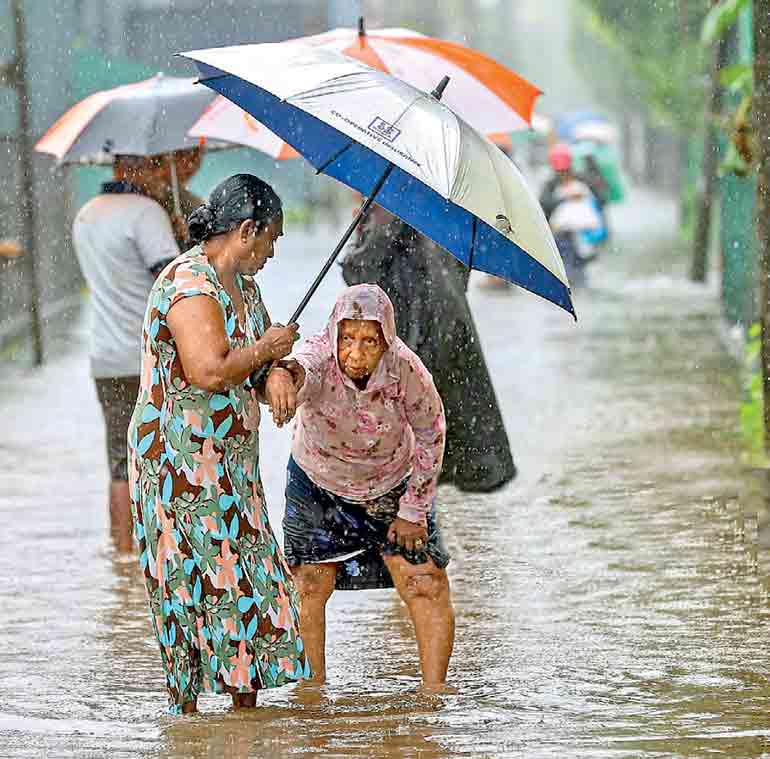
From 12 November did they get any warning at all?
 “As a country, we are facing the largest and most challenging natural disaster in our history” declared President Anura Kumara Dissanayake addressing the nation for the first time since the cyclone struck. (https://www.dailymirror.lk/breaking-news/Emergency-powers-will-not-be-misused-President-assures/108-326543).
That’s not only typically misleading hyperbole, factually that’s wrong, untrue, false, fake—but that’s Anura. In the tsunami of 26 December 2004, 35,000 people were killed. Thousands went missing. 1.7 million were displaced. Before the tsunami hit, there was no warning, unlike in the case of the November 2025 cyclone.
‘The flash of lightning that revealed the reality’ was a famous phrase of Lenin’s. This weather symbolism should be extended to contemporary Sri Lanka. The cyclone of November 2025 swept away the pretensions to comparative superiority or even basic competence, of the Anura Dissanayake administration.
The twin cyclones which hit Indonesia-Thailand-Malaysia and Sri Lanka are clearly evidence of climate change, but neither the Sri Lankan President nor Prime Minister participated in COP 30, the 30th UN annual conference on climate, held in Brazil, hosted by one of the greatest progressive leaders in the world today, Luis ‘Lula’ Inacio da Silva. One would have thought AKD would have regarded him a hero and regarded the opportunity with eagerness, but obviously not. If Anura had been at COP30 he could have learned things and made connections which might have proved useful today.
The Anura administration already stands out among all post-independence administrations for utter incongruity between its election manifesto and its post-election practice, its incarnation as an Opposition on the cusp of power and a party established in power.
On top of that comes the cyclone and its management. The imminence of cyclonic weather was on the public record two weeks before the actual event, and yet the Government did not take the most basic steps that previous governments have done with far less lead time. Furthermore, its post-event response has been incompetent when compared with its predecessors.
On the Derana’s Big Focus show of 12 November, hosted by (arguably) the country’s best TV interviewer/presenter Kalindu Karunaratne, the Director-General of the Meteorological Department Athula Karunanayake warned in some considerable detail of clear signs that he can see of the extreme weather buildup in Sri Lanka arising from the turbulence observed in the Bay of Bengal, saying that while he is reluctant to use the C-word, the impending weather is for all intents and purposes, cyclonic in character, scale and scope. He confirmed that authorities should remain alert to this probability in the days following the 14th of November.
(https://www.youtube.com/live/WJgLftkD43A?si=_a5iehxIxgVPUlnZ)
 The imminence of cyclonic weather was on the public record two weeks before the actual event, and yet the Government did not take the most basic steps that previous governments have done with far less lead time. Furthermore, its post-event response has been incompetent when compared with its predecessors
But did the authorities remain alert? What action did the agencies of Government take on that basis? Why was there no national warning, or rather, repeated warnings over days? Why were there no preparations? Were there any contingency plans? Who is in charge at the political level of Disaster Management? What did he/she do?
The Sunday Times Political Desk summarises the tragic farce that ensued on AKD’s watch:
…The Meteorology Department had warned around mid-November of the atmospheric disturbances which had the potential to develop into a major cyclonic condition over the island. Unlike earthquakes, cyclones are easier to track with the use of modern technology such as satellites, weather radar and computers, and hence the Met Department warned of the changes in the weather conditions and related the information to the relevant government institutions. What is clear from the unfolding events of the past few days is that such warnings may not have been taken with due seriousness. There were no preparatory meetings, and there were no major public announcements until all hell broke loose and it became clear that the country was in the throes of one of its worst natural disasters in years.
It was on Thursday (27 November) that an emergency meeting was held at the Parliament premises, chaired by the President, to review the emergency disaster situation that has arisen in the country and how the relief services could operate…’
(https://www.sundaytimes.lk/251130/columns/govt-in-eye-of-storm-over-disaster-handling-622557.html)
Who will be accountable for the criminal negligence that led to the death of 474, with 356 missing—and counting?
Has the Government been responsible and competent enough to renew the Flood/Catastrophe Insurance Cover for 2025, that takes care of 30% of the claims-- as is done routinely in all other years? Such claims could run into billions.
Structural Gap: Provincial Councils
Having just turned 69 (the last year my father lived), I have never seen the Sri Lankan state and Government and the national leadership function less competently in a crisis, an extreme emergency, than the AKD-JVP-NPP administration. One reason for this abysmal performance is structural: the absence of functioning Provincial Councils, Provincial Cabinets and Chief Ministers. During floods, the tsunami and other natural disasters, these played a vital role as transmission belts between the top and bottom, and also as mini-armies of active agents of relief.
If this tragedy teaches anything it should be that once normalcy is restored, PC elections have to be held and fully functioning PCs in place within 2026.
But did the authorities remain alert? What action did the agencies of Government take on that basis? Why was there no national warning, or rather, repeated warnings over days? Why were there no preparations? Were there any contingency plans? Who is in charge at the political level of Disaster Management? What did he/she do?
Tsunami management
During the 76 years that are designated ‘accursed’ by the JVP-NPP, Sri Lanka’s competence and responses in disaster management came in for international praise. I have some personal experience of this.
I was in Sri Lanka in 2004 when the tsunami hit and Foreign Minister Lakshman Kadirgamar drew me into assisting his efforts at securing external assistance and managing foreign agencies and media. I used to attend meetings that he chaired for the purpose at the Ministry, at which Gen. Daya Ratnayake and Aruni Wijewardena played key roles. Gen. Ratnayake, with his Directorate of Military Intelligence background, was appointed the main spokesperson interfacing with media, foreign and local. I had a sense of how effectively the state worked during the tsunami in a complex emergency made far more complex by LTTE control of a large part of the tsunami-hit areas.
I also observed how Prime Minister Mahinda Rajapaksa drew in the military and the JVP into a common approach in the Southern areas hit hardest by the tsunami.
In Fall 2005 I was in the USA as a (visiting) adjunct professor at the School of Advanced International Studies (SAIS) of Johns Hopkins University in Washington DC. It was the shocking season of Hurricane Katrina. During my stint I was on a televised panel discussion which contrasted three experiences of natural disasters: the effects of the tsunami in Indonesia’s Aceh province and Sri Lanka, and Louisiana’s Hurricane Katrina. Fellow panellist Joel Schumacher, Vice-President of Refugee International posed the problem of a seeming anomaly: separatist Aceh had seen progress on the peace efforts due to the shared suffering of the tsunami while Sri Lanka hadn’t, but Sri Lanka had clearly done better than either Indonesia or the USA’s Louisiana – much richer places --in facing and managing the tsunami and its aftermath.
In the face of an infinitely worse calamity than the cyclone, President Chandrika Kumaratunga (assisted by Dr. Tara de Mel) and Prime Minister Mahinda Rajapaksa, together and sequentially provided vastly superior leadership than AKD and the JVP-NPP.
AKD’s administration laudably trimmed its number of Ministers, but ‘Disaster Management’ could have been twinned with another Ministry just as Mahinda Samarasinghe was the Minister of Human Rights and Disaster Management under President Mahinda Rajapaksa. The Director-General of Disaster Management was the ‘father of Sri Lanka’s Special Forces’, General Gamini Hettiaraachchi. Such was the priority accorded the subject by MR. It worked.
An SJB-UNP rapprochement will be positive, if it is on the development program that President Premadasa bequeathed the UNP. What is likelier is that an SJB-UNP bloc will tilt the balance within the SJB itself to the liberal economic Right
Impediments to SP-SJB success
Kusum Wijetilleke has published in these pages an important think-piece on how the NPP can be defeated in 2029 and how Sajith Premadasa and the SJB should clinch a win he sees as probable. (https://www.ft.lk/opinion/How-to-beat-the-NPP-In-2029-BluePrints-and-Bloc-parties/14-784924) I write to push the envelope.
Neither UNP nor SJB have acknowledged and addressed:
 The failure to be elected to the presidency since 1988.
The secular decline in the post-Premadasa, Wickremesinghe UNP vote, inherited by the SJB.
The protracted, organic crisis of the liberal-conservative Centre-Right.
The UNP was reduced by the electorate to the 20% range in Feb 2018, before the Easter massacre, and the SJB inherited that 20+% vote in 2020, after and despite the undivided UNP’s victory over MR’s 52 Days.
Sajith came closest to winning the Presidency at an election he couldn’t have won—running against Gotabaya Rajapaksa backed by Mahinda Rajapaksa in November 2019. Sajith clocked 42%, an amazing achievement, the full measure of which can be understood only when we remember that Anura Kumara Dissanayake too scored only 42%-43% when he won the presidency in 2024.
November 2019 was the most populist campaign of Sajith’s political life so far. He wore black short-sleeved T-shirts throughout and adopted a discourse that made Dayasiri Jayasekara phone me in Moscow to relate with amusement that the puzzled political officer of the Japanese Embassy had asked him: “how is it that your friend Sajith Premadasa, candidate of the centre-right UNP, is considerably to the left of Gotabaya Rajapaksa, candidate of the centre-left SLPP?”
In 2020 Sajith became the founder-leader of his own party. All he and the SJB had to do was focus on closing the 8% gap to the winning 50%. Even if he had maintained his 42% and improved it by 2%, he would have been president in 2024, beating Anura Dissanayake.
Instead of focusing on winning the next Presidential election, Sajith wasted almost two years on a campaign to abolish the executive presidency, under the banner of ‘19 Plus’. This was especially foolhardy because the SLPP had a 2/3rds majority and had neither mandate nor inclination for abolition.
Having campaigned as a
populist invoking his father Ranasinghe Premadasa in 2019 and polled 42%, Sajith abandoned populism, failed to commemorate President Premadasa’s birth centenary nationwide in election year 2024, ran chained to a neoliberal economic iron ball—Harsha de Silva’s ‘coherent’ Blueprint-- and dropped to 32%.
The twin cyclones which hit Indonesia-Thailand-Malaysia and Sri Lanka are clearly evidence of climate change, but neither the Sri Lankan President nor Prime Minister participated in COP 30, the 30th UN annual conference on climate, held in Brazil, hosted by one of the greatest progressive leaders in the world today, Luis ‘Lula’ Inacio da Silva. One would have thought AKD would have regarded him a hero and regarded the opportunity with eagerness, but obviously not. If Anura had been at COP30 he could have learned things and made connections which might have proved useful today
2024 was a far easier for Sajith and the SJB to win than 2029 will be. Gotabaya had wrecked the SLFP, including its peasant base; Sajith was Opposition Leader and the SJB was the overwhelmingly preponderant Opposition party, with its main competitor Anura and the JVP-NPP having 3 seats and 3% of the vote as start-line. Sajith and the SJB lost, Anura and the NPP won. Had Sajith re-run his 2019 populist campaign also reminding people that they’d made the wrong choice in Gotabaya, he’d have won. Instead, his political instincts were wrong and he misread the situation.
Having suffered under Gotabaya’s ‘voodoo economics’, the citizens had overthrown him through the Aragalaya which Sajith had morally supported and even helped spark-- with Hirunika’s splendid activism in Maharagama, the SJB’s march to the presidential Secretariat and Sajith’s own defiant speech outside it.
In 2024, the SJB campaigned not on Sajith’s meliorative economics but Harsha de Silva’s Blueprint which was upheld by SJB speakers as the best single reason to vote for Sajith! For his part, Harsha had openly announced that they (“we”) held the same economic doctrine and ideology as President Ranil Wickremesinghe, and a vote for the SJB would provide the most logical corollary and completion of Ranil’s program. But in 2023-2024, the people were suffering from ‘unmandated’ Ranil Wickremesinghe’s austerity program which was among the world’s harshest ever. The SJB’s strategic stupidity opened a huge space for Anura Dissanayake and the JVP-NPP which adopted a left-populist platform. Sajith dropped from 42% in 2024 to 32% in 2024, while AKD rose from 3% to 42%-43%, and the NPP from 3 seats to 169.
This is not a matter purely of the past. It is exceedingly relevant to the present and 2029. The SJB has an existential crisis; one of identity. While Sajith sincerely insists that his party is centrist, standing for a Middle Path, Social Democracy, and a social market economy, his party spokespersons are on TV referring to the SJB as belonging to the Right. The call for unity with the UNP is marketed as ‘reunifying the Right’. A slogan is rattling around the SJB called ‘Dinana Dakuna’, ‘the Winning Right’.
Is the SJB today, rightist, Social Democratic or centrist? Are the dominant ideas and ideology of the SJB those of Sajith Premadasa or Harsha De Silva, or are they the same? What is the qualitative difference between Harsha de Silva’s economics, Ranil Wickremesinghe’s and AKD’s — or are they overlapping and on a continuum?
An SJB-UNP rapprochement will be positive, if it is on the development program that President Premadasa bequeathed the UNP. What is likelier is that an SJB-UNP bloc will tilt the balance within the SJB itself to the liberal economic Right. As in 2024, the SJB will probably go into the 2029 election as a Rightist party with Sajith as a Centrist candidate. Just as it failed in 2024 because the economic context was one of austerity, a liberal centre-right profile will be a strategic blunder in 2029 when the existing figures of multi-dimensional poverty (poverty has risen to twice that of 2019) cry out for a robust (Ranasinghe) Premadasa developmentalist-populism.
The economic crisis driven by Anura’s debt repayment deals will sink AKD-JVP-NPP, but not inevitably hand the 2029 election to Sajith/SJB. Voter behaviour is shaped by a variety of extra-economic factors, including different perceptions of the economic reality filtered through extra-economic prisms.
Is the SJB today, rightist, Social Democratic or centrist? Are the dominant ideas and ideology of the SJB those of Sajith Premadasa or Harsha De Silva, or are they the same? What is the qualitative difference between Harsha de Silva’s economics, Ranil Wickremesinghe’s and AKD’s — or are they overlapping and on a continuum?
For instance, the Trincomalee statue incident must be correctly deciphered so as to avoid repetition. The monks were doubtless ‘hawks’ but the incident went viral because an SSP was seen on TV news addressing monks rudely, even aggressively, and later in the day, police were seen using physical force against ‘the saffron robe’ and the ‘Muthu Kuda’. Any such incident, including the unauthorised removal of signboards making archaeological claims (doubtless expansive, even expansionist), could turn any national election into a ‘1956’.
If Dr Harsha De Silva repeats his strident advocacy of roads-railways-bridges integrating Sri Lanka with South India, it will lose Sajith the election in a Brexit-like backlash.
2024 was the easiest election for Sajith and the SJB to win because the nationalist centre-left, the Rajapaksa-led SLPP, had deviated to the Right under Gotabaya, and been dislodged and de-legitimised by the Aragalaya. Even so, SP/SJB managed to lose. 2029 will be more difficult to win.
A young anti-Rajapaksa friend who academically analyses political opinion trends and has consulted for heavy-hitter establishments overseas, explained Namal’s latent strength:
“The NPP’s two-thirds majority came from the same populist swing that went to GR in 2019-2020. Sajith/SJB couldn’t attract them even after they swung against GR with the Aragalaya. Anura did. As they hive off, what percentage can SP/SJB win over? Most came originally from the pro-MR vote; some went along with the 2015 Maithripala rebellion. They’ll find Namal closer, easier to relate to, shift to...”
He wasn’t referring to one or more ‘cycles’ down the road as Kusum Wijetilleke did.
Sajith’s path to success isn’t ‘Rightist’, ‘liberal’ or shielding/propping-up AKD as Her Majesty’s Loyal Opposition (the Westminster model, alien to a Presidential republic). Rather, his sole path to success is following the path of his father—patriotic, pugnaciously populist, progressive.
(https://dayanjayatilleka.webflow.io/)




