Saturday Oct 03, 2026
Saturday Oct 03, 2026
Friday, 27 February 2026 00:22 - - {{hitsCtrl.values.hits}}
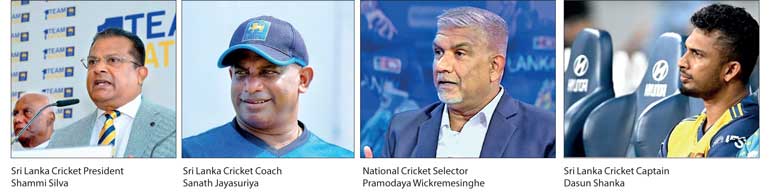

Dasun Shanaka did something rare in the aftermath of Sri Lanka’s T20 World Cup exit. He spoke the truth — unfiltered, uncomfortable, and personal. “Cricket is beyond skills,” he said, in effect, when he appealed for protection of his players from the wave of public negativity that followed. “It is about thoughts, feelings and belief.”
He is right. And for that honesty, in a culture that rarely rewards it from sportspeople, he deserves genuine credit.
But here is the problem with honest words from a captain when the institution above him remains silent, and largely unchanged: they fill the room briefly, then fade. They generate headlines for a news cycle, then disappear. They make the captain look thoughtful — and leave everything else exactly as it was.
Because the real crisis in Sri Lanka cricket is not the noise from outside. It is the silence — and the inertia — from above.
The brand nobody is managing
Let us begin with a number. Global cricket is now a $3.84 billion industry, projected to grow to $4.21 billion by 2029. The Business of Cricket: Global Revenue Analysis by Country (2025) | by BestReads | MyCricket | Medium) The IPL alone carries a brand valuation exceeding $18 billion. Even Zimbabwe Cricket — Zimbabwe — has built an institutional net worth of $38 million through disciplined financial management, surpassing boards from countries with far longer traditions in the game.
Sri Lanka Cricket’s net worth sits at approximately $20 million. The lowest among Asian boards. This, despite the fact that Sri Lanka recorded a record net surplus of Rs. 6.3 billion in 2022, with total income of Rs. 17.5 billion. ( Cricket Market Analysis 2026, Market Size, Share, Growth, CAGR, Forecast, Trends, Revenue, Industry Experts, Consultation, Online/Offline Surveys, Syndicate Reports) The money flows in. The structural investment in the game — in domestic cricket, in grassroots development, in the long pipeline of future talent — has not kept pace.
 The financial picture, stark as it is, tells only part of the story. The deeper issue is this: cricket is not just a sport in Sri Lanka. It is perhaps the single most recognisable Sri Lankan brand in the world. More globally visible than any product, any company, any institution this country has. When Sri Lanka plays, the nation watches. Hotels fill. Restaurants put up screens. The diaspora from Melbourne to Manchester stays up past midnight. Productivity measurably drops. That is not sport in the ordinary sense. That is a national institution, a reservoir of collective hope, and an economic and cultural asset of staggering potential.
Brands of that magnitude are not managed by sentiment alone. They require governance, strategy, Clear leadership, and above all, accountability from those entrusted to steward them.
Sri Lanka Cricket has not consistently had that. And until it does, no captain — however courageous, however emotionally intelligent — can compensate.
The scoreboard nobody is reading aloud
Look at what happened in this T20 World Cup with clear eyes.
Sri Lanka beat Australia — a genuinely remarkable performance. They reduced England to under 150. These are not the results of a broken team. This is a squad with real quality, real firepower, real potential.And yet, they were bowled out for 90 in the same match. They lost to Zimbabwe. They watched New Zealand crawl to 86 for 6 — six wickets down, a chase seemingly in hand — and then saw the Kiwis end up past 160. The bowling dissolved. The composure cracked. What should have been a famous victory became another chapter in a familiar story.
What does it mean when a team can dismantle the world champions( Australia) one day and collapse against a lower-ranked side ( Zimbabwe) the next? It means the problem is not talent. It is not a skill in the narrow technical sense. It is exactly what Shanaka said: thoughts, feelings, and beliefs. It is also the structure, physical and mental preparation. The environment in which talent is developed, managed, and — critically — sustained under pressure.
Since 2019, Sri Lanka has participated in five World Cups — two 50-over editions and three T20 tournaments — and has suffered first-round exits in every single one. The team currently ranks sixth in Tests, sixth in ODIs, and eighth in T20 internationals. These are not the rankings of a nation that once changed the way limited over cricket was played. And yet, the leadership of the institution that governs this team has remained, to an extraordinary degree, unchanged.
Every time results like these arrive, the same conversations follow. A new coach is appointed. A selection committee is reshuffled. A captain is changed. A mental conditioning specialist is brought in. The public vents, the Board issues a statement, and the cycle begins again.
But here is the question that cuts through all of it: are we treating the symptoms and not the disease?
Because if the disease is structural — if it lives in the governance, in the absence of real managerial architecture, in the entrenchment of leadership that faces no competitive accountability — then no amount of coaching changes or selection tinkering will cure it. You can prescribe the best medicine in the world. If the patient keeps doing what made them sick, the symptoms will keep returning.
The diagnosis has to be honest. And the honest diagnosis points not to the dressing room, but to the boardroom.
A Manager is not a coach — and Sri Lanka has confused the two
Here is a distinction that Sri Lanka cricket has blurred dangerously, and it is costing the team in ways that the selection debates and batting order conversations never quite capture.
A coach works on skills. A batting coach refines technique. A bowling coach analyses dismissals. A fielding coach sharpens reflexes. These are indispensable functions. But a manager runs the team — the whole environment. The culture. The stakeholder relationships. The welfare of players who are struggling. The bridge between the dressing room, the field and the Board. The structure within which coaches can do their best work.
These are not the same job. They require different skills. And for much of its recent history, Sri Lanka cricket has either conflated these roles or left one of them functionally vacant.
In the great eras of Sri Lankan cricket, there was a team manager — a figure who handled the human architecture of the touring party, who navigated the off-field dynamics that inevitably shape on-field performance, who allowed the captain and coach to focus on cricket. That role has been progressively diluted. The result is a vacuum — a dressing room with technical guidance but lacking the managerial structure that converts talent into consistent performance.
Crucially, a great manager does not need to have been a great cricketer. What this role demands is people skills, emotional intelligence, and the ability to create sustainable synergy between individuals with different temperaments, motivations, and pressures. These are leadership qualities, not batting averages.
Look at what Michael Carrick has done at Manchester United in the recent months – he is not the coach but the acting manager. Here is a man who, as a player, was a fine but rarely spectacular footballer — known more for composure and intelligence than headline statistics. He took over a Championship club that was struggling, with the same players, the same budget, broadly the same resources. What changed was the management: the clarity of roles, the culture of the dressing room, the way players were made to feel trusted and prepared. The results were sensational. Not because new talent arrived, but because existing talent was finally placed in an environment where it could unleash its potential and consistently perform.
Sri Lanka does not need to discover new cricketers to become competitive again. It needs to build the managerial architecture that allows the cricketers it already has — the ones who beat Australia — to perform like that every week, not occasionally.
The leadership deficit — Starting from the very top
This brings us to the most uncomfortable part of this conversation. The part that the post-tournament press conferences never quite reach. The leadership deficit in Sri Lanka cricket does not begin with Dasun Shanaka. It begins with the Sri Lanka Cricket Board.
And to understand just how deeply entrenched that Board has become, consider what happened in November 2023 — one of the most extraordinary episodes in Sri Lankan sporting governance.
Following another World Cup humiliation — bowled out for 55 against India — Sports Minister Roshan Ranasinghe had had enough. He dissolved the entire SLC Board, called its members “traitorous and corrupt,” and installed a seven-member interim committee headed by Arjuna Ranatunga. His case was not without foundation: he cited audit reports, accusations of financial misappropriation, and years of declining results. Here, at last, appeared to be a moment of accountability.
What followed was a masterclass in institutional self-preservation. Within 24 hours, the SLC President had obtained a court order suspending the interim committee. The courts ruled the minister’s dissolution of the Board “unlawful” and “procedurally flawed.” The Board was reinstated. The ICC, meanwhile, suspended SLC for government interference — an outcome that, in a remarkable twist, using the ICC suspension as a weapon to pressure the minister. Sri Lanka lost its hosting rights for the Under-19 World Cup — millions in revenue, a developmental showcase gone — as collateral damage in a boardroom power struggle.
The final act was almost Shakespearean. The Sports Minister stood in Parliament and said: “I have told the President to remove me from the ministry.” The President obliged — Ranasinghe was stripped not just of the Sports portfolio but of his other ministerial roles as well. Gone.
The Cricket Board remained. The Cricket Board president remained. Uncontested, in every sense of the word.
This is not a story about who was right and who was wrong in that particular dispute — Ranasinghe’s own conduct was far from reproach, and installing politicians’ sons on a cricket interim committee was not a serious reform. The point is what the episode revealed about power. The Sports Minister who tried to hold SLC accountable lost his job. The Board that had presided over five successive World Cup exits, an ICC suspension, and years of declining standards kept its position.
That is not institutional resilience. That is institutional imperviousness. And imperviousness is the enemy of change. And the response to all of this? Shammi Silva has since been re-elected for a fourth consecutive term — uncontested, the third time he has faced no opposition at an election. The Board’s key office bearers returned, also without contest. Only one new face sits in the executive committee.
There is a word for governance structures where elections produce no challengers, where the same individuals cycle through roles across years, where changes to the rules of tenure are engineered to extend the stay of incumbents rather than renew the institution. That word is entrenchment. And entrenchment is the enemy of the fresh thinking that any struggling brand desperately needs.
The question of term limits for the SLC president is not a procedural nicety — it is a fundamental question of institutional health. Should a national Cricket Board be run indefinitely by the same president, without a genuine democratic contest, without a competitive election of ideas? The most successful sporting institutions in the world build succession into their governance DNA. They understand that no single leader, however capable, should become irreplaceable. Because irreplaceability is not strength. It is fragility disguised as stability.
Are Cricket Board elections politicised? Look at who votes, who controls the club affiliations that make up the electoral base, and who benefits from maintaining the status quo — and draw your own conclusions. What is clear is that the current structure has not produced the accountability that results demand. Constitutional reform that streamlines the voting bloc while leaving the same leadership in place indefinitely is rearranging the furniture without addressing the structural cracks in the walls.
Stakeholder expectations and the accountability gap
There is another word conspicuously absent from the public narrative around Sri Lanka cricket: Accountability.
Accountability to the fans who fund this sport through tickets, merchandise, and the taxes that build and maintain facilities. Accountability to the sponsors who invest in the brand. Accountability to the government — of whatever political stripe — that implicitly backs the institution with its endorsement. Accountability to the thousands of young cricketers across this country, from Galle to Jaffna, who dream of wearing the lion on their chest.
Shanaka’s appeal for “government intervention” to protect players from public criticism is well-intentioned and speaks to a real problem. The personal abuse directed at players — the kind that targets families, that wishes harm on individuals who gave years of their lives to representing this nation — that is not passion. It is cruelty in fandom’s clothing, and it has no place in this conversation.
But the answer to toxic public discourse is not government censorship of how citizens discuss their cricket team. It is institutional trust. And institutional trust is earned through transparency, through honest communication about what is happening and why, and above all, through results that give frustrated fans something to celebrate rather than something to rage about.
The fans who are loudest in their criticism are, in their own imperfect way, stakeholders registering their dissatisfaction. The right response from a well-governed institution is not to silence that dissatisfaction but to address its root causes. That means being honest about selection philosophy. About the domestic cricket pipeline. About whether the coaching structure is right. About what the realistic path looks like from where Sri Lanka is now to where it needs to be.
Fans who feel informed and respected are more patient. Fans who watch losses pile up without explanation, who see the same faces making the same decisions year after year, default to frustration — and sometimes to toxicity. The Board cannot demand civility from the public while refusing accountability to it.
What the custodians of a national brand owe this country
Sri Lanka cricket’s heritage is extraordinary. The 1996 World Cup remains one of the most astonishing achievements in the history of the sport. A small island nation, with modest resources, led by a captain who played chess while others played draughts, and backed by players who dared to change the game forever. The 2014 T20 World Cup was built on the same foundations: fearless cricket, collective belief, and a culture where every player knew their role.
What made those teams great was not just extraordinary individual talent — though they had that too. It was a specific kind of institutional alignment: a management structure, however imperfect, that created the conditions for excellence. A culture of purpose. A shared belief that Sri Lanka belonged at the very top table of world cricket.
Rebuilding that is possible. The talent has not disappeared from this island. The passion of the public — for all its noise and frustration — has not gone anywhere either. The foundation is there. But the rebuilding has to start where every serious rebuilding starts: at the top. Not with a new batting coach or a new middle-order selection. Not with appeals to the government to manage public opinion. It starts with a Cricket Board that treats itself as the custodian of a national brand and a national sentiment — and governs accordingly.
That means professional management, not just election winners. It means a genuine team manager alongside the coaching staff — someone with people skills and emotional intelligence, not necessarily a former Test player. It means term limits that bring in fresh thinking rather than entrenching familiar power. It means transparent communication with stakeholders at every level. And it means a willingness to ask, honestly and without defensiveness: are the people leading this institution producing the results that Sri Lanka’s cricket legacy demands?
A final word
Dasun Shanaka stood in front of the cameras after a painful defeat and told the truth: cricket is not just about skills. It is about thoughts, feelings and belief. He said it knowing it would be interpreted as excuse-making by some. He said it anyway.
For that, he deserves respect.
But the truest measure of leadership — at every level, including the boardroom — is not what is said after defeat. It is what is built in the time that follows. Sri Lanka cricket has the talent, the history, and — if Shanaka is right — the emotional intelligence within its dressing room to be something special again.
The question is whether the people above that dressing room have the courage to match the honesty of the man standing in front of the microphone.
The Sri Lankan public is not asking for perfection. It is asking for accountability. For genuine leadership. For a Board that understands it does not own Sri Lanka cricket — it is merely entrusted with it, on behalf of a nation that loves this game with a depth that deserves far better than what it has been given.
The change has to start at the top. Not next year. Not after the next election. Now.
(The author with MBA Sri J; FIB; is a former senior banker, educationist, transformation strategist, and certified coach with extensive experience in both public and private sector leadership. He has served on the boards of state and private institutions and was formerly Chief Operating Officer of a Public-Private Partnership unit, bringing a unique perspective on governance, institutional reform, and economic development in Sri Lanka)



