Sunday Sep 13, 2026
Sunday Sep 13, 2026
Monday, 9 February 2026 01:00 - - {{hitsCtrl.values.hits}}
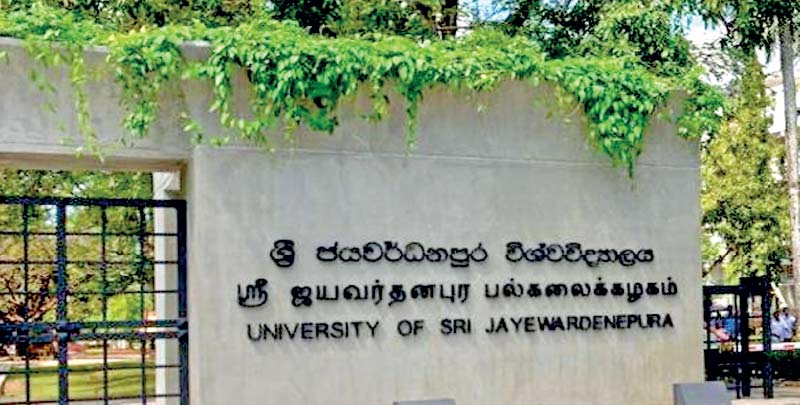
 Sri Jayewardenepura University Founding Vice Chancellor, Rev. Welivitiye Sri Soratha Thero once said: “If our graduates are not proven with the expected intellectualism that their degree claims them to possess, people will indubitably arrive at the conclusion that our university is a ‘store’ where degrees are ‘sold’. Thus, everybody affiliated to the University should keep in mind not to engage in any act that will undermine the quality of our degrees and research work
 Education: bridging tradition and modernity
On this occasion of the issue of the Classic’25 magazine by the Association of Public Administration of the University of Sri Jayewardenepura, I will use the opportunity to discuss the need for introducing wider reforms to the country’s educational system. It was the editors of Classic’25 who paved the path for me to do so. Writing an explanatory note [ ] on the cover page of the magazine, the editors have declared that education is the best bridge to the city, implying ‘city’ as the future and ‘non-city’ as the place where we are now in.
There is a suspension bridge which has cracked in the middle and beneath the bridge, there is a deep dark ravine threatening to perish anyone who falls into it. Two people are standing on either side of the cracked bridge unsure of how they should cross it safely. Say the editors: “At the edge of a deep divide stand two worlds: one rooted in tradition, simplicity, and inherited wisdom; the other driven by innovation, technology, and rapid progress”.
The fragile bridge symbolises the challenge confronting modern education: how to connect two sides where separation seems inevitable. The connection comes from knowledge, represented by an open book which is the main instrument used by someone wishing to acquire knowledge.
The editors say that knowledge is the strongest force capable of uniting generations, cultures, and time periods. According to them, education is not merely a path to success, but a bridge that transforms uncertainty into opportunity and diversity into strength. Classic’25 is a platform for students to walk into the modern world ahead, while upholding the values they have learned in the traditional world. Education is at the core of this exercise because it teaches them to balance their approach, inculcates critical thinking in them, and make them responsible citizens. The editors conclude: “As we move forward, we may remember that no matter how advanced the world becomes, it is education that holds us together and leads us safely across every divide”.
Wisdom of Rev. Welivitiye Sri Soratha
In my view, this is an exemplary expression of wisdom. However, it applies not merely to learners in schools or universities but to all of us across all walks of life holding diverse social or professional statuses. It should also not be new wisdom for a university of which the founding Vice Chancellor, Rev. Welivitiye Sri Soratha Thero is said to have espoused the same wisdom as follows:
“It is our mission to present society with intellectual, and not merely to breed, graduates. If one endeavours to transform this sacred abode to a place where degrees are sold, or to a place in which students are given degrees in a mere mechanical fashion that will only lead the University as well as the country to be dragged into disgrace. If our graduates are not proven with the expected intellectualism that their degree claims them to possess, people will indubitably arrive at the conclusion that our University is a ‘store’ where degrees are ‘sold’. Thus, everybody affiliated to the University should keep in mind not to engage in any act that will undermine the quality of our degree and the research work.” [ ]
He has further elaborated on this when he has said that students should be radical (or challenging existing knowledge), but they should also work with intelligence [ ]. This wisdom can be abridged as that university students should not be mere learning machines but those guided by criticality in approach, exploratory in finding evidence, and challenging in assessing the extant wisdom. This has been embodied in the anthem of the university which is being played and sung at every formal function. It is this wisdom which is upheld as tradition in the university, and it applies to all educational institutions in Sri Lanka.
Education reforms should not be confined to school education. Since the purpose of education is to develop human capital to facilitate faster economic growth, all the subsectors that provide this service should be included in a holistic educational reform program. It is only through such a national effort that Sri Lanka could improve its human capital to facilitate the needed accelerated economic growth
Education, a holistic concept
There is a tendency to define education as an exercise pertaining to formal Governmental institutions like schools, universities, or technical colleges. Going by this tendency, the educational reform program proposed by the present Government confines itself only to school education [ ]. However, it has an expansive vision planning to nurture ethical, socially responsible, innovative, and lifelong learners through school education [ ]. It has further elaborated its vision by stipulating that those lifelong learners should strive for equality, inclusivity, peace, prosperity, justice, sustainability, and global citizenship. These are laudable goals but cannot be achieved only through school education. While school education will help Sri Lanka to attain these goals, it alone is not sufficient. That is because education is the development of members of a society to facilitate its continuous advancement by equipping them with the necessary skills, creativity, inventiveness, and innovativeness. It is a process that should start from the womb and end in the tomb.
Education is being provided to society’s members in three different ways [ ]. One is through formal institutions like schools, universities, and technical colleges owned and operated by the State as well as the private sector. These institutions have structured courses and learners are recognised by assessment of learning and awarding certificates. The second method is through non-formal institutions, still with structured courses but not leading to formal assessment and certification. The third is informal education that provides an opportunity to learn from society at large on a continuous basis from families, friends, or other members of society. In this third method, there are no formal courses, but it is as effective as the other two categories. Present day, this informal education is being provided widely by social media. The outcome of these three methods is the development of worthy human capital, known formally as human resource development.
Government Finance Statistics Manual
The financing of human resource development is done by both the Government and the private sector entities that include individuals. The Government does so by taxing people, or borrowing money, or simply by printing money to finance the budget. Private sector entities and individuals do so out of their earnings. The total investment in human resource development is the sum of the expenditure by both these sectors. The investment of Government in education is usually taken as synonymous with the total allocated in the Budget to Ministries of education and higher education. This is a wrong calculation since the computation of the investment in education (also in healthcare) should be done by following the guidelines given in the Government Finance Statistics Manual or GFSM issued by the International Monetary Fund [ ]. In terms of these guidelines, the budget numbers should be represented in terms of the functions of the Government which produces a specific data table titled: ‘Functional classification of Government expenses’ [ ]. Education, healthcare, and environmental protection are some of the functions performed by the Government through budgetary expenses.
The Buddha has identified five essential qualities a Bhikku intending to illuminate his monastery should possess [ ] which can be applied to contemporary education reforms. According to this wisdom of the Buddha, a good learning Bhikku should learn many Dhamma, understand and remember that Dhamma, continuously reflect on that Dhamma, develop the ability to relate that Dhamma in his own words to another, and see beyond that Dhamma
Compatibility with other macroeconomic manuals
This statistical format serves two purposes. It enables the international comparison of Governmental expenses since they are recorded by following a standard methodology. For instance, Government expenditure on education in Sri Lanka is comparable with that in India or any other country because all countries adhere to the same standards. The second purpose served by this statistical format is that within the economy, the public finance numbers are compatible with other macro numbers like the computation of the national accounts that produce growth rates, gross domestic product, and other computations involved. The guidelines for computing national accounts have been issued by the United Nations in the form of a manual titled ‘System of National Accounts’, commonly known as SNA. The presently used manual has been issued in 2008, and the IMF has updated its GFSM to be compatible with this edition. SNA has been revised in 2025 and is expected to be issued in 2026 and the IMF is presently updating its GFSM to be in line with the forthcoming edition of SNA.
Two types of expenditure on education
According to GFSM, Government expenditure on education includes two types [ ]: One is the expenditure incurred for providing services to individual pupils and students. This covers payment of salaries to teachers, expenses involving the provision of learning materials like textbooks, laboratory materials, ancillary expenses like the provision of uniforms, and scholarships granted to pupils and students to enable learning in formal institutions and so on. In the case of university and technical college students, the Mahapola scholarship grants which are financed outside the Budget of the central Government also come under expenses incurred for education. Students comprise all types of learners including Government servants, private sector employees trained at the expense of the Government, and senior citizens who are facilitated by the Government to improve their working skills.
The second type of educational expenditure covers services which are enjoyed by pupils and students on a collective basis. These expenses include the costs of conducting examinations to assess the learning of pupils and students, money allocated for curriculum development, and quality assurance etc. Thus, the educational expenditure in the Budgetary numbers include all direct and collective expenses incurred by the Government to educate, train, retrain, and develop skills of all citizens. Contrary to what is popularly believed, they do not confine themselves only to education provided by organised institutions like schools, universities, vocational training institutions, and technical colleges. According to this definition, money spent for providing various services to those in the education ministry or administrative units of a university, such as purchase of a laptop or vehicle is not included as educational expenditure since that spending does not benefit pupils or students to improve their learning. Such expenditure is therefore included in the general administration of the categorisation of the Budget by functions.
Private expenditure on education
In addition to the Government, the private sector also incurs expenditure to acquire knowledge. For instance, private schools or private universities also incur expenditure which directly benefit their students. In addition, parents incur tuition payments to help students advance their knowledge. From a national point, such private expenditure should also be included in society’s investment in education. Accordingly, in SNA, investment in education by society is the sum total of such expenditure that directly benefits pupils and students and are incurred by both the Government and private sector.
The principles preached by the Buddha some 2500 years ago are equally relevant and valid to us today. Without building these principles into the core of the educational reforms, no country can develop the creative human capital for accelerating economic advancement
Reforms should address broad educational issues
Educational reforms should not be confined to school education. Since the purpose of education is to develop human capital to facilitate faster economic growth, all the subsectors that provide this service should be included in a holistic educational reform program. It is only through such a national effort that Sri Lanka could improve its human capital to facilitate the needed accelerated economic growth.
A good learner according to the Buddha
Educational reforms covering all those who desire to acquire new knowledge should produce good learners. The Buddha has identified five essential qualities of which a Bhikku intending to illuminate his monastery should possess [ ]. According to this wisdom of the Buddha, a good learning Bhikku should learn many Dhamma, understand and remember that Dhamma, continuously reflect on that Dhamma, develop the ability to relate that Dhamma in his own words to another, and see beyond that Dhamma. These principles preached by the Buddha some 2500 years ago are equally relevant and valid to us today. Without building these principles into the core of the educational reforms, no country can develop the creative human capital for accelerating economic advancement.
A laudable attempt
In my view, Classic’25 has attempted to fill some of the gaps in present-day learning which we observe. To cross-fertilise the minds of its readers, the editors have included several guest articles on the subject relevant to modern public administration from academics at the Kabianga University in Kenya, University of Colombo, and the University of Kelaniya. However, the articles and creative work in Tamil should have been supported by at least synopses in English to facilitate non-Tamil readers to understand the contexts in such work. My overall assessment is that Classic’25 is a commendable exercise by the students of the University of Sri Jayewardenepura.
(The writer, a former Deputy Governor of the Central Bank of Sri Lanka, can be reached at [email protected] )




