Sunday Sep 13, 2026
Sunday Sep 13, 2026
Friday, 10 July 2026 00:24 - - {{hitsCtrl.values.hits}}
 SME ecosystem creation is an art by understanding the scientific realities
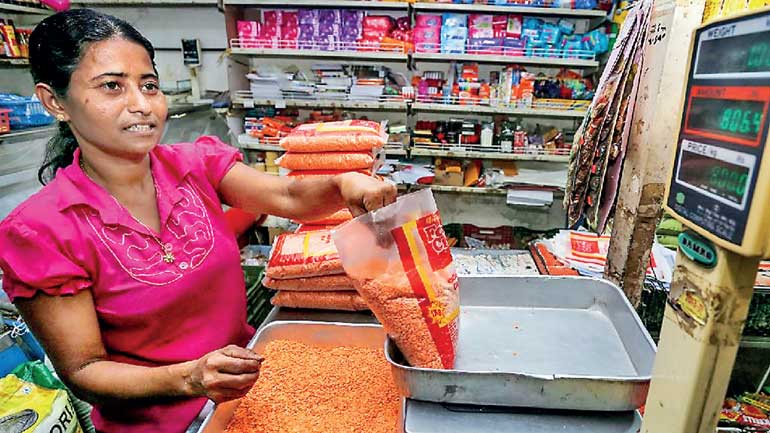
Sri Lanka is a country that in the last 70 years received the facilitation of the World Bank, Asian Development and many other multilateral financial institutions to build an empowering banking and finance landscape to create a thriving SME entrepreneur ecosystem in Sri Lanka. The reality is thanks to solid Central Bank of Sri Lanka regulatory mechanism, we have a strong and vibrant banking and finance landscape solidly built in Sri Lanka, however we cannot say Sri Lanka have a strong and sustainable SME entrepreneur ecosystem in Sri Lanka that is enriching the diversity of economic initiatives across the country, but a struggling, lackluster and marginalised SME entrepreneur community.
In the journey mapping of any entrepreneur and enterprise, micro, small, medium and commercial, need to showcase the DNA of the enterprise and it is unquestionable the DNA need to reveal three most relevant essences, firstly the Commercial Viability in the short, mid and the long term, secondly scalability of the enterprise in the short, mid and the long term, thirdly and finally is sustainability and succession planning in the short, mid and the long term. Even if you take the global measure of journey mapping of entrepreneurs, short term could be one to five years, mid could be five to twenty years and the long is twenty five years and beyond.
If we take a very clear snapshot of the SME entrepreneur ecosystem in the last 100, years, though we very proudly boast as the engine of the economic growth and the largest employer, there is no way we can the state country’s economic transformation is driven by a thriving SME Industry, this is despite much support facilitated by multilateral agencies like, World Bank, Asian Development Bank and other international facilitators under the direction Central Bank of Sri Lanka (CBSL) for creating access to banking and finance by the commercial banking network in the country in the last 70 years.
Sri Lanka SME community fall short of journey mapping of commercial viability, enterprise scalability, business sustainability and succession planning
There are numerous engagements time to time, through government mechanisms connected various key departments such, industries development boards, but what we have witnessed in the last few decades there have been only bits pieces and here and there, and time to time blow hot and blow cold nature of the engagements. Unfortunately, seeing the Big Picture and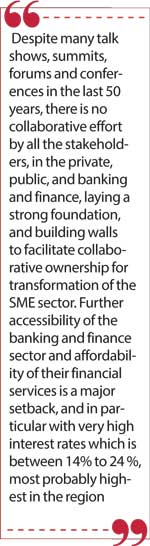 seeing Eye to Eye in creating a thriving Entrepreneur ecosystem, no one takes the responsibility with accountability to reach critical journey milestones to bring life, light and energy to genuinely empower Sri Lanka’s SME entrepreneur ecosystem.
Whilst recognising the all good work done by the banking and finance sector in creating access to banking and finance for the SME sector under the facilitation CBSL, results and the impact far below by any global or that matter South East Asian vibrancy of the SME industries. Despite many talk shows, summits, forums and conferences in the last 50 years, there is no collaborative effort by all the stakeholders, in the private, public, and banking and finance, laying a strong foundation, and building walls to facilitate collaborative ownership for transformation of the SME sector. Further accessibility of the banking and finance sector and affordability of their financial services is a major setback, and in particular with very high interest rates which is between 14% to 24 %, most probably highest in the region.
SMEs themselves have to take the major responsibility to for their predicament, mainly with a tunnel vision, they are trying to steer their SMEs to development and growth on one trajectory which has created major challenges in the product refinement , market development and employability of skill labor force are much needed to create greater commercial viability, scalability and sustainability. In the journey map of a serial entrepreneur, accessing, measuring and creating timeliness of commercial viability in the mid and the long term, entrepreneur scalability, mid and long term and sustainability and succession planning in the mid and the long term is an absolute necessity. Investment in research, development and innovation is key to create SMEs to graduate from small to medium and then commercial levels for commercial viability, scalability and sustainability from small to mid, and then into commercial level. An investment in the research, development and innovation cannot be driven through bank loans or finance or self-finance but needs the engagement and the inflow of patience and responsible capital with a ten year time horizon. Sri Lankan SMEs need to understand the value and importance of equity investor capital flowing into their enterprise, journey firstly private equity, then on maturity stage walk towards the public listing. It's pathetically disappointing that in the last fifty years not even a handful, but less than five SMEs, have gone toward initial public listing.
Those who put food on the table are not on the talk shows
One of the banking giants I have had the privilege of working under very closely is Rienzie Wijethilake, a legendary banker who was the managing director and later Chairman who made several initiatives for the country’s SME sector development through HNB ( Hatton National Bank). I join the HNB in the year 1990, and HNB had only 22 branches, Reinzie Wijethilake had ten year vision for the bank and for the country, when I retired in 2013, HNB reached 250 branches, I was responsible for branch network management, retail and development banking, whilst I was the Deputy General Manager, carried the vision of Rienzie Wijethileke into execution along with my other colleagues in the corporate management of the bank for nearly 25 years. This was the most enriching time in my corporate career, travelling across the whole country in facilitating and empowering over 200,000 entrepreneurs in the micro, small and medium space. During this period I have witnessed the struggles and tribulations of the Sri Lankan MSME sector go through.
One of the pioneering initiatives, I wanted to the pursue as the next stage of my corporate life was to embark of on creating a platform for ‘access to private equity for the MSME sector’, that is where I pioneered and co-founded a TV reality show with a friend of mine, got around twenty high net worth corporate leaders in the country to partner and collaborate with me for the launching the first ever TV reality show for social entrepreneurs and impact investors. The program ran for two seasons on Independent Television Network (ITN) under the brand name, ‘Ath Pavura’ (Wall of Tuskers). This program became the best business program in Sri Lanka conducted on a TV network, and for the very first time in the country a trailblazing initiative to create access to private equity infusion to power entrepreneurship was innovated, created and launched very successfully. Nearly 200 entrepreneurs across the country were made ready for equity investment, out of which nearly 50 entrepreneurs received investments as equity. This program was greatly appreciated and received many local and international recognitions, unfortunately we had to put the program on hold due to Covid-19 two years and thereafter the economic setback faced by the country.
Creating dynamic SME ecosystem and building impact investment landscape for Sri Lanka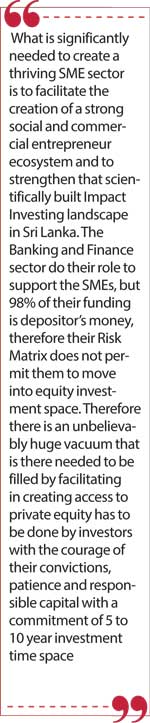
What is significantly needed to create a thriving SME sector is to facilitate the creation of a strong social and commercial entrepreneur ecosystem and to strengthen that scientifically built Impact Investing landscape in Sri Lanka. The Banking and Finance sector do their role to support the SMEs, but 98% of their funding is depositor’s money, therefore their Risk Matrix does not permit them to move into equity investment space. Therefore there is an unbelievably huge vacuum that is there needed to be filled by facilitating in creating access to private equity has to be done by investors with the courage of their convictions, patience and responsible capital with a commitment of 5 to 10 year investment time space.
Lanka Impact Investing Network (LIIN) which I founded ten years ago not only launched the first TV Reality program for the country connecting entrepreneurs to investors , in the last ten years done many initiatives, engagement and ecosystem creation with multiple international partners, LIIN is pioneering the creation of the first ever ‘Impact Investing fund ‘to facilitate equity investment on SME entrepreneurs across the country. LIIN will be embarking on one of the biggest initiatives in Sri Lanka and South Asia called ‘On Eagle’s Wing - A reality show in all three languages as a key platform for creating access to private equity to MSMEs. LIIN is now connected to Global Steering Group Impact Investing (GSG Impact Global) , the largest impact investor network and is well poised to facilitate global impact investors to put their foot holds in Sri Lanka. Unlike many others who only promise good days are ahead, LIIN has put food on the table.
Vision to power Sri Lanka’s SME ecosystem hugely now depends on mapping the journey of the entrepreneurs for scientific transformation of SME to commercial viability in the short, mid and the long term. Secondly, enterprise scalability in the short, mid and long term and finally enterprise sustainability and succession planning in short, mid and long term. Building a mechanism, a structure and environment to flow impact capital and diversity of shapes and sizes is the way to walk and not just SME talk shows.
(The author is a senior commercial banker, with global expertise in the retail and development banking, financial inclusion, social entrepreneurship and impact investing and Founder and Chairman of Lanka Impact Investing Network, Co-Founder of ‘Athpavura’ reality show, and founder of ‘On Eagle’s Wing’ reality show)




