Monday Oct 12, 2026
Monday Oct 12, 2026
Monday, 12 October 2026 03:03 - - {{hitsCtrl.values.hits}}
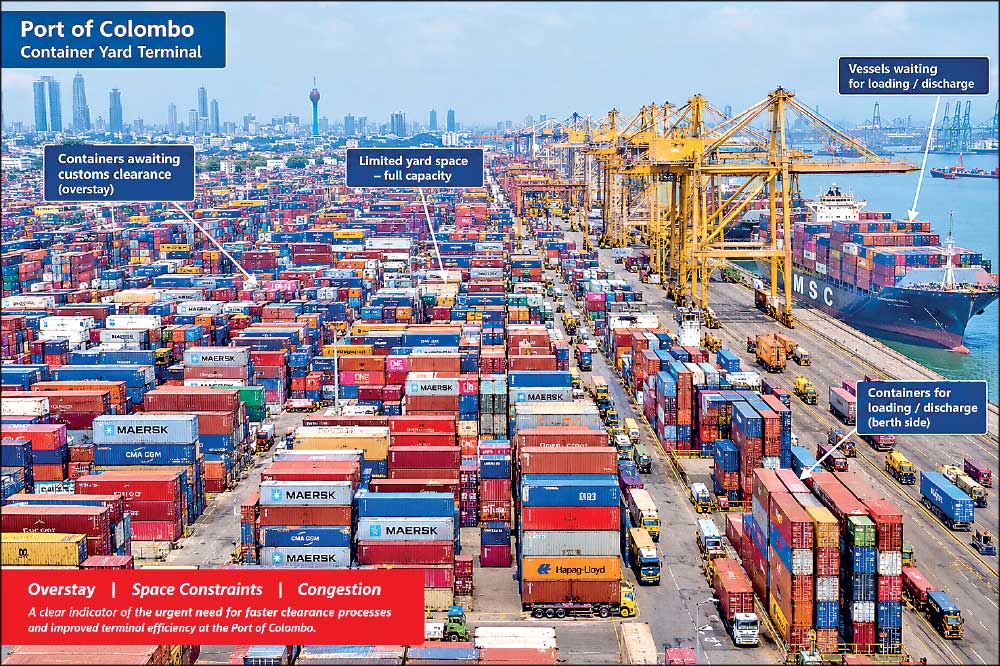
 Every avoidable day that cargo remains uncleared imposes costs on businesses, ties up capital, disrupts production and risks undermining investor confidence. The Government must treat container dwell time as a national competitiveness emergency—not simply a port congestion issue. The question is no longer whether Sri Lanka can afford to reform its container clearance ecosystem. It is whether Sri Lanka can afford to delay that reform any longer
 Time lost at the port is money lost to the economy
Container dwell time—the time a container remains within a port before being collected for import or loaded onto a vessel for export—is a critical measure of a country's trade efficiency.
It directly affects the cost of importing raw materials, manufacturing, exporting finished goods, maintaining supply chains and attracting foreign direct investment (FDI).
Sri Lanka cannot credibly aspire to become a leading regional logistics hub while importers, exporters and manufacturers face prolonged, unpredictable cargo clearance.
The critical issue is not simply how quickly a ship is unloaded. It is how quickly cargo moves through the entire clearance ecosystem—from documentation and regulatory approvals to Customs release, payment, scanning and physical evacuation.
What the India comparison tells policymakers
Published comparative data cited by JM Financial in September 2025, drawing on World Bank figures, reported the following median port dwell times:
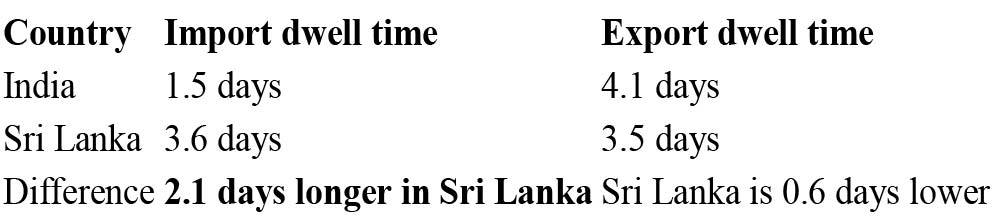
Current Port of Colombo Import Container dwell time is 7 days.
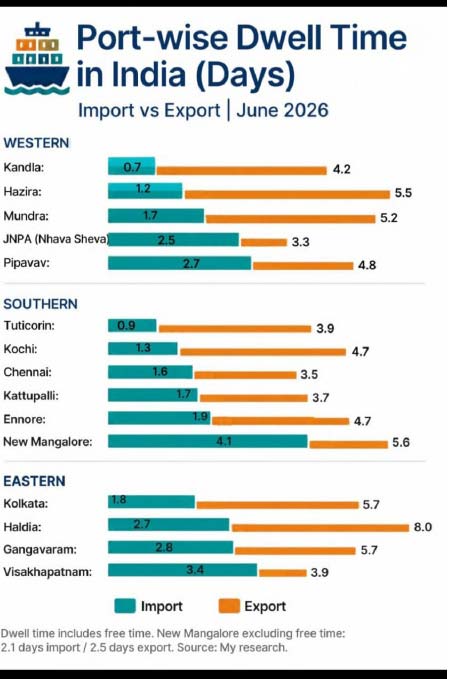
These figures are a useful warning, not a definitive like-for-like performance audit. The precise definitions, reporting periods and measurement methodologies must be verified against the attached India chart and corresponding Sri Lankan data before final publication.
Nevertheless, the comparison highlights an important policy question: Why should businesses operating through Sri Lanka have to accommodate substantially longer import dwell times than those reported for India?
Sri Lanka must benchmark itself against competing trade and manufacturing locations, not merely against its own historical performance.
 How excessive dwell time damages investment and exports
Investment decisions: Investors assess total operating costs, delivery reliability, working-capital requirements and the predictability of supply chains. Uncertain clearance times weaken Sri Lanka's investment proposition, particularly for export manufacturing, logistics, distribution and time-sensitive industries.
Manufacturing and employment: When imported machinery, components, fabric or raw materials are held up, production schedules are disrupted. This can lead to idle factories, missed export deadlines, overtime costs and reduced confidence among international buyers.
Higher costs and weaker competitiveness: Prolonged dwell time exposes importers and exporters to additional storage, demurrage, detention, handling, transport and financing costs. These costs ultimately burden businesses and consumers and can make Sri Lankan exports less competitive.
Working capital trapped in the supply chain: Goods and inventory remain tied up for longer, increasing financing needs and reducing the funds available for investment, expansion and employment.
Regional hub ambitions at risk: Colombo's strategic location is an advantage, but geography alone cannot secure cargo, logistics investment or manufacturing activity. Operational speed, reliability and transparent procedures must support that advantage.
Investor confidence: Repeated delays, uncertain release times and the need for manual follow-ups create an impression of procedural risk. Investors can compare locations and choose jurisdictions where goods move more predictably.
The real problem is the entire clearance ecosystem
Container clearance depends on coordinated action by multiple parties:
Other Government Agencies → Customs → Customs House Agents → Banks and payment systems → Shipping lines and agents → Port terminals → Scanning facilities → Transporters and warehouses.
A delay at any one stage can hold up the entire chain.
Increasing yard capacity, adding equipment or creating additional container storage space may provide temporary relief, but these measures cannot permanently resolve congestion if declarations are not processed promptly, regulatory approvals are delayed, risk management is ineffective or cleared containers cannot be evacuated efficiently.
The policy priority must shift from merely creating more space to ensuring faster, predictable and accountable cargo movement.
Urgent policy measures required
1. Introduce measurable clearance-time standards. Establish clear service standards for Customs declaration processing, examination, release and other agency approvals. A proposed operational target could be a decision within 45 minutes for straightforward declarations, subject to appropriate risk and compliance controls.
2. Make pre-arrival processing effective. Allow documents and declarations to be processed before cargo arrival wherever legally and operationally possible, reducing avoidable delays after berthing.
3. Strengthen risk-based controls. Direct examination resources towards genuinely high-risk consignments, supported by reliable automated risk management, intelligence and post-clearance audit. Facilitate compliant traders without compromising revenue or border security.
4. Digitise the entire process—not just submission. Paperless declarations will deliver limited benefits if payments, regulatory approvals, appraising, examination orders and release remain delayed or dependent on manual intervention.
5. Establish end-to-end performance monitoring. Record time stamps for every stage, identify the responsible agency or process, and publish average and median dwell times, clearance times and delay categories regularly.
6. Coordinate all stakeholders under accountable leadership. Establish a high-level mechanism involving Customs, the Ports Authority, relevant government agencies, payment providers, shipping lines, terminals, clearing agents and transport operators, with defined responsibilities and escalation procedures.
7. Set national improvement targets. Benchmark Sri Lanka against Indian ports and other relevant regional competitors, then adopt phased, measurable targets for import and export dwell-time reduction.
The decision required from Government
Container dwell time must be elevated to a national economic priority, with direct oversight at Cabinet or an appropriately empowered national trade-facilitation level.
Government should require:
The program should begin immediately; the initial assessment must not become a reason to postpone corrective action.
Conclusion: Competitiveness is measured in time
Sri Lanka's ports are not merely gateways for moving containers. They are gateways to investment, industrial production, export growth, employment and national economic prosperity.
Every avoidable day that cargo remains uncleared imposes costs on businesses, ties up capital, disrupts production and risks undermining investor confidence.
The Government must treat container dwell time as a national competitiveness emergency—not simply a port congestion issue.
The objective must be clear: faster and predictable clearance, lower logistics costs, reliable supply chains and a more attractive environment for investment and export-led growth.
The question is no longer whether Sri Lanka can afford to reform its container clearance ecosystem. It is whether Sri Lanka can afford to delay that reform any longer.




