Sunday Sep 13, 2026
Sunday Sep 13, 2026
Saturday, 6 June 2026 01:00 - - {{hitsCtrl.values.hits}}
 The Central Bank of Sri Lanka (CBSL) suddenly increased interest rates a few days ago. This was to stop further depreciation of the rupee or to stabilise the exchange value of the rupee by containing private credit growth. Many writers, including the writer of this essay, have pointed out that excessive private credit growth could destabilise the managed exchange rate mechanism.
It has happened now. However, now it seems the obvious solution was to increase the interest rates, thinking that borrowers would respond by reducing borrowing. This policy action of CBSL was completely a reactive one. The country wants CBSL to make proactive policy decisions and take action based on unbiased economic forecasts. Just a few weeks ago, CBSL’s tone was completely different. To be exact, on 2 April 2026, Dr. Lasith Pathberiya, the Economic Research Director of CBSL, said: “interest rates are expected to ease, with private sector credit continuing to grow” ( 2 April 2026, Daily FT). It was a completely wrong signal to the market, lenders and borrowers. In regard to the IMF framework, this was not what they expected.
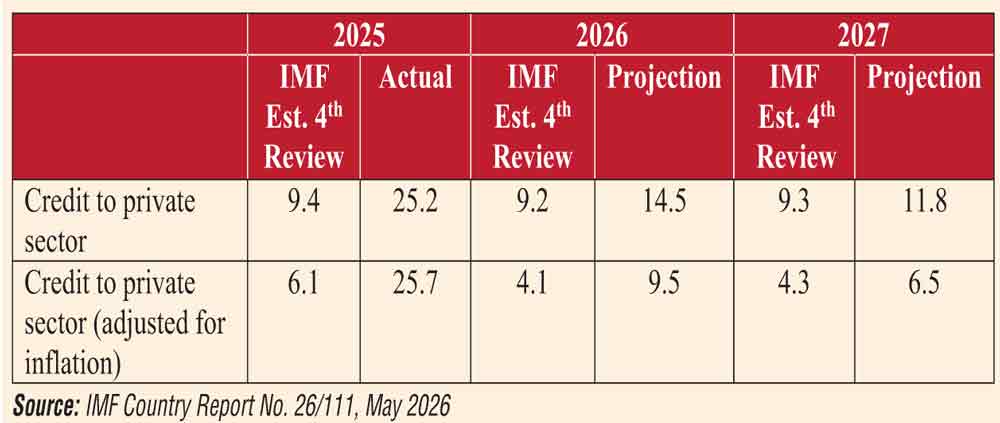
IMF’s fourth staff review insists that expected private credit growth should be as follows.
|
CBSL Governor
|
According to the IMF framework for the year 2025, private credit growth must not be exceeded over 9.4% of GDP. But actual data show that Private Credit Growth increased by 25% in 2025. IMF’s estimate for the year 2026 is 11%. But the same pattern was to continue for 2026 if the recent exchange rate crisis had not happened. It was an early warning. For the first quarter of 2026, private credit growth exceeded 20%. At the very beginning of the second quarter, on April 02, 2026 as mentioned above, the CBSL declared that interest rates would ease and private credit would continue to grow. This is a clear deviation from IMF framework.
We are not saying that Sri Lanka must strictly adhere to benchmark estimates of the IMF. Instead, we suggest that Sri Lanka deviate from those estimates only if the country can sustain those deviations positively and viably.
If CBSL wants to deviate from IMF framework, then it must create the necessary conditions to do it. This means that CBSL should have a clear idea of how much private credit growth it could tolerate deviating from IMF’s estimates without having no negative impact on the managed exchange rate mechanism. Without having such unbiased forecasts, allowing excessive private credit growth to rise until the country faces a real exchange rate crisis and uncertainty on the domestic currency is a monetary crime. As a remedy, the CBSL increased the rate of interest. Still, investors and markets are having real uncertainty.
 We are not saying that Sri Lanka must strictly adhere to benchmark estimates of the IMF. Instead, we suggest that Sri Lanka deviate from those estimates only if the country can sustain those deviations positively and viably. If CBSL wants to deviate from IMF framework, then it must create the necessary conditions to do it
Some economists look at one single variable to understand whether the country’s economy is growing. That variable is private credit growth. If private credit growth is increasing, it means the economy is growing. But increasing private credit growth could bring a negative impact on the national current account too, creating unnecessary pressure on dollar reserves and creating exchange rate instability. All these mean that, if the private credit growth is increasing without creating any instability on exchange rate, then we can be happy that the country is growing sustainably. It seems this was not what happened in the previous year and the first quarter of this year, even though the country recorded higher growth rates.
Therefore, the primary role of CBSL in regard to economic growth, no matter whether it is written in the CBSL Act or not, is to ensure optimum private credit growth while ensuring exchange rate stability. This is a challenging and necessary role, rather than increasing policy rates by a certain percentage.