Sunday Sep 13, 2026
Sunday Sep 13, 2026
Wednesday, 29 July 2026 00:26 - - {{hitsCtrl.values.hits}}
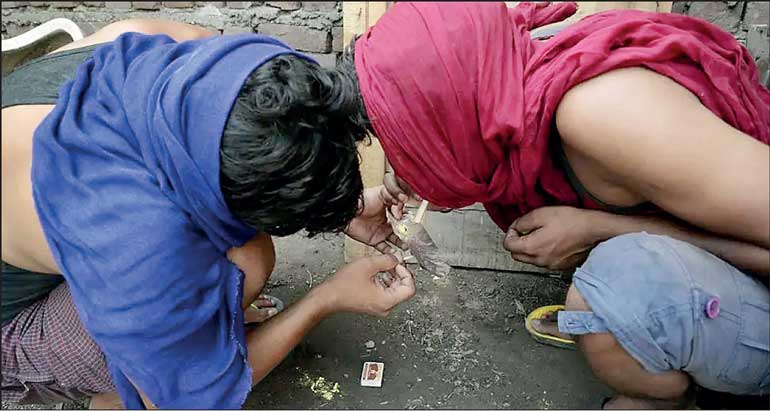
 Beginning of drug menace globally - 1970s
Main drugs during this era were Heroin, cocaine, weed, alcohol and some barbiturates. They were used more privately or in clubs.
They are basically plant based natural drugs unlike today where drugs are more man made. Hence they have become cheaper and available in large quantities. The modern industry doesn’t need fields. Just a lab and some barrels of chemicals would suffice its purpose.
Therefore, many of the drugs in the 1970s period were mostly Plant based and came from nature followed by a short production process.
1. Heroin from opium poppy. Farmed in Afghanistan, Mexico and the Golden Triangle.
2. Cocaine from coca leaf. Grown in South America.
3. Marijuana cannabis plant
Sri Lankan drug industry in the 1970s
In the 1970 s Sri Lanka was producing cannabis mainly for medical use. Traditionally we call it Ganja or weed. The production of ganja was not alarming. Cannabis together with opium and alcohol became the drug menace.
In the late 1970s heroin was introduced into Sri Lanka. With the liberalisation
of the economy in 1977 and a large influx of tourists were the main contributors that brought heroin into Sri Lanka. In addition to the tourists, the heroin found its way through a few routes of India , Pakistan and Afghanistan to some extent. With the police keeping a close monitor, the use of these drugs were hidden and confined to older males.
In the past, the Board of Investment (BOI) had approved a few projects for foreign investors to grow and cultivate cannabis for medicinal purposes. The entire production must be exported as stipulated by BOI. There were more restrictions and safeguards imposed by not only the BOI but also by other relevant authorities. The current status of these projects needs to be verified.
Sri Lankan drug industry in 2026
In the 1970s the drug industry was basically Plant based and hence the production was limited to the extent of the cultivation but when Heroin entered Sri Lanka in the late 1970s,it was the beginning of the dangerous gateway .
As of today Heroin together with ICE/meth now dominate. They have become Kingpins of our drug market. What was a couple of grams in the 1970s has now become thousands of kilograms with about half a million people affected and some addicted. While heroin still comes from Afghanistan and Pakistan ICE is produced in local labs as well. In 2024 /25 around 2000 kg of Heroin and another 4000 kg of ICE were seized by police and other authorities.
While cannabis and opium makes you feel high, Heroin makes you nod and sleepy. ICE makes you paranoid and aggressive and you have no sleep for days. Even school children are affected. Around 7500 school children under the age 21 years were arrested in 2025.
Alarming future
ICE has taken its roots : Looks like ICE has come here to stay in Sri Lanka.
How come drugs like Fentanyl and Xylazine have not yet entered the Sri Lankan drug trade and industry?
This is because the underworld is locked into heroin and ICE and hence the users. In fact Fentanyl is cheaper per dose than heroin. Xylazine is a veterinarian sedative used in cattle and horses in the USA. Hence the supply routes are different
Fentanyl and Xylazine if combined will be disastrous. This will create Zombies among drug addicts like what we see in the streets of LA and NY. They are truly drugged and remain like statues staring down for hours and hours.
Any product has a defined PLC (Product Life Cycle). The Sri Lankan industry fortunately or unfortunately is still holding onto Heroine/ICE PLC. This is due to the fact that this product comes from our neighbouring countries. Thus the distribution channels have become routine. But products like Fentanyl are produced to channel into the USA and hence belong to a different PLC class.
It is important for the Sri Lankan Government to take preventive measures now to combat its fight against ICE use in Sri Lanka while at the same time not permitting the emergence of a new PLC in terms of Fentanyl or Xylazine.
Our prisons are filled with these young drug addicts. Thousands of them are inside these cells and that exceeds the normal capacity of the cells. The recent violent fight among the inmates of the Negombo prison which saw almost 30 dead including a few jailers and hundreds hospitalised. The obvious assumption is that the majority were under the influence of drugs, though this assumption needs to be verified. If true, how does such a large volume of drugs get into the prison premises?
Almost all the successive Governments since recent times have given priority to combat this drug menace. However the initial momentum wanes off due to over congestion in our prisons. The recent decision to consider opening new prisons is a practical approach.
The recent extraordinary gazette notification declaring the former Mahamodara hospital premises in Galle as requisitioned for a prison is a good move in the right direction. There was yet another extraordinary gazette notification reinstating the old Bogambara Prison as a prison.
Where are we now here in Sri Lanka?
We are still at an infant stage as compared to organised drug gangsters
(mafia) in Cambodia and Brazil. The President Anura Kumara Dissanayake Government so far is doing a good job to squash this ring or rather rings. This timely action of the Government must succeed. This is a national catastrophe, crisis, and the support of not only the opposition parties but the entire nation is very much needed.
As at present, what is in active motion is the “Individual gangster model” dominated by some strong underworld figures such as Kehelbaddara Padme, Podi Lassie etc. With the AKD Government taking a more focused and tough stand, quite a many of them are now operating from countries like Dubai, Malaysia and even India. Each gangster has a couple of dozens of gunmen and also has had some influence on both the police and politicians but such protection has now fast diminishing under the AKD Government. There had been some targeted shootings and courtroom hits but no direct confrontation with police or army.
The AKD Government must prevent this Individual Gangster Model from becoming a “cartel “type organisation with links with the network syndicates in Cambodia when foreign funds become lavishly available to continue and expand their trade with Colombo becoming yet another transit station. This expanded network is deadly in terms of their access to run casino scam centres and other online scams. Such large syndicates will have the financial capacity to work with “officials” rather than fight with them
The Government can’t afford to become complacent in knocking down the individual gangsters. Though the Cambodian and the Brazil drug models (which are capable of creating a parallel state to fight against the legal Government) are a distant possibility and will not happen given the limited volume and size of our market. But if such cartels set eyes on Sri Lanka as a transit destination then the danger of it becoming a viable profit centre should not be ignored.
The Government cannot allow this individual gangster model to become too big with too much money and power and must also ensure that there is no forced political cover. Right now the Government is doing the right thing not only by arresting them, wherever they are, but also confiscating what they own as a business (the local ICE factory for instance) and all of their other businesses and properties. The focus of the Government is to break and disintegrate the network early with extraditions coupled with asset seizures.
While the USA battles a complex opioid and fentanyl epidemic, the Sri Lankan drug mafia is heavily concentrated on Ice due to specific regional advantages.
Conclusion
The war with drug cartels is not won easily. There is no science in fighting this deadly and dirty battle. Fighting becomes an art since it revolves around changing situations. When they become a strong cartel with overseas connections, they can even install a Government of their choice. Be aware.
(The writer is a former Deputy Director General of the Board of Investment of Sri Lanka)




