Sunday Sep 13, 2026
Sunday Sep 13, 2026
Monday, 1 June 2026 00:20 - - {{hitsCtrl.values.hits}}
 As global economies evolve, one of the strongest shifts is the rise of the experience economy: people increasingly spend on moments, memories and shared cultural experiences rather than only on products. At the centre of this shift is the concert economy, a fast-growing sector that combines live entertainment, tourism, culture, hospitality, media and commerce.
Live entertainment has moved beyond leisure. Global stadium tours, music festivals and immersive productions now influence travel patterns, shape city branding and generate measurable economic value. For Sri Lanka, this represents a timely opportunity. With the right policy direction, infrastructure and public-private alignment, the country can use live entertainment to attract high-value visitors, create employment, energise Colombo and strengthen Sri Lanka’s position as a modern, experience-led destination.
The global surge of live entertainment
The global live entertainment industry has become a multi-hundred-billion-dollar ecosystem, driven by consumers who prioritise experiences over possessions. According to Custom Market Insights, the global live entertainment market is projected to grow at a CAGR of 5.4% between 2025 and 2034, from an estimated $ 535.4 billion
in 2025 to $ 859 billion by 2034 (Global Live Entertainment Market Size, Share 2025 - 2034).
A major trend within this growth is event-driven travel. Audiences are increasingly willing to travel across cities and countries for concerts and festivals, creating a strong link between entertainment and tourism, often referred to as music tourism. Destinations such as Singapore, Dubai and Mumbai have actively used this trend to position themselves as regional entertainment hubs, attracting global tours and generating spillovers across hotels, airlines, restaurants, transport, retail and media.
Strategic direction and objectives
Sri Lanka should commit to developing a vibrant, sustainable and internationally competitive live entertainment sector. This focus is justified by the sector’s ability to generate employment, encourage infrastructure investment, support cultural exchange and improve global visibility.
The strategic objectives should be to position Sri Lanka among Asia’s leading live entertainment destinations by 2030; generate significant direct and indirect employment across the entertainment ecosystem; address the shortage of purpose-built event venues; professionalise the workforce through training and certification; and support the growth of local intellectual properties while attracting international productions, tours and festivals.
Understanding the concert economy
The concert economy is often seen narrowly as ticket sales and performances. In reality, it is a multi-sector economic ecosystem. A single major event activates aviation and travel networks, accommodation, food and beverage, transport and logistics, technical production, creative professionals, media, advertising and digital platforms.
Its impact extends well beyond the venue. Major concerts generate temporary and recurring employment across specialised technical roles, operational support, hospitality, security, vendor services and transport. They also create urban energy, support youth culture, increase destination visibility and help cities project a modern, globally connected image.
Sri Lanka’s strategic advantage
 Sri Lanka is well positioned to benefit from this global shift. The country has a strong hospitality base, a compact and travel-friendly geography, a young and socially connected population, growing appetite for international and local performances, and emerging lifestyle and integrated developments in Colombo.
Colombo is gradually evolving into a city capable of hosting larger experiences, but supply-side readiness remains limited. Demand is visible, yet the enabling infrastructure, approvals process and technical ecosystem need improvement if Sri Lanka is to compete for regional and international tours.
India provides an important benchmark. In 2024, India’s organised live events segment crossed approximately $ 1.2 billion, growing by around 15% and adding nearly $ 156 million in incremental revenue. This positioned live events as one of the fastest-growing areas within India’s media and entertainment industry, supported by concerts, festivals and event-led tourism. At the same time, regulatory and administrative challenges have led to cancellations or execution difficulties for some large-scale events, creating space for emerging destinations such as Sri Lanka to attract international productions (India’s M&E Sector crosses INR2.5 trillion in 2024, advertising revenues surge by 8.1%: FICCI- EY | EY - India/ India’s Live Events Economy - Whitepaper).
Recent statements by India’s Prime Minister have also highlighted the untapped potential of the concert economy as part of the creative industries, with emphasis on infrastructure investment, employment, tourism and global presence. Against this backdrop, Sri Lanka has a timely opportunity to position itself as a preferred regional destination by developing venues, streamlining approvals and offering organisers a predictable operating environment.
India A-list concert case studies, 2024-2025
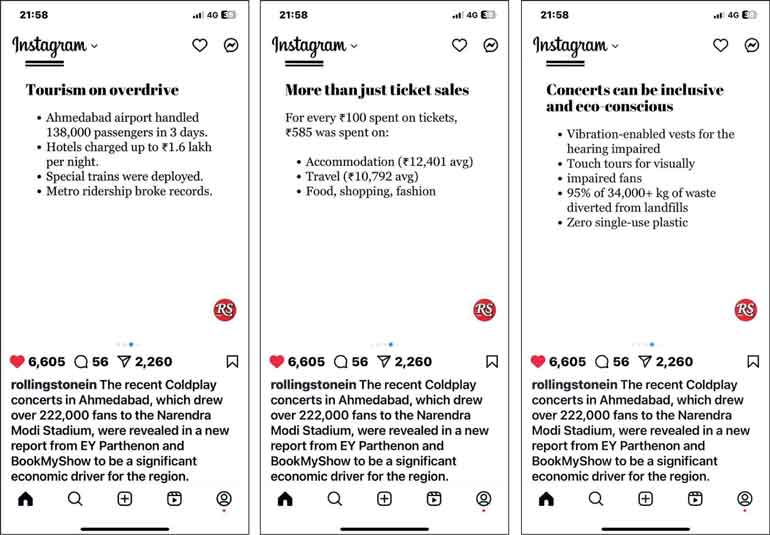
Coldplay’s Music of the Spheres concerts in Ahmedabad in January 2025 attracted 222,000 attendees over two nights. EY-Parthenon and BookMyShow Live estimated a total economic impact of $ 76.9 million, including $ 47.0 million in direct economic benefit to Ahmedabad and $ 8.6 million in GST revenue. Importantly, 86% of fans travelled to the host city, showing the power of concerts to generate destination travel (Coldplay’s Ahmedabad concerts generate ₹ 641 Cr estimated economic impact: EY-Parthenon and BookMyShow Live report | EY - India.)
Ed Sheeran’s Mathematics Tour in Mumbai in March 2024 drew approximately 55,000 attendees and created strong event-day demand across transport, food and beverage, hospitality and surrounding services (Ed Sheeran Mathematics Tour Mumbai: It Was Cheerios For Sheerios, Ed Is Secretly A Desi, And My Top Moments.)
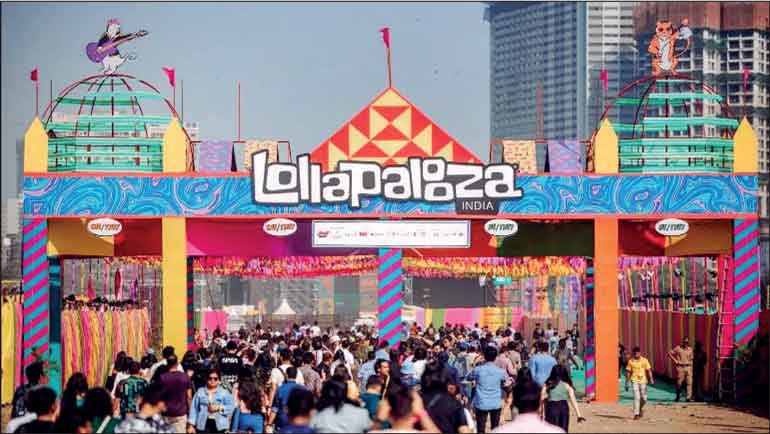
Lollapalooza India’s inaugural Mumbai edition in 2023 attracted more than 60,000 attendees over two days at Mahalaxmi Racecourse. The festival’s return in 2024 confirmed repeat demand and demonstrated the viability of annual large-format international music festivals in India (Lollapalooza is all set to return to India in 2024; know details / Inaugural Lollapalooza India draws 60,000 fans | IQ Magazine.)
Bryan Adams’ So Happy It Hurts India Tour in December 2024 delivered seven sold-out shows across seven Indian cities, attracting over 150,000 fans. This demonstrated the potential of multi-city routing across both metro and regional destinations (Bryan Adams ‘So Happy It Hurts’ India Tour Becomes 2024’s Biggest International Event)
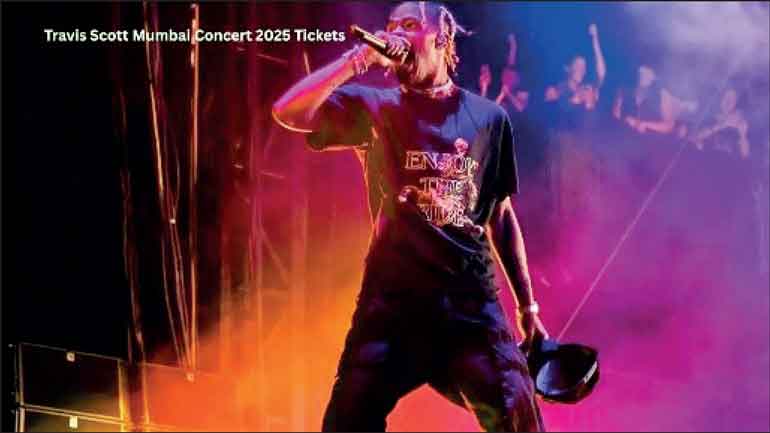
Travis Scott’s Circus Maximus India debut was scheduled for October and November 2025, with shows in New Delhi and Mumbai. Delhi shows at Jawaharlal Nehru Stadium were expected to draw approximately 50,000 to 60,000 spectators per night, while a Mumbai show was added following strong demand. This reflects India’s growing ability to attract global hip-hop stadium-scale tours and shows the regional appetite for large-format international live entertainment (Travis Scott Announces Mumbai Show in November/ Delhi gears up for Diwali and rapper Travis Scott’s concerts, extensive traffic restrictions and diversions | - The Times of India / Rapper Travis Scott to debut in India with ‘Circus Maximus World Tour’; Check Concert Date, Venue, ticket details | Entertainment News - Business Standard).
Economic effects and measured impacts
Major live events generate direct value through ticket sales and visitor spending on accommodation, food and beverage, transport, retail, merchandise and local services. This spending creates business receipts and contributes to government revenue through taxes, permits, venue charges and consumption-based taxation.
They also create multiplier effects. Event-related spending flows through suppliers, workers, service providers and surrounding businesses, supporting jobs in production, staging, lighting, sound, security, crowd management, hospitality, transport, logistics, marketing and media.
Live events strengthen place branding through media coverage, social media engagement, influencer content and global audience attention. They improve a destination’s image as vibrant, contemporary and experience-led. They also generate event-driven tourism demand, including hotel bookings, airline demand, taxis, restaurants, attractions and city experiences. This can help fill shoulder periods and support year-round tourism activity.
A strong live entertainment calendar also builds private sector confidence. Promoters, sponsors, venue operators, investors and tourism stakeholders are more likely to invest when the market shows consistent demand, clear rules and dependable infrastructure.
The missing pieces in Sri Lanka
Sri Lanka’s concert economy has not yet reached scale because the constraints are structural rather than demand-driven.
First, the country has a shortage of purpose-built, mid-to-large capacity venues. Events are often staged in sports grounds, open fields or temporary structures, which limits production quality, safety standards, weather resilience and audience experience.
Second, the approval process is complex. Organisers must engage multiple institutions, often without clear timelines or standardised requirements. This creates uncertainty, increases cost and discourages international promoters.
Third, there is a skills and professionalisation gap. Although local talent exists, Sri Lanka lacks a formal training ecosystem for event production, stage engineering, rigging, lighting, sound, safety and crowd management. Much of the workforce operates informally, limiting scalability and consistency.
Fourth, policy and incentive gaps remain. Live entertainment is not yet fully recognised as a strategic sector in national economic planning. The absence of targeted incentives, financing mechanisms and regulatory clarity has slowed investment.
Why this sector matters now
Sri Lanka is redefining its economic priorities and global positioning. The concert economy aligns with several national objectives: tourism growth through higher-value visitors, employment creation across skill levels, urban development through venue and precinct investment, and cultural diplomacy through global engagement.
Unlike tourism models that depend mainly on volume, live entertainment can increase value per visitor through higher spending, longer stays and stronger destination recall. Events can also be programmed during off-peak periods, helping balance seasonality and creating more consistent economic activity.
Economic and social impact
The live entertainment industry can support formal, freelance and informal employment. Large-scale events can generate substantial direct and indirect work across event producers, tour managers, sound engineers, lighting technicians, designers, riggers, loaders, caterers, security teams, transport providers and logistics personnel.
Employment growth would initially concentrate around Colombo, where most large-scale events are likely to be held. However, the sector also provides accessible entry points for young people, allowing them to gain hands-on experience and progress from informal roles to skilled, certified professions.
Beyond employment, the sector creates spillover benefits for tourism, hospitality, transport, logistics and creative services. It also engages youth audiences, shapes modern cultural trends and strengthens Sri Lanka’s soft power by enabling international collaborations, artist exchanges and large-scale productions that project the country globally.
Roadmap for Sri Lanka
To unlock the concert economy, Sri Lanka should adopt a coordinated, practical and forward-looking roadmap.
Global integration: Simplify visa and entry processes for international artists, performers and technical crews, including a dedicated performer visa and group visa provisions. Dedicated support units should assist organisers with regulatory, logistical and operational needs, reducing uncertainty for international promoters.
Domestic IP development: Provide grants, incubation and promotional support for local artists, festivals and original event properties. This will ensure Sri Lanka does not only host imported productions but also builds exportable cultural assets and recurring local event brands.
Tourism integration: Embed live events into the national tourism calendar and connect them with international promotions, destination campaigns and shoulder-season strategies. This should align with the Sri Lanka Tourism Events Policy, which seeks to improve global visibility, increase visitor arrivals and spending, support infrastructure development, protect culture and promote responsible practices.
Role of key ministries and agencies
A coordinated government approach is essential. The Ministry of Information and Broadcasting, or the appropriate lead agency, should drive the Single Window Clearance Mechanism. The Ministry of Sports should enable structured use of stadiums and arenas for non-sporting events, improving asset utilisation and commercial sustainability. Clear operating guidelines would allow existing arenas to generate revenue while encouraging upgrades, maintenance and dual-use models.
The Department of Immigration should introduce performer and group visa mechanisms. The Sri Lanka Convention Bureau should support training, certification and event facilitation. The Ministry of Tourism should position Sri Lanka as an event-driven tourism destination and assist with venue promotion and policy alignment. The Ministry of Finance should consider VAT concessions, subsidies, viability gap financing, blended finance and temporary entertainment tax relief for strategic events. The Ministry of Industry should recognise live entertainment within the MSME or Creative Industries framework, extending support to promoters, venue operators, technical providers, artist managers and related service businesses.
Policy alignment with Sri Lanka Tourism events policy
The Sri Lanka Tourism Events Policy provides a relevant foundation for this agenda. Its intent is to position Sri Lanka as a global destination for tourism and events, using events as a driver of economic growth, cultural promotion and international branding.
The concert economy directly supports the policy’s key objectives: enhancing global visibility and brand positioning; increasing visitor arrivals and spending; generating employment through events; promoting cultural preservation and community engagement; supporting infrastructure development and regional tourism; and ensuring environmental sustainability and responsible event practices.
This means live entertainment should not be treated as an isolated entertainment activity. It should be embedded into national tourism planning, city development, creative industry policy and investment promotion.
Beyond economics: Building national identity
The concert economy is not only about revenue. It is also about identity. Countries that lead in live entertainment are seen as culturally vibrant, progressive and globally connected. Events create narratives, shape perceptions and influence how a country is experienced by the world.
For Sri Lanka, this is especially relevant. The country is rich in culture, creativity and hospitality. Live entertainment provides a platform to showcase tradition and modernity together, in a format that appeals to both regional and global audiences.
Implementation note
For the roadmap to work, implementation must be phased and measurable. In the first phase, Sri Lanka should focus on quick wins that improve organiser confidence without requiring long construction timelines. These include a published approval checklist, fixed approval timelines, a temporary event-zone framework, a dedicated government liaison desk, and clear rules for sound, traffic, safety, insurance and crowd management. These measures would immediately reduce uncertainty for promoters.
In the second phase, the country should prioritise venue and skills development. Existing public assets should be assessed for event readiness, with selected locations upgraded through PPP models. At the same time, training programs should be launched with private production companies, hospitality institutions and tourism bodies so that the workforce grows alongside the event calendar.
In the third phase, Sri Lanka can move from hosting one-off international events to building a recurring annual calendar. This should include international concerts, regional festivals, local IPs, cultural showcases and shoulder-season events linked to tourism campaigns. The goal should be a predictable pipeline that gives promoters, hotels, airlines, sponsors and local suppliers the confidence to plan and invest.
Conclusion and proposed next steps
The concert economy represents a convergence of economic, cultural and strategic opportunity. Sri Lanka has the demand, location and foundational strengths to become a regional live entertainment hub. What is required now is intentional policy direction, infrastructure investment and close alignment between public and private sectors.
If approached with clarity and ambition, the concert economy can help transform Colombo into a vibrant entertainment gateway and position Sri Lanka as a destination defined not only by natural beauty, but also by world-class experiences.
Immediate next steps should include expediting implementation of the proposed Events Policy; securing government support for a dedicated event space within a designated zone with pre-cleared sound and operational approvals; establishing a one-stop approval unit at the Sri Lanka Convention Bureau; granting one-time duty-free approval for high-end technical equipment such as advanced sound and lighting systems; and launching reskilling and upskilling programs for event technical staff.




