Wednesday Nov 11, 2026
Wednesday Nov 11, 2026
Wednesday, 11 November 2026 00:21 - - {{hitsCtrl.values.hits}}
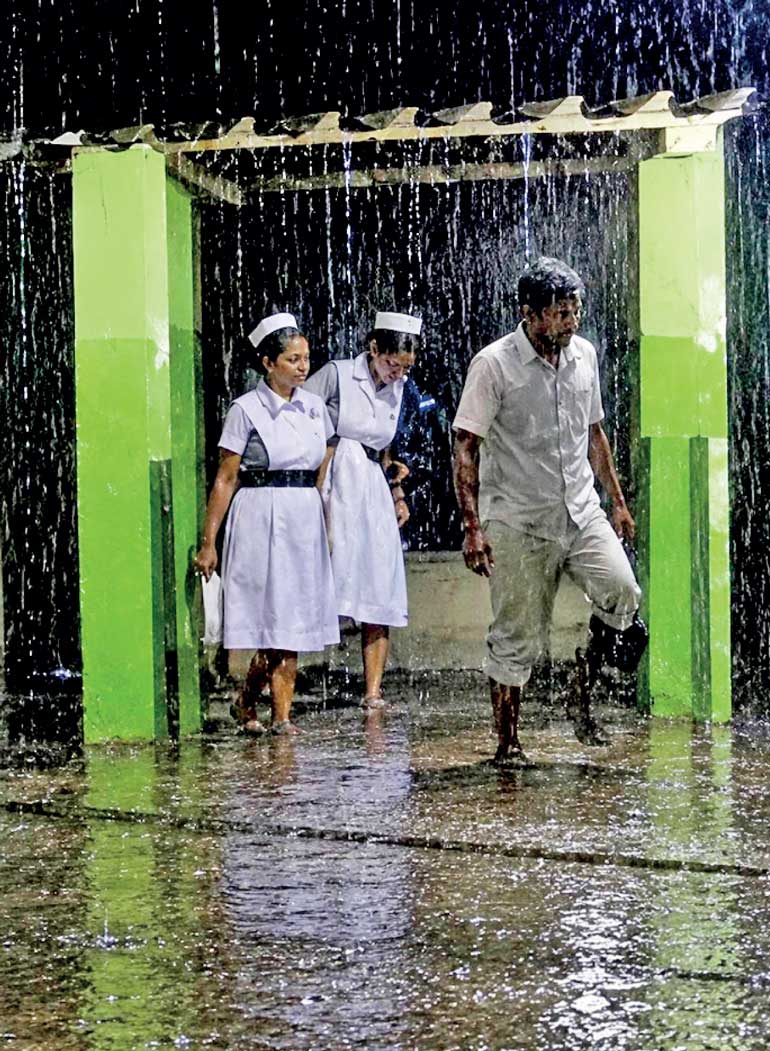
Colombo National Hospital
 The floods that inundated several parts of Colombo on November 06, 2026 have once again exposed the vulnerability of Sri Lanka’s commercial capital to heavy rainfall. This incident highlights the urgent need for a comprehensive assessment of the capacity and adequacy of the existing urban drainage system, particularly its ability to withstand increasingly intense rainfall events under changing climatic conditions. The flooding of several key areas brought economic and social activities to a standstill, underscoring the need to strengthen Colombo’s urban flood resilience through improved drainage infrastructure and effective stormwater management.
According to reports, approximately 129 mm of rainfall were recorded within a few hours. Officials revealed that the existing drainage system had originally been designed to accommodate approximately 30 mm of rainfall per hour. Meanwhile, some argue that Colombo’s drainage capacity has been significantly enhanced through several infrastructure development projects implemented in recent years and attribute the recent flooding primarily to blockages in the drainage network.
However, attributing urban flooding entirely to heavy rainfall would be an oversimplification. While extreme weather can trigger flooding, the severity and duration of its impacts are often determined by inadequate infrastructure, poor maintenance, unplanned urban development and weaknesses in urban water management.
Beyond heavy rainfall: Understanding the real causes
One of the most likely causes of drainage failure in a city is the accumulation of solid waste and debris in drainage channels. Plastic bottles, polythene, discarded food containers and household waste frequently obstruct roadside drains, culverts and canals. Absence of a proper garbage collection system can even be another contributing factor. Silt deposition at the bottom of drains due to soil washed away from urban construction sites is another issue. Even a properly designed drainage network can become ineffective when it is blocked by waste materials. Recent discussions following the Colombo floods also identified improperly disposed waste as a contributing factor to blocked drains and canals. Regular maintenance, responsible waste disposal and stronger enforcement of environmental regulations are therefore essential.
The second major concern is insufficient drainage capacity. Urban drainage systems must be designed according to rainfall intensity, catchment characteristics, land-use patterns and expected future development. When rainfall exceeds the system’s design capacity, water cannot be discharged quickly enough, resulting in surface flooding. Hence, it is important to reassess the historical design criteria in light of climate-induced changes in rainfall patterns and changes in land use.
Urban development at the cost of nature
Rapid and poorly planned urbanisation is another significant contributor to urban flooding. Colombo city and its surrounding areas have undergone considerable transformation through residential development, commercial buildings, road construction and infrastructure expansion. Unfortunately, this development has often come at the expense of natural drainage systems, wetlands, marshlands and open spaces.
Natural landscapes absorb and temporarily store rainwater, allowing it to infiltrate into the ground or gradually flow into waterways. However, when these areas are replaced by concrete buildings, asphalt roads and paved surfaces, the proportion of rainwater entering drainage channels increases considerably. This increased surface runoff places additional pressure on existing drainage infrastructure.
Studies indicate that the total wetland extent in the Colombo Region declined by approximately 40% between 1992 and 2021, primarily due to urbanisation and land-use changes. The reduction of these green spaces and natural water-retention areas is an important factor contributing to increased flood vulnerability.
Poor connectivity and coordination: A network-wide problem
An effective drainage system is an interconnected network comprising roadside drains, culverts, canals, retention areas, pumping stations, gates and final discharge points such as rivers or the sea. If one section of this network is blocked, damaged or undersized, the performance of the entire system can be affected.
In Colombo, the drainage network involves multiple institutions, including the Colombo Municipal Council, the Sri Lanka Land Development Corporation, the Urban Development Authority and other relevant agencies. Their responsibilities extend across different components of the urban water-management system. Hence, the drainage system should be maintained in a well-coordinated manner to ensure that it functions efficiently. Establishing a single authority to handle the entire drainage system is another option. Integrated drainage planning must therefore consider the entire catchment, from the point where rainwater falls to the location where it is safely discharged.
Building a climate-resilient city
Building a climate-resilient city requires a shift from reactive disaster management to proactive risk reduction. Clearing blocked drains after a flood is necessary, but preventing future floods requires an integrated approach including planning and building climate-resilient infrastructure and the protection of natural ecosystems.
Individuals and business entities can also contribute to urban flood mitigation by adopting measures such as rooftop rainwater harvesting, green roofs and rain gardens to temporarily retain stormwater. These interventions reduce surface runoff, ease pressure on urban drainage networks and help minimise peak flows during intense rainfall events.
A modern city should not be measured solely by its skyscrapers, highways and commercial developments, but also by its ability to withstand natural hazards while protecting the commercial activities, lives and livelihoods of its people.
(The writer is a water resources engineer)



