Monday Nov 16, 2026
Monday Nov 16, 2026
Monday, 16 November 2026 03:16 - - {{hitsCtrl.values.hits}}
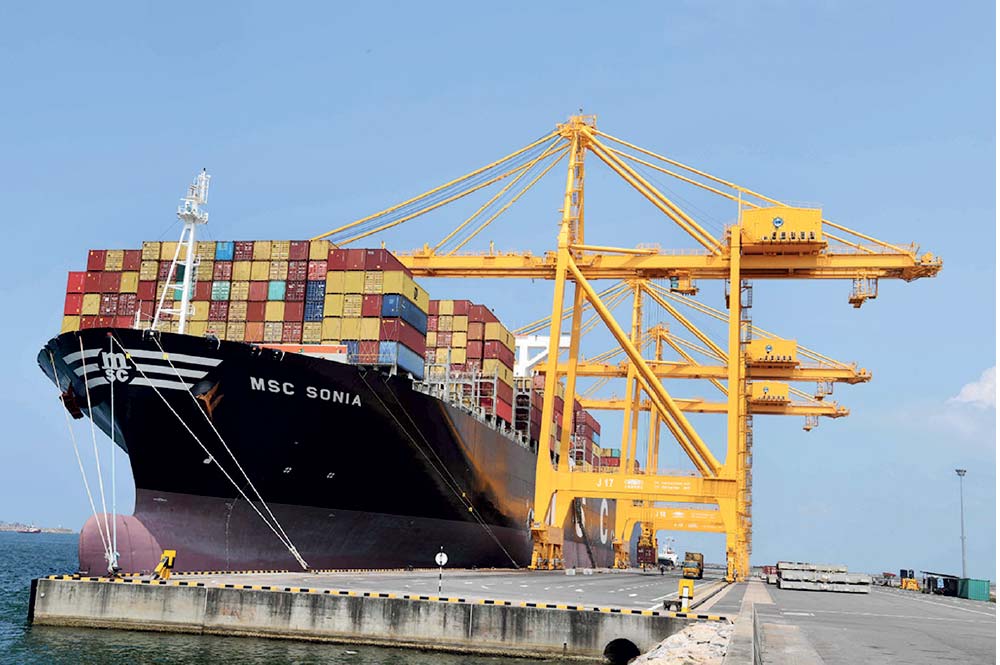
 The recent public debate initiated by the Ceylon Freight and Logistics Association (CEYFFA) concerning Terminal Handling Charges (THC), foreign exchange outflows and the competitiveness of Colombo Port raises important questions about the direction of Sri Lanka’s maritime industry.
The association has called for changes to the existing regulatory framework, arguing that the country could be losing more than
$ 50 million annually in foreign exchange due to the prevailing charging arrangements. It has also called for a review of the relevant gazettes and a new consultative mechanism involving industry stakeholders.
These are legitimate subjects for public discussion. However, when dealing with a sector that contributes significantly to international trade, national revenue and foreign exchange generation, the debate must be based on accurate financial information, a proper understanding of international shipping practices and a comprehensive assessment of the entire maritime logistics ecosystem.
The fundamental question is whether Sri Lanka is developing a globally competitive maritime hub or creating a regulatory environment that increasingly complicates the business of international shipping.
The THC debate: Understanding the commercial reality
Terminal Handling Charges are associated with the physical handling of containers at port terminals, including loading, discharge and related terminal operations.
The regulatory debate in Sri Lanka dates back to Gazette No. 1842/16 of 2013, followed by Gazette No. 2041/10 of 2017. These measures introduced and strengthened the all-inclusive freight regime, with the objective of preventing additional charges being imposed on parties who were not contractually responsible for them.
Subsequently, Gazette No. 2321/62 of March 2023 and Gazette No. 2334/26 introduced further changes to the regulatory framework. The central issue, however, should not be reduced to whether THC should appear separately on a freight invoice. There is an important commercial distinction between a terminal operator charging a shipping line for services provided and a shipping line or intermediary recovering charges separately from an importer or exporter. These are different transactions involving different contractual relationships.
Terminal operators must recover the legitimate costs of their services. Shipping lines must account for port and terminal costs when determining their freight rates. At the same time, importers and exporters are entitled to transparent pricing and protection against arbitrary or undisclosed charges.
A sustainable regulatory framework must recognise all these realities. The objective should be to ensure that the same service is not charged twice, that contractual obligations are respected and that all charges are transparent. This requires a comprehensive examination of the commercial arrangements rather than an approach driven by competing industry interests.
The $ 50 million foreign exchange claim: Where is the evidence?
One of the most significant claims made by CEYFFA is that Sri Lanka could be losing more than $ 50 million annually in foreign exchange. Such a figure deserves serious attention. However, a financial claim of this magnitude must be accompanied by a transparent methodology and supporting evidence. Who receives these payments? What proportion represents payments to overseas shipping lines? What proportion is paid to Sri Lankan terminal operators? How much relates to legitimate international freight services, and how much, if any, represents avoidable additional charges?
A payment made in foreign currency to a Sri Lankan service provider does not automatically constitute an external foreign exchange loss. Similarly, payments to overseas carriers for international transportation services must be examined in the context of the services received. It is therefore essential to distinguish between foreign exchange expenditure, domestic foreign-currency receipts and genuine economic leakage. The Central Bank, Sri Lanka Ports Authority, Sri Lanka Customs and relevant maritime authorities should jointly examine the claim using actual transaction records. National maritime policy should not be influenced by a headline figure without an independently verifiable financial assessment.
Colombo Port’s performance: What do the official figures tell us?
The Sri Lanka Ports Authority’s August 2026 performance review provides a useful perspective on Colombo’s actual performance. During January–August 2026, Colombo Port recorded total container throughput of approximately 5.995 million TEUs, compared with 5.435 million TEUs during the corresponding period in 2025. This represents an increase of 10.3%. Transshipment throughput increased by 10.9%, from approximately 4.353 million TEUs to 4.828 million TEUs. Transshipment accounted for approximately 81% of total throughput. Total cargo handled increased by 2.8%, while the number of ships arriving increased by 2.8%.
These figures demonstrate that Colombo continues to attract significant international transshipment business and remains an important maritime gateway in the Indian Ocean. The performance of the Colombo West International Terminal (CWIT) is particularly noteworthy. Its cumulative container throughput increased from approximately 256,000 TEUs in the first eight months of 2025 to approximately 1.146 million TEUs in the corresponding period of 2026. This represents growth of approximately 347.6%. These developments demonstrate the importance of investment, additional capacity and the expansion of terminal operations. They also challenge the suggestion that Colombo’s overall competitiveness can be assessed primarily through the THC regulatory debate. However, growth alone should not create complacency. The industry must continuously improve productivity, connectivity, capacity and service reliability.
Operational efficiency: The real competitiveness challenge
More recent terminal operational figures dated 3 November 2026 reveal several areas requiring attention. Reported yard utilisation stood at 109% at CICT and 121% at ECT. Window berthing delays were reported at 24–36 hours at CICT and 12–18 hours at ECT. In comparison, CWIT reported no berthing delay in the figures provided. The same operational summary identified 19,326 TUs in inter-terminal trucking balance, 1,112 customs-detained containers and approximately 940 salt cargo containers. These figures highlight the importance of looking beyond individual terminal charges. Port competitiveness depends on the efficiency of the entire supply chain. Vessel scheduling, yard management, customs clearance, inter-terminal transportation, digital integration and coordination between terminal operators are equally important. A container that experiences unnecessary delays in the port ecosystem imposes costs on the shipping line, importer, exporter and ultimately the consumer. Consequently, Sri Lanka must focus on reducing the total cost and time involved in moving cargo through the port, rather than concentrating public debate on one particular category of charge.
Licensing reform: Another example of the need for regulatory rationalisation
The issue of THC is not the only regulatory concern affecting the maritime logistics sector. A submission made by BAZ Global Logistics Colombo Ltd., to the Director General of Merchant Shipping on 18 August 2026 raises another important question concerning the licensing of freight forwarders and Non-Vessel Operating Common Carriers (NVOCCs). The company has requested a review of the requirement for the same incorporated legal entity to maintain separate licences for freight forwarding and NVOCC activities. Its submission argues that Gazette Extraordinary No. 1877/26 of 28 August 2014 provides a common regulatory architecture for these related activities, while recognising their different responsibilities. The company does not argue that NVOCC operations should be exempt from additional regulation. On the contrary, it recognises that an NVOCC assumes additional contractual responsibilities, particularly when issuing its own House Bill of Lading, contracting as a carrier and accepting cargo-related liabilities. Its proposal is to consider a principal Class A licence with an additional NVOCC endorsement, supported by appropriate financial responsibility, insurance, professional competence and reporting requirements. This is a proposal worth examining.
The important principle is that regulation should be proportionate to the activities undertaken and the risks assumed by the operator. The objective should be to prevent unnecessary administrative duplication without compromising consumer protection, financial security or regulatory supervision. The submission also refers to the United States Federal Maritime Commission’s Ocean Transportation Intermediary framework, which accommodates both Ocean Freight Forwarder and NVOCC authorities within a broader regulatory structure. Sri Lanka should examine such international approaches and determine whether similar administrative efficiencies can be achieved within its own legal framework. Effective regulation does not necessarily mean multiple licences, multiple registrations and repetitive administrative processes for the same legal entity. It means regulating the activity, responsibility and risk appropriately.
The danger of fragmented maritime policymaking
Sri Lanka’s maritime sector consists of interconnected stakeholders: shipping lines, terminal operators, freight forwarders, NVOCCs, customs brokers, exporters, importers, logistics companies and government institutions. No single stakeholder can develop the national maritime industry independently. When regulatory decisions are made without adequate consultation, the consequences are often reflected in commercial uncertainty, additional administrative costs and reduced investor confidence. Equally, allowing individual commercial interests to dominate national maritime policy can undermine the wider objective of developing Colombo as a regional logistics hub. Sri Lanka needs a permanent maritime consultative mechanism that brings together all relevant stakeholders. Such a mechanism should examine:
The objective should be to develop an evidence-based national maritime regulatory framework rather than repeatedly responding to disputes between individual industry associations.
Looking beyond Colombo: The Indian Ocean opportunity
Colombo’s strategic location along major East–West shipping routes provides Sri Lanka with a significant competitive advantage. But geography alone does not make a country a maritime hub. India is investing heavily in port infrastructure and logistics connectivity. Other regional economies are also improving their maritime capabilities. Sri Lanka must therefore offer international shipping lines and logistics investors a predictable regulatory environment, efficient port services, competitive pricing and reliable infrastructure. The development of the Regional Maritime Single Window and Port Community System initiatives also presents an opportunity to improve coordination, transparency and digital efficiency across the maritime ecosystem. These developments should form part of a broader national maritime strategy.
The way forward: A national interest approach
The THC debate should be an opportunity to undertake a comprehensive review of Sri Lanka’s maritime regulatory environment. The Government should establish an independent technical and economic review involving the Sri Lanka Ports Authority, Merchant Shipping Secretariat, Central Bank, Sri Lanka Customs, terminal operators, shipping lines, freight forwarders, NVOCCs, customs brokers, exporters and importers. The review should establish the actual financial implications of the current THC arrangements, clarify the legal status and operation of relevant regulations, and identify areas where administrative and commercial practices can be improved.
Any reform must protect exporters and importers against arbitrary or duplicate charges while ensuring that legitimate service costs can be recovered through transparent contractual arrangements. Similarly, licensing reforms should reduce unnecessary duplication without weakening the responsibilities of regulated operators. The ultimate objective must be the long-term competitiveness of Sri Lanka’s maritime industry. Colombo Port has demonstrated growth in container throughput and transshipment activity. That is encouraging. But the next stage of development requires more than growth statistics. It requires operational excellence, regulatory predictability, private-sector confidence and a shared national vision.
Sri Lanka must stop treating maritime regulation as a collection of isolated commercial disputes. Our ports, shipping services and logistics industry are strategic national assets. Their regulation must be designed to generate greater economic value, attract international business and strengthen our position as an Indian Ocean maritime hub. The question is not which association wins the THC debate. The question is whether Sri Lanka wins the competition for maritime business in the Indian Ocean.
(The author is Secretary General, Ceylon Chamber of Shipping, former Director, Media and Defence Spokesperson, Ministry of Defence, former Acting Director General, Institute of National Security Studies (INSS), and former Executive Director, South Asia Sustainability and Security Research Institute (SASSRI). He is a Non-Resident Fellow, London Dialogue, and a security, maritime, and strategic affairs analyst)




