Friday Sep 25, 2026
Friday Sep 25, 2026
Friday, 25 September 2026 00:22 - - {{hitsCtrl.values.hits}}

 Sri Lanka could be staring at food crisis in the near future. The country is vulnerable on several fronts. The war in Iran and the conflagration of the Gulf region has serious implications for food security. Sri Lanka depends heavily on imported inputs for agriculture. Studies show that 36% of Sri Lanka’s fertiliser imports come through the Strait of Hormuz controlled by Iran. At the same time, the effects of El Niño could significantly affect food production. According to the Department of Census and Statistics, agricultural activities declined by 2.3% in the second quarter of 2026.
When we talk about food security in Sri Lanka, small farmers are key. FAO data shows that around 80% of Sri Lanka’s national food requirements are met through domestic production. World Bank data shows 1.65 million smallholder farmers contribute about 80% of the country’s total annual food production. This makes small farmers central to Sri Lanka’s agricultural production. Here, food security is not simply about producing enough food. It is also about building institutions that allow small farmers and consumers to collectively shape and control the food system.
Co-operative possibilities
This is where co-operatives can play a pivotal role. By bringing farmers and consumers together, co-operatives can help build a food system where production, storage, processing and marketing are organised collectively. They can give small farmers greater bargaining power and create more direct links with consumers. Co-operatives are not foreign to Sri Lanka. They are part of the country’s own institutional history and can be strengthened as institutions of food security.
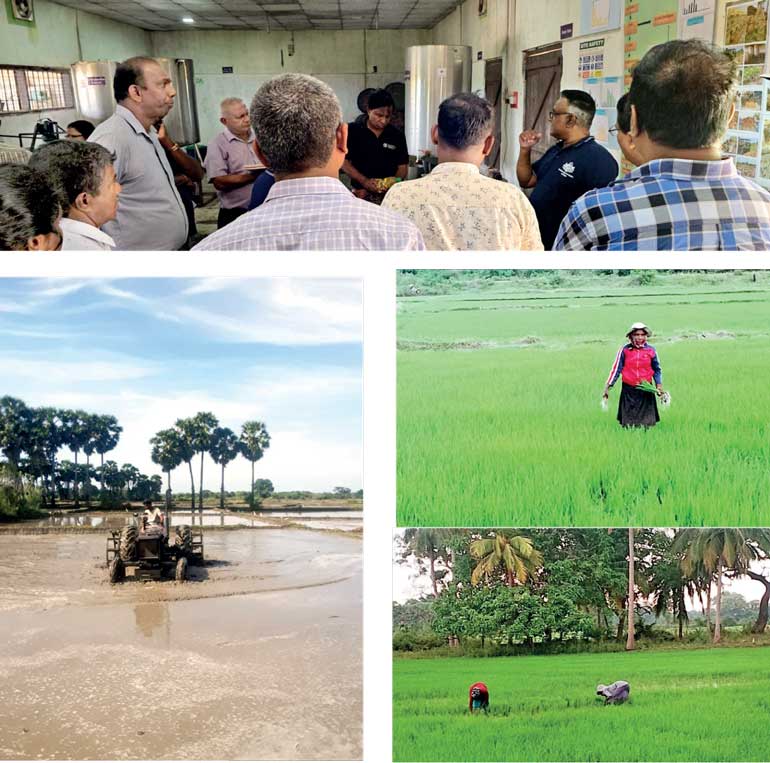
In the Northern Province, where much of our work is grounded, co-operatives are not simply service providers. Rather, they are already linking agricultural production through mechanisation with food security. Co-operatives are working across the food chain, from certified seed paddy production to cultivation, processing and marketing.
Agricultural development
Local seed production is reducing dependence on supplies coming from outside the region. And co-operatives are organising and training farmers on paddy seed production. The use of paddy transplanting machines are improving productivity while reducing fertiliser, water and seed requirements. These machines that remained unused in other provinces were recently reallocated to the North. Instead of placing them with individual operators, they were transferred to farmer organisations and co-operatives. This allows more farmers to access costly equipment with suitable technology through shared services.
Co-operatives can also act as a counterweight to powerful private intermediaries in the paddy market. They can purchase paddy directly from farmers and sell rice to consumers at more reasonable prices. This can strengthen the bargaining position of farmers while keeping food more accessible to rural consumers. Multi-Purpose Co-operative Societies’ consumer shops are especially important in rural areas, where local shops can jack up prices knowing that rural folk will not have money to purchase in bulk, and will just pay much more for their daily provisions than go to the shops in the town.
The co-operative model is also extending to production of pulses and other crops. Collective production is helping manage irrigation more effectively, while greater pulse production can improve nutrition and reduce dependence on imports.
Another advantage of the co-operative system is its ability to address expected shortages in essential inputs such as fertiliser. Private traders may withhold stocks when demand peaks and release them later at inflated prices. Community-based co-operatives, by contrast, can maintain a more regular supply. The government can therefore channel fertiliser stocks through co-operatives and ensure they reach farmers on time. This can protect farmers from the volatility of private markets and prevent input shortages from disrupting cultivation. It can also strengthen the stability of food supplies.
Beyond agriculture
Co-operatives are not limited to agriculture. Fisheries co-operatives also play an important role in supporting fishers and strengthening the local fisheries sector. Co-operatives can help members access essential inputs by connecting them with state-owned enterprises such as the North Sea Net Factory and CENOR Boat Yard. This helps them obtain boats, nets and other equipment at fair prices. Co-operatives also provide credit at lower interest rates than informal lenders, helping fishers avoid debt traps. Northern fisheries co-operatives also operate fish auctions, allowing fishers to secure better prices while consumers can access fish at reasonable prices.
Beyond agriculture and fisheries, Northern co-operatives are contributing to food security through several other sectors, including dairy and palmyra. If co-operatives are to build a stronger food system, they need to maintain a presence across different parts of the value chain. This also means developing small-scale industries that can strengthen local production and processing. This is where the role of co-operative federations becomes important to scale up and market locally produced food.
Northern food security convening
Along with other youth interested in research and agricultural development, we were introduced to co-operatives through the Northern Co-operative Development Bank (NCDB). Established in 2019, NCDB is federation owned by the members of more than 1,200 active co-operatives in the Northern Province, and has developed into a rural development banking institution. Many of the co-operative initiatives we mentioned above are linked to the work of NCDB, which is now seeking to play a role in building a co-operative-led food security system in the North.
This potential was visible during a three-day co-operative food security convening held in the North from 6 to 8 August 2026. The event was supported by the Governor’s Office in the Northern Province and the Australian High Commission, with representatives of several ministries participating. Field visits provided an opportunity to observe co-operative-led food production and food security initiatives. Policy discussions focused on how these initiatives could be strengthened, including through a comprehensive market study for co-operatives. The convening ended with close to five hundred co-operative representatives coming together for a half day conference on food security. The convening showed the organisational strength of the co-operative movement in the North and its potential to build a more secure and locally rooted food system.
After decades, Sri Lanka now has a political environment that is more supportive of co-operatives. The co-operative sector is being recognised as an important pillar of the economy. The task now is to strengthen co-operatives across the country and put food security back in the hands of the people. Co-operatives can play a central role in building a food system that is controlled by producers and consumers, rather than face the disruptions of market forces. The co-operative movement in the North is leading the way on food security, but the sustainability of this initiative will depend on scaling up to the national level.
(Suhaina Razaq is a member of the Young Researchers’ Network (YRN). Shalomitha Louis is an agricultural development officer at the Northern Co-operative Development Bank)




