Friday Oct 16, 2026
Friday Oct 16, 2026
Friday, 10 July 2026 00:16 - - {{hitsCtrl.values.hits}}
 In the paddy fields around Nagollagama, in Sri Lanka’s Kurunegala District, the monsoon no longer behaves the way it used to. Rains that once arrived on a familiar calendar now come early, late, or not at all. For a farmer deciding when to sow, irrigate, hold back water, and fertilise, that uncertainty is not an abstraction. It is the difference between a good year and a hopeless one.
These are genuinely hard decisions and until recently farmers were making them largely in the dark.
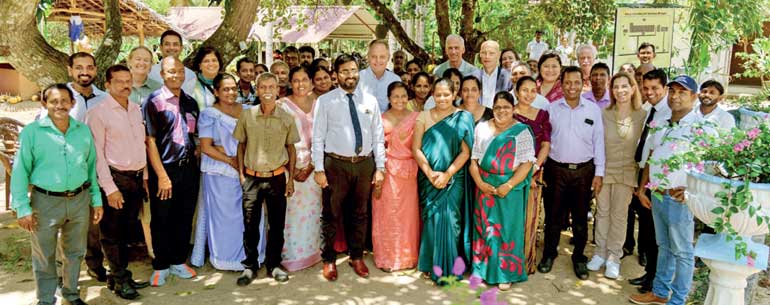
On 1 June, first, the International Water Management Institute (IWMI), in partnership with Sri Lanka’s Department of Agrarian Development (DAD), inaugurated an Agro-Climate Advisory Lab at the Nagollagama Agrarian Service Centre. A modest building, now home to an outsized idea — that a seasonal weather forecast, properly translated and delivered, can become a farmer’s most valuable input.
A five-year journey, not overnight fix
The lab did not appear from nowhere. It is the visible result of a patient, five-year engagement.
In 2021, the first pilot reached 250 farmers, bundling climate-resilient seed, agro-climatic advisories and crop insurance. When these farmers met with climate-induced losses, insurance payouts cushioned the blow. By the Yala harvesting season in 2025, the model had sharpened to include climate-resilient paddy seeds from private sector partner CIC holdings, 6,000 agro-climate advisories to 100 farmers, and a yield-improvement program. Then came the leap. In the 2026 Maha season, the same service center disseminated more than 125,000 advisories to nearly 10,000 farmers — a hundredfold increase in reach in a single year. The program also supported Nagollagama by rehabilitating an irrigation canal.
What makes this remarkable is not the technology alone. It is that climate-agriculture advice reaches the farmer in their own language, tailored to local conditions, and explained in ways that are directly relevant to their farming activities, and timely enough to shape how they plan their work.
From satellite to SMS
The journey of a single advisory follows five simple steps. IWMI’s AWARE platform gathers a seven-day weather forecast. Field officers observe the real condition and growth stage of the crop. Raw data is then translated into plain-language guidance any farmer can understand. Weather, crop status and agronomic recommendations are combined into a tailored advisory — validated by DAD and Agrarian Service Centre officers and shaped in consultation with the Aruna Farmer Organisation ¬– one Sri Lanka’s largest community led farmers’ organisations. Finally, the advisory reaches each farmer’s phone, twice a week.
Forecast, translate, observe, integrate, and deliver. No step is glamorous. Together, they close the gap between a meteorological model and a muddy field.
Proof is in the harvest
Sceptics rightly ask whether agro-climatic advisories change anything. In Nagollagama, the evidence is notably straightforward. IWMI compared 100 supported farmers with 100 non-beneficiary farmers in the same area, on the same land, under the same skies.
The farmers who were supported by the Agro-Climate Advisory Lab harvested 226 kilograms more rice per acre, worth roughly Rs. 27,100 ($ 82) in additional income per acre.
An intensive cohort of just ten farmers, given more targeted support through the CIC holdings climate resilient paddy partnership, did even better: 390 kilograms more per acre, and about Rs. 46,800 ($ 141) in extra income, against only Rs. 6,000 ($ 18) in added input costs. That is a strong return on a small investment.
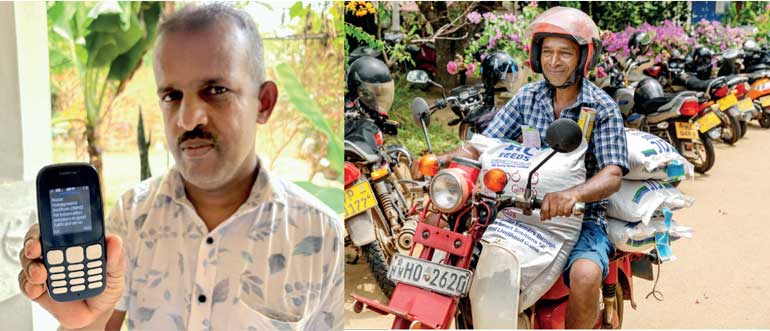
“We planned how to spray fertiliser and prepare the soil based on the climate advisory” said Sardha Dayanshani, secretary to the Aruna Farming Organisation, explaining how they operationalised the advisory service received through SMS.
The partnerships underpinning this impact is equally important. A catalytic contribution from IWMI, backed by the CGIAR Climate Action program and Japan’s Ministry of Agriculture, Forestry and Fisheries unlocked the potential of these farmers in Nagollagama. Mobilising the reach of the Department of Agrarian Development, the expertise and seed resources of CIC holdings, and the trust of the Aruna Farmer Organisation, they were able to meaningfully improve harvests for thousands of farmers.
For C. Dayawathi, an agriculture research and production assistant at DAD, the ambition is simply to grow. “We moved away from traditional systems and achieved better standards — and we got a good harvest,” said Dayawathi. “My hope is for the next seasons to bring a bigger group of farmers into this effort.”
Clearest signal of success: Increased demand
The most telling indicator is one no project can manufacture — unsolicited demand. Two neighboring service centres, in the villages of Mahawa and Polpithigama, have formally asked for the same advisory service. Word travels fast between farming communities when something works.
This is why 2026 was the year the Nagollagama approach moved from pilot to institution. The Agro-Climate Advisory Lab anchors the local generation of advisories so the model can be handed to DAD and replicated across districts, rather than depending on any single project.
Interest already extends beyond Sri Lanka. IWMI is positioning Nagollagama as a model site for South-South learning, with engagement underway involving partners in Zambia and Pakistan, and a CGIAR science delegation expected to visit later in 2026.
How governments and donors can invest
For a finance ministry or a development partner weighing where to put scarce climate funds, Nagollagama offers a practical template.
Governments can embed advisory generation inside existing agrarian extension structures — as Sri Lanka has done through Sri Lanka’s Department of Agrarian Development — so the service outlives the project and reaches the last mile user through institutions farmers already trust. Donors can fund the bundle, not just the gadget: climate-resilient seed, twice-weekly localised advisories, light-touch insurance and the modest digital backbone that ties them together. Both should resource the unglamorous middle layer — the people and platforms that translate forecasts into farm-ready instructions — because that is where most early-warning systems quietly fail.
The impact on farmer income makes the case. A modest catalytic investment, placed inside trusted institutions, generated measurable income gains for nearly 10,000 households — a return that compounds with every season and every new service center that adopts the model. The lesson is not that climate adaptation is cheap; it is that well-targeted public and donor finance, channeled through structures farmers already rely on, can deliver outsized and lasting returns.
Change-making capability for the region
The world has rightly rallied behind Early Warning for All — the goal of protecting everyone on Earth with early warning systems. Yet a warning is only protective if it can trigger timely and practical action. Nagollagama shows that early warning is only meaningful when it reaches a farmer through accessible technology, in a language they understand, at the moment in their farming cycle when decisions need to be made.
That is the quiet revolution here. Not a new satellite, but a new pathway — from forecast to field, from data to dignity, from uncertainty to a harvest a family can count on. If this model spreads across South Asia and Africa as the demand suggests it will, the region will have built something rare: a climate capability that does not merely warn people of the storm, but helps them plant through it.




