Friday Oct 02, 2026
Friday Oct 02, 2026
Friday, 12 June 2026 00:20 - - {{hitsCtrl.values.hits}}
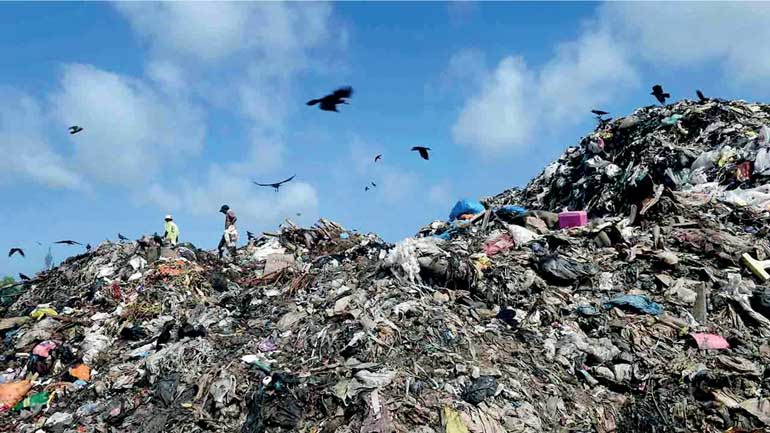
The country generates more than 7,000 tonnes of municipal solid waste per day
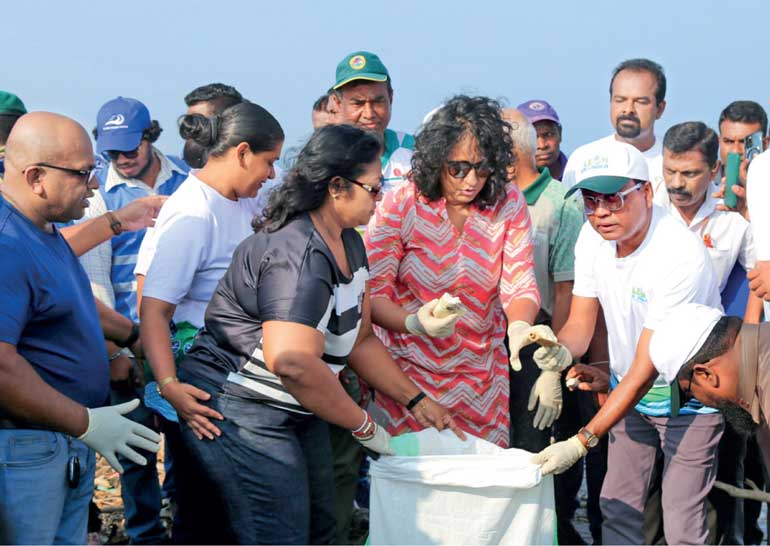
Prime Minister Dr. Harini Amarasuriya taking part in a Clean Sri Lanka beach clean-up campaign in February 2025
 Social media often portrays Sri Lanka as a clean, waste-free destination. Influencers showcase spotless expressways, manicured roundabouts and pristine tourist corridors, reinforcing an image of a cleaner and greener nation. These curated clips have become part of the national branding: a digital chorus insisting that Sri Lanka is cleaner, greener and more disciplined than its neighbours. And on the surface, they’re not wrong. Watching some of these reels we truly feel proud of Sri Lanka.
But then reality hits. Step outside the tourist haunts and the illusion cracks. The backroads tell a different story: littered roadside verges, informal dumps behind houses, plasticclogged canals and the acrid smell of open burning drifting from empty lots. This is the Sri Lanka that rarely appears on Instagram; the one that exposes the gap between the aspiration of a Clean Sri Lanka and the reality of a fragmented, underresourced waste system.
While Clean Sri Lanka encompasses broader social, ethical and governance objectives, waste management remains one of the most visible tests of whether the initiative can translate aspiration into measurable outcomes.
Clean Sri Lanka requires more than clean tourist corridors
The Clean Sri Lanka vision is powerful and deserves credit for elevating waste management and environmental stewardship to a matter of national discussion. The challenge now is to ensure that ambition is matched by the institutions, investment and long-term reforms needed to deliver lasting results.
To put Sri Lanka’s waste management problems into context, the country is thought to generate more than 7,000 tonnes of municipal solid waste per day. The systems meant to manage this waste remain fragmented and outdated. It is also impossible to find someone accountable to blame because accountability is spread over many organisations.
Sri Lanka has already paid a terrible price for treating waste as an afterthought. In April 2017, the collapse of the Meethotamulla garbage dump killed dozens of people, destroyed homes and displaced entire families. What should have been a routine municipal service became a national disaster. The tragedy reflected years of fragmented governance, inadequate planning, weak regulation and dependence on open dumping. The lesson from Meethotamulla remains as relevant today as it was then: that poor waste management is not merely an aesthetic problem, but it can cost lives.
To define national policy and develop effective waste management systems, we must start with accurate and consistent data on waste generated. A striking weakness in Sri Lanka’s wastemanagement landscape is the absence of clear, comprehensive and publicly accessible national data. Different agencies publish different figures. Municipalities measure waste inconsistently. Even basic questions — How much waste does the country generate? What proportion is plastic? How much is recyclable? — do not have authoritative, unified answers.
This lack of transparency is a result of the multitude of organisations lacking singular unified guidance on what and how to measure waste. 
Fragmented governance: Too many agencies, too little expertise and weak accountability
Waste management in Sri Lanka is currently split across ministries, provincial councils, local authorities, the Central Environmental Authority (CEA), various semiautonomous agencies and adhoc committees formed after crises. This is not a case of “the-more-the-merrier”. Instead, it is a case of “too many cooks spoiling the soup”. Having a two or more organisations working on waste management causes overlapping mandates resulting in confusion and conflict. In other aspects or areas, no one takes responsibility, which result in inconsistent or absent enforcement. Equally bad, overlapping mandates result in duplicated responsibilities and a waste of resources.
This fragmentation is one of the core reasons why the influencer narrative diverges so sharply from the lived reality. Clean tourist areas are easy to maintain when responsibility is clear. Clean backroads are harder when responsibility is scattered. This inability to apply tourist standards to non-touristy areas also speaks to a lack of concern for the native population while catering to a transient foreign population. Sri Lanka should implement an excellent waste management system for its own citizens, one that will naturally create that utopian image the influencers portray.
It would be unfair to suggest that successive governments have ignored the waste challenge. Over the past two decades Sri Lanka has introduced plastic bans, supported composting programs, promoted source segregation initiatives, developed sanitary landfill projects, encouraged recycling industries and more recently launched the Clean Sri Lanka initiative. Some measures have delivered local successes and demonstrated what is possible when policy, funding and enforcement align. Yet many initiatives have struggled to achieve lasting national impact because implementation has been inconsistent, institutional responsibilities remain fragmented and long-term funding and accountability mechanisms have been weak. The challenge is therefore not a lack of effort, but the absence of a coherent system capable of sustaining and scaling successful interventions.
Unified national waste authority: reform Sri Lanka needs
Countries that have successfully modernised their waste systems, such as Singapore, South Korea, Estonia, all share one structural feature: Centralised authority, decentralised execution. Sri Lanka needs a single institution with clear statutory responsibility for waste management including setting standards, collecting and publishing data, planning infrastructure, enforcing regulations, coordination and oversight.
The Waste Authority (WA) must not be the Central Environmental Authority! The role of the WA is to manage wastes to maximise sustainability. The role of the CEA must be to ensure that the environment is protected and that the WA follows principles of environmental excellence. If the roles are combined, there will be a conflict of interest, and a resumption of business as usual (i.e. corruption, inefficiency, etc.). The role of the local governments would still be to manage daytoday operations, but under a coherent national framework and under the guidance and oversight of the national authority.
Single-use plastic crisis: The most visible threat to a clean Sri Lanka
If there is one waste stream that most clearly exposes the gap between influencer generated image and reality, it is singleuse plastics. Sri Lanka consumes over 300,000 tonnes of plastic annually, including lunch sheets, shopping bags, PET bottles and disposable cups and cutlery.
Despite bans on certain plastic items, enforcement remains inconsistent. Plastic waste continues to accumulate in rivers and canals, where it is carried to the sea and damages coastal ecosystems, fisheries and tourism. It also ends up in illegal dumps, contaminating soil and groundwater, blocks stormwater drains and worsens urban flooding.
The consequences extend far beyond visible litter. Poorly managed waste contributes to air pollution through open burning, contaminates soils through uncontrolled dumping and pollutes rivers, reservoirs and coastal waters through leachate and runoff. In many areas, pollutants can infiltrate groundwater aquifers that communities depend upon for drinking water. These environmental impacts ultimately become public-health impacts, increasing the risks of respiratory illnesses, waterborne diseases and long-term exposure to hazardous substances. A Clean Sri Lanka is therefore not simply an environmental objective—it is a public health imperative. 
The plastics polluting Sri Lanka’s environment are not merely a waste management problem. They remain widespread because they are cheap and convenient, while producers and importers bear little responsibility for the waste they generate and public awareness remains limited.
Modern solutions to reduce waste
Modern waste management is much more than just collecting unwanted material, transporting it to a landfill, burying it and walking away. The waste has value – from the resources that were used to generate the material in the first place, to its potential value from reusing or recycling and thereby retaining land for productive use instead of as landfill. For a nation such as Sri Lanka the value of “waste” is much higher than for a country with boundless wealth. Therefore, Sri Lanka must focus on reusing, recycling, and where possible converting the waste to a form that provides value to the country. A modern waste system in Sri Lanka must combine multiple tools.
A circular economy is the opposite of the traditional “take, make, use and discard” model that dominates modern consumption. Instead of treating products as disposable, it seeks to keep materials circulating within the economy for as long as possible through reuse, repair, refurbishment, remanufacturing and recycling. In practical terms, a circular economy transforms waste from a liability into a resource, reducing environmental impacts while creating economic opportunities.
EPR is based on a simple principle: those who profit from products should also help pay for managing the waste those products create. Rather than leaving taxpayers and local authorities to bear the entire burden, EPR requires manufacturers to finance collection, recycling and safe disposal systems. It aligns economic incentives with environmental responsibility and encourages businesses to design products and packaging that generate less waste; essentially a polluter pays system.
Since imported goods contribute significantly to the plastic burden and they would fall outside the formal definition of EPR, Sri Lanka should consider widening the EPR concept to include importers – to EPIR (Extended Producer & Importer Responsibility). Clean Sri Lanka provides the political mandate to finally implement EPIR nationwide — a reform long overdue.
Organic materials can be composted (using small-scale industrial units) deployed throughout suitable high-organic content waste generating areas and WtE technologies to convert residual waste that cannot reasonably be reused or recycled, into electricity. When implemented within a broader waste management hierarchy, both technologies can reduce dependence on landfills while recovering value from materials that would otherwise be discarded. However, it should complement and not replace recycling and waste reduction efforts. WtE plants can reduce landfill volume by up to 90% and generate electricity.
WtE should be used only for residual, nonrecyclable waste, after recycling and composting have been maximised. The potential exists to expand WtF from the current plant at Kerawalapitiya generating approximately 10MW of electricity by tenfold or more. This would have to be done with due consideration to where waste is generated and operational costs, including the cost of transport, potential air pollution, societal concerns, etc.
Education is an essential component of responsible waste management. Sri Lanka must engrain the principles of waste management and sustainability into the very core of society beginning in every classroom, from grade 1 onwards. Children can have a greater impact on parental and adult behaviors than any law or regulation. Clean Sri Lanka will ultimately succeed not because of what happens in Colombo, but because of what happens in every village, town, and neighbourhood across the country.
The real Clean Sri Lanka: Beyond the influencer version
The real measure of a Clean Sri Lanka will be whether ordinary Sri Lankans can live in communities free from waste-strewn landscapes, polluted waterways, toxic smoke and the ever-growing burden of unmanaged waste.
The solutions are neither mysterious nor unattainable. Sri Lanka already possesses the knowledge, technology and policy tools needed to build a modern waste-management system. What has been missing is the governance framework to bring these elements together under clear leadership, consistent standards and genuine accountability.
Clean Sri Lanka should become more than a campaign or slogan. It should become a national commitment to protecting public health, preserving the environment, strengthening local economies and leaving future generations a cleaner country than the one we inherited. The choice before us is simple: continue managing waste as a recurring crisis, or begin treating it as a national resource and strategic priority. The future cleanliness of Sri Lanka will depend on which path we choose.
(Dr. Amrita de Soyza is a specialist in environmental monitoring, regulation and enforcement, and Siraj Perera is a specialist in water policy and regulation)



