Thursday Oct 22, 2026
Thursday Oct 22, 2026
Thursday, 25 December 2025 00:27 - - {{hitsCtrl.values.hits}}
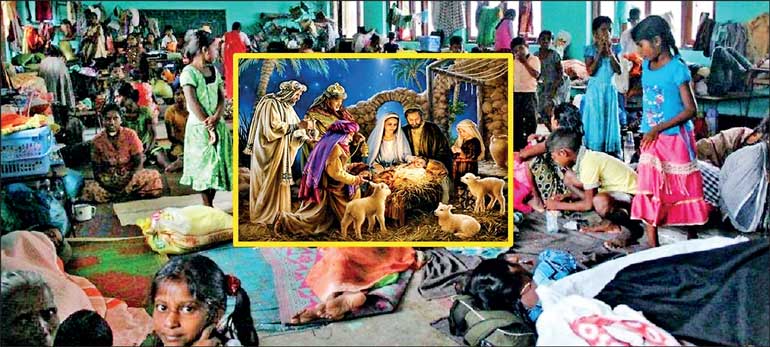

We Sri Lankans are showing solidarity in recovering from the devastating Ditwah, one of the worst climate catastrophes ever seen. It is not just a time to relax and refresh, but also to reflect and to reinforce. Despite the overly commercial coverage of Christmas, the true serenity associated with spirituality is still significant. As someone boldly said the other day, Christmas is certainly not the Santa’s Birthday. Let us reflect on it further.
Overview
A “manger” in the little town of Bethlehem became world famous because of Christmas. I think it is high time to be brilliant on basics in responding to the call to be spiritual. It supersedes traditional religious boundaries. In essence, Christmas invites us to awaken ourselves towards spirituality. I would call this a message from “manger” to “managers”.
Let us see what spirituality from a management perspective. It involves a term for many beliefs and practices intended to develop one’s inner life. It is associated with a feeling of interconnectedness. In other words, it is the vital principle that gives breadth of life to physical organism.
A time for living, a time for believing
A time for trusting, not deceiving,
Love and laughter and joy ever after
Ours for the taking, just follow the master.
The above is an extract from one common Christmas carol we hear, "Mistletoe and Wine". It was made popular as a single by Cliff Richard. We observed how many corporates committed in organising Christmas carols during recent weeks. It has become not a mere annual ritual but a deeper organisational phenomenon in strengthening employee engagement. Participating in carols is a demonstration of unity, solidarity, and team collaboration as a set of professional colleagues. In turn it helps the needy in the society as well.
The essence here is synergy in action, leaving aside differences. This has clear connection to what management scholars termed as “spiritual intelligence.”
Spiritual intelligence in focus
What is Spiritual Intelligence? It is what all great religious leaders aptly demonstrated. It is what was available in leaders of all spheres of life from time immemorial. It is what got repackaged by Dana Zohar, a quantum physicist in late nineties. Interestingly, her work heralded an era where whole new focus on spirituality linked to intelligence began.
As Zoar vividly describes, spirituality is to “know” who you are, and Spiritual Intelligence is to “realise” who you are and to live life in that awareness. You have always been who you are, and, in truth, you can never be other than who you are, but it requires “realisation” i.e. that moment when you “see it”, when you “get it” and then you “be it”.
Spirituality is different to being religious. You can go to all the religious places in the world but if you do not demonstrate values in your action, you are not spiritual yet. Being spiritual is essentially maintaining three connections. They are connecting to self, to others and to the universe (higher being).
Components of spiritual intelligence
Based on the work done by Zohar and Marshall (1997), the following have been highlighted as key components.
Self-Awareness
Knowing what I believe in and value, and what deeply motivates me. As Thich Nhat Hanh, A reputed Vietnamese Monk told once, “feelings come and go like clouds in a windy sky. Conscious breathing is my anchor”.
Spontaneity
Living in and being responsive to the moment.
Being Vision and Value led
Acting from principles and deep beliefs and living accordingly.
Holism
Seeing larger patterns, relationships, and connections; having a sense of belonging.
Compassion
Having the quality of "feeling-with" and deep empathy.
Celebration of Diversity
Valuing other people for their differences, not despite them.
Field Independence
Standing against the crowd and having one's own convictions.
Humility
Having the sense of being a player in a larger drama, of one's true place in the world.
Tendency to ask Fundamental "Why?" Questions
Needing to understand things and get to the bottom of them.
Ability to Reframe
Standing back from a situation or problem and seeing the bigger picture; seeing problems in a wider context.
Positive use of Adversity
Learning and growing from mistakes, setbacks, and suffering.
Sense of Vocation
Feeling called upon to serve, to give something back.
Having looked into the components of spiritual intelligence, it will be interesting to see its connection to values.
Values as the core
Jim Collins’ best-selling book, "Built to Last: Successful Habits of Visionary Companies” conclude that truly great companies are visionary and value driven. In his latest book, "Good to Great: Why Some Companies Make the Leap and Others Don’t,") Jim Collins researched 11 companies who made the transition from being good companies to being "great" companies on par with the companies in "Built to Last". A key finding was that each company had what he calls "Level 5 Leadership" or in simple terms, leadership at its greatest level.
The logical connection here is that great leaders seem to demonstrate most or all of the characteristics described as Spiritual Intelligence by Zohar. Great leaders showed a profound personal humility and a powerful faith that they and their company would prevail in the end, regardless of the difficulties.
Spiritual intelligence as five-fold capacities
Robert Emmons (2000) illuminates us on five key capacities of spiritual intelligence. They are as follows:
1. Capacity to transcend the physical and material
This refers to mental action of thinking beyond what is seen. It involves a deep level of thinking.
2. Capacity to experience heightened states of consciousness
This is essentially mindfulness. An area where conscious breathing can be of very high importance.
3. Capacity to sanctify everyday experience
In simplifying, this refers to accepting things as they are rather than as they ought to be. It makes one positive and constructive.
4. Capacity to utilise spiritual resources to solve problems
Relying on your “built in wisdom “or trusting the gut in approaching problems where there is no precedence is what it means.
5. Capacity to be virtuous
The reference here is to be ethical in demonstrating values in action.
It seems the common thread that cuts across all above aspects is the connectivity.
Spirituality in action
Spirituality should be reflected in action. Four Zen-like principles which are simple as ideas yet so deep as actions shed light on this.
Whoever comes is the right people.
Whatever happens is the only thing that could have happened.
Whenever it starts is the right time.
Whenever it is over, it is over.
By practicing spiritual intelligence, Seven Sins in the world as identified by Mahatma Gandhi can be overcome, at least where an individual has some influence.
Spiritual Intelligence should be seen more in practice than in preaching. It applies to business managers and public administrators alike. It reminds me of one of my precious childhood memories of visiting a remarkable personality, and now I know that he was highly spiritually intelligent.
I together with my parents visited Rev. Fr. Mercelline Jayakody, who was at the old Catholic Church of Pilapitiya, Kelaniya. His room had a beautiful scenic view of Kelani River. Perhaps he would have been influenced to write many Sinhala carols connecting natural beauty of Sri Lanka to nativity of Christ. When he wrote:
“Dina dina wehi kalu barawenawa, Maweli ganga diya borawenewa, Naththaa Kath beda gene enawa, Wehibara Uduvapaye”
(Christmas comes with loads of gifts in rainy December when waters of Mahaweli becomes murky”.
Aftermath of devastating Ditwah
It was Cardinal Malcolm Ranjith who emphasised a need for spiritual happiness over extravagance, in a message after the devastating Ditwah. It highlights the need to support the suffering, in avoiding excessive extravaganza. St. Paul offers us hope in his writings. “We are hard pressed on every side but not crushed; perplexed, but not in despair; persecuted, but not abandoned; struck down, but not destroyed” (2 Corinthians 4:8-9).
Based on the details currently known, over 600 people have been confirmed dead due to rain, flood, and landslide-related incidents while over 300 people are still missing. The Kandy District has the highest number of fatalities and more than two million people across all 25 districts have been affected. Nearly 1.4 million people have been displaced into temporary shelters. More than 75,000 houses have been damaged, with nearly 5,000 completely destroyed. One third of the country had to suffer for some time without water and electricity.
Way forward
Let me conclude with what Rev. Fr. Mercelline Jayakody, aptly hailed as the Priest of the Temple (Pansale Piyatuma), wrote in Sinhala highlighting the social reality of Christmas. My translation of it goes as follows:
My Christmas is…
When poor are well fed
When ragged cloths are no more
When your hands are consoled
When sin “goes” to Church.
It is all about being humane. Let us be human beings and not “human doings” or “human undoings”. There is no better time than this week, just before Christmas, to reflect on ourselves. Let that inward journey be a truly meaningful one. Merry Christmas to all.
(The author is a Senior Professor in Management, and an Independent Non-executive Director, can be reached at [email protected], [email protected] or www.ajanthadharmasiri.info.)




