Thursday Oct 15, 2026
Thursday Oct 15, 2026
Monday, 27 April 2026 00:23 - - {{hitsCtrl.values.hits}}
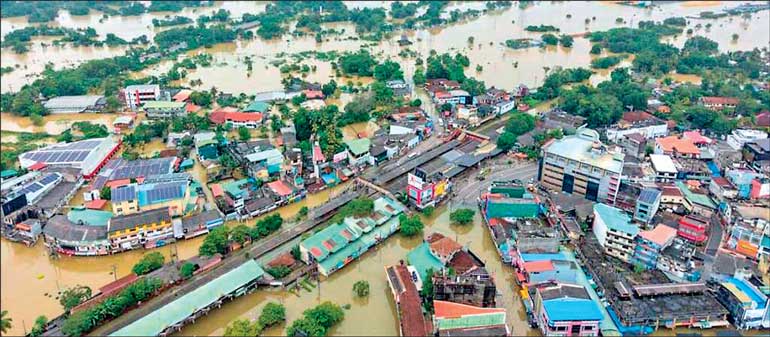
 Sri Lanka has been a serial victim of a brutal cocktail of natural and man-made macro disasters in recent times. These twin forces have not only claimed thousands of lives but have systematically crippled the country’s economic foundation, exposing a dangerous void in proactive national planning.
This relentless series of disasters has ranged from devastating natural phenomena to man-made catastrophes. The 2004 Indian Ocean Tsunami, triggered by a massive undersea earthquake, caused an unprecedented loss of more than 35,000 lives and destroyed assets valued at approximately $ 1 billion, equivalent to 4.5% of the GDP at that time. More recently, Cyclone Ditwah (2025) left a trail of destruction across all 25 districts. According to the World Bank, the cyclone caused $4.1 billion in direct physical damage to infrastructure, agriculture, and housing, was responsible for 618 confirmed deaths, and disrupted the livelihoods of two million people. The nation’s food and energy security has also been frequently compromised. Heavy flooding in 2003, 2007, 2011, and 2024 severely impacted food supplies, while prolonged droughts in 2001, 2016, and 2018 led to electricity rationing and significant decreases in agricultural outputs. Man-made disasters have played their part in exacerbating the nation›s woes. The 2017 Meethotamulla Garbage Mound Collapse, a landfill failure that buried dozens of homes, caused heavy fatalities. The 2022 Economic and Social Crisis stemming from Government mismanagement and policy failures led to a sovereign debt default and a currency freefall. With external debt skyrocketing past $50 billion (exceeding 100% of GDP), the economy contracted by 7.8% in 2022 alone, freezing essential imports and shattering daily life. Additionally, frequent landslides arising from unauthorised construction and poor land management have caused many deaths and disrupted daily life. Today, the country continues to struggle, beset by the collateral effects of the "Iran Conflict." The list of challenges seems endless. We are paying big pounds for our penny-driven approach.
Financing
Despite the staggering costs in human lives, social disruption, and economic instability, the most frustrating and distressing element of this predicament is not the fury of nature or the severity of man-initiated transgressions, but the glaring absence of structured, proactive risk management at the national level. Sri Lanka’s approach remains stubbornly reactive; a model centered heavily on post-disaster relief rather than strategic pre-disaster planning. Despite the available data, the allocation of a paltry Rs. 5 to 6 billion for mitigation activities in the National Budget 2026 speaks of the scant importance placed by the authorities on proactive risk management. For a country that has historically paid a staggering price in human lives and economic decimation, as described before, operating without a structured, dedicated climate adaptation and resilience fund in the main budget is tantamount to gross negligence. Because of the lack of built-in provisions, the State had to call on a massive Rs. 500 billion supplementary Budget to handle the immediate fallout and reconstruction of infrastructure and housing and to shore the livelihood of persons affected by Ditwah. Despite the facts that stare in our face, the State has, over the years, treated predictable climate patterns and the ever-recurring man-made hazards as isolated, unforeseen events with low probability of occurrence, rather than as inevitabilities. Reacting to disasters after the fact is a failed strategy. Sri Lanka can no longer afford to treat survival as a roll of the dice. The nation urgently requires a robust, institutionalised framework for national Risk Management to safeguard its economy and its people against the next strike.
Risk management
Sri Lanka suffers from an illusion of preparedness. It boasts of a formal Disaster Recovery Policy, an Institutional Disaster Management Plan, and the Disaster Management Act No. 13 of 2005. On paper, the country is ready for anything. But the State operates in a chronic cycle of reactive chaos. It is said that the National Council for Disaster Management (NCDM), the apex body chaired by the President and vice-chaired by the Prime Minister, has failed to abide by the statutory minimum of four meetings per year. National disaster councils fail to convene outside active crises, leaving robust policies strictly on paper. Critical early warnings go unheeded. Instead of investing in resilient infrastructure, modernised forecasting, and cohesive inter-agency coordination, the leadership defaults to reactive, post-disaster finger-pointing. This continuous cycle of administrative inertia and localised neglect has transformed manageable natural hazards into national catastrophes. This is a state that must be redressed immediately.
The persistent lack of a forward-looking approach means Sri Lanka remains perpetually exposed, scrambling to fund recovery with borrowed time and money rather than actively preventing the next catastrophe. To break this exhausting cycle of devastation, Sri Lanka must pivot away from ad-hoc crisis management and embrace a disciplined, forward-looking risk governance model. The tragic reality of Sri Lanka’s risk management framework is not a lack of paperwork, but a lack of political will. The nation has no shortage of masterfully drafted policies, beautifully bound frameworks, and international compliance checklists. Yet, a glaring, systemic chasm separates these theoretical procedures from actual, life-saving execution.
 In an increasingly volatile and interconnected global landscape, National Risk Management (NRM) has evolved from a bureaucratic afterthought into a fundamental pillar of sovereign survival, economic prosperity, and social stability. Governments face an unprecedented convergence of threats ranging from rapid climate change, cyber warfare and pandemics to supply chain fractures and geopolitical instability. Managing these at a national level is not merely about disaster response; it is about the proactive preservation of a nation’s future. Sadly, Sri Lanka’s modus operandi in respect of disaster governance has been reactive crisis management, paying heavily after the horse has bolted. This must change. A proactive NRM framework with the capacity to systematically identify, assess, and mitigate vulnerabilities ranging from political instability and regulatory shifts to economic volatility and natural disasters, before they can escalate into catastrophic failures, is a pressing need. This is the foresight that is essential in safeguarding critical infrastructure, securing financial ecosystems, and fostering the public trust required for continuous economic investment. When a nation operates with a clear-eyed understanding of its risk profile, it builds the resilience necessary to absorb shocks and seize emerging global opportunities. For foreign investors, who commit capital to long-term physical assets, NRM serves as the ultimate litmus test for security. Strong NRM lowers the “country risk premium,” directly reducing the cost of capital and increasing the predictability of future cash flows. Conversely, weak risk management signals a threat of asset expropriation, currency inconvertibility, or sudden policy reversals, actively repelling foreign direct investment (FDI).
Global benchmarks
Singapore, Switzerland and New Zealand are three countries that immediately come to mind as global benchmarks in forward-thinking risk management. These practices have produced for them a competitive advantage via the assurance of a safe environment.
Singapore treats risk management as a core driver of its national strategy. Facing limited natural resources and relying heavily on global trade, the City-State utilises a ‘whole-of-Government’ approach, being an approach where diverse Government ministries, agencies, and departments jointly coordinate policies and programs in breaking down administrative silos to achieve a unified and effective response to complex, cross-cutting challenges. Singapore’s National Security Coordination Secretariat (NSCS) continuously scans the horizon for emerging threats, ranging from maritime supply disruptions to digital infrastructure vulnerabilities. This proactive stance has created one of the safest, most stable investment climates in the world. It is not surprising that Singapore has solidified its position as a top FDI destination, attracting Singapore Dollars 14.2 billion in 2025 in fixed asset investment commitments. This is a 5% increase year-on-year, despite a challenging global environment.
Regularly ranked at the top of global resilience indices, Switzerland excels in economic and regulatory risk management. The Swiss Government mandates rigorous, decentralised risk assessments across cantons, focusing on inflation controls, climate adaptation, and strict anti-money laundering frameworks. These measures have created a highly predictable legal and financial environment that effortlessly attracts top-tier global investment, innovation, and talent.
 Situated on the ‘Pacific Ring of Fire’, New Zealand is prone to natural hazards that it finds difficult to avoid. So, it masters managing them. Its National Risk Register tracks specific catastrophic scenarios under a “4Rs” framework of reduction, readiness, response, and recovery. By funding science-backed reduction strategies long before a crisis occurs, they effectively minimise loss of life and accelerate economic recovery when earthquakes or extreme weather events do strike.
National Risk Management is a sine qua non of sovereign responsibility. It is the fundamental process through which a State identifies, assesses, and mitigates threats to its population, economy, and national security. It requires breaking down Government silos, investing in predictive data analytics, and shifting political will from short-term fixes to long-term resilience. Nations that aggressively anticipate the “unknown” of tomorrow will not just survive the next crisis; they will thrive despite it.
Multi-tiered National Risk Management Framework
To transition from a culture of emergency reaction to one of institutionalised resilience, the Government must adopt a multi-tiered National Risk Management Framework built on the following basic principles,
> Mandatory Risk Integration in Capital Development. National and local planning authorities must treat disaster risk as a direct financial and physical constraint and enforce strict zoning laws by halting unplanned urban expansion and cutting steep slopes for infrastructure in high-risk landslide zones. All public infrastructure must be climate resilient. All major State projects, such as roads, bridges, reservoirs, etc., must undergo mandatory multi-hazard risk assessments before capital is allocated,
> Transition from Relief to Resilience Funding. The current model of scrambling for funds after a disaster occurs is economically unsustainable and leaves the most vulnerable populations stranded. Establish a Statutory Climate Resilience Fund that is strictly non-divertible and dedicated to pre-disaster mitigation, such as building robust drainage networks, reinforcing slopes, and restoring natural flood-buffering wetlands, > Introduce sovereign disaster insurance and weather-indexed insurance products for smallholder farmers to buffer the economy from localised agricultural wipeouts,
> Decentralise Execution and Empower Communities. Top-heavy decision-making creates bottlenecks when rapid action is required. Empower local authorities. Devolve the execution of disaster management plans to the Divisional Secretariats and Grama Niladhari (village) levels. These levels must be equipped with localised hazard maps. Train and equip local community leaders in evacuation protocols, first aid, and localised early-warning communication to maximise survival rates in the critical first hour of an event, > Data-Driven Early Warning Systems. Introduce modern technology to eliminate blind spots and predict complex emergencies. Upgrade meteorological and hydrological tracking to provide real-time, granular predictive data directly to citizens’ mobile devices,
> Leverage Nature. Use nature-based solutions, such as restoring mangrove belts on the coasts and maintaining upstream forest cover, to act as natural, low-cost shock absorbers. These are just a few quick steps.
Vulnerability to climate-induced hazards
 The anatomy of macro disasters in Sri Lanka is characterised by a high vulnerability to climate-induced hazards, such as floods, landslides and droughts, which are increasingly exacerbated by rapid, unplanned urbanisation, environmental mismanagement and self-inflicted economic fragility. While nature provides the trigger, human negligence constructs the disaster. When we replace absorbent wetlands with concrete jungles, obstruct natural drainage with plastic waste, and strip hillsides of stabilising forests, a heavy downpour stops being a weather event and becomes a death toll. By defying ecological boundaries for short-term profit, Sri Lankan society has transformed manageable seasonal rains into “unprecedented” catastrophes. We are not just victims of the elements; we have been the architects of our own vulnerability.
For example, Sri Lanka is acutely vulnerable to severe droughts, which trigger a devastating ripple effect across the economy. As a nation reliant on hydropower for a significant portion of its grid, receding reservoir levels necessitate either expensive thermal power or disruptive load shedding. Simultaneously, water scarcity parches the “Rice Bowl” regions, decimating paddy yields and threatening food security. This dual dependency makes drought not just an environmental issue, but a profound systemic risk to national stability. Proactive mitigation demands a shift from reactive relief to systemic resilience. We must modernise water management by restoring ancient tank cascades and expanding rainwater harvesting to buffer dry spells. In the energy sector, diversifying into solar and wind is critical to reduce hydro-dependency during droughts. Furthermore, implementing climate-smart agriculture, using IoT for precision irrigation, and using drought-tolerant seeds protect food yields. Finally, establishing a national risk-governance framework that mandates proactive infrastructure audits and integrates parametric insurance will ensure the State can respond financially and logistically before a seasonal shift escalates into a national disaster.
Historically, Sri Lankan governance has been trapped in a reactive mindset that favours immediate visible relief over invisible prevention. From the 2004 Tsunami, the 2022 economic collapse to Ditwah and disruptions caused by the “Iranian War”, the State has been compelled to divert development budgets to emergency “cure.” Political short-termism and fiscal fragility have birthed this. Prevention offers no “ribbon-cutting” political glory and takes years to yield results, making it unattractive within five-year electoral cycles while persistent debt and foreign exchange shortages have resulted in the Treasury lacking “upfront” capital for proactive risk tools like ‘strategic reserves’ and parametric insurance. This forces a reliance on expensive, high-interest emergency borrowing. Ex-ante financing by resorting to pre-arranged disaster risk financing, i.e. catastrophe bonds and contingency credit lines, in ensuring liquidity without depleting the national budget is something to look at. We must decouple national survival from weather variability and the other effects of nature. Prevention is an investment in sovereignty; cure is merely a cost of failure.
The National People’s Power (NPP) Government stands at a historic crossroads where its unprecedented mandate provides the moral and political capital to dismantle the culture of reactive governance. With a philosophy rooted in collective accountability, the administration must now transition from rhetoric to ruthless enforcement. This glorious opportunity requires the “velvet gloves” to come off. Approving authorities and regulators must not be permitted to short-circuit legislation for political or commercial expediency. A proactive national risk-prevention framework is only as strong as its weakest link. By institutionalising strict discipline and uncompromising penalisation for regulatory negligence, the NPP can ensure that disaster mitigation is a mandatory standard rather than a discretionary choice. True selfless leadership demands the courage to enforce the law today to safeguard the nation’s tomorrow. Ad-hoc, reactive cures must give way to systematic, proactive prevention. Strict, non-negotiable compliance must overtake the bypassing of regulations via influence. Whilst I am not an advocate of leading through fear, at least in the immediate term, leniency for regulatory failure in risk management must be replaced by severe penalties for negligence.
Sri Lanka cannot afford to view Risk Management as a burden. It must recognise it as an economic catalyst. By shifting from chaotic reactions to aggressive, data-driven mitigation, the nation will do more to safeguard its people and avoid staggering recovery costs. The signal to the global market must be powerful and unmistakable. We are prepared. Predictability arising from preparedness breeds investment. When Sri Lanka actively derisks its infrastructure, energy, and governance, it will transform from a high-risk gamble into a magnet for Foreign Direct Investment.
(The author is, currently, a Leadership Coach, Mentor and Consultant and boasts over 50+ years of experience in very senior positions in the Corporate World – local and overseas. www.ronniepeiris.com)




