Sunday Sep 13, 2026
Sunday Sep 13, 2026
Saturday, 18 July 2026 04:59 - - {{hitsCtrl.values.hits}}
 Our country has entered a period of development in which strategic opportunities, risks, and challenges are concurrent. We must therefore be more mindful of potential dangers, be ready to withstand high winds, choppy waters, and even dangerous storms - President Xi Jinping at the 20th party congress
 This reflects the readiness of the world’s second largest economy’s military and the priority its government places on national defence while pursuing broader development goals. On the occasion of the 99th Anniversary of the founding of People’s Liberation Army (PLA) of China, which falls on 1 August, the Embassy of China in Sri Lanka held a commemorative celebration on the evening of 21 July 2026.
On 1 August 1927, the Communist Party of China (CPC) launched an uprising against the Nationalist Party of China (KMT) in Nanchang, the capital of Jiangxi Province. The Nanchang uprising marked the birth of the CPC’s armed wing and the beginning of the party’s independent command over military operations. In the years leading up to President Xi Jinping’s rise to power, the Chinese military underwent a significant transformation, achieving rapid advancements that strengthened its overall capabilities.
When President Xi Jinping came to power, a new phase of military development began, marked by a stronger emphasis on modernisation and strategic reforms. At the 12th National Congress in 2013, President Xi Jinping described his security outlook, noting that “the stronger we get, the larger the obstacles and pressure will be. The more external dangers there will be. This is the reality we cannot escape as China gets stronger” .
Compared with his predecessors, President Xi Jinping has taken a far more hands on approach to military affairs, dedicating significantly more time and efforts to defence issues. With that commitment, the country continues to strengthen its capacity to safeguard national sovereignty, security, and development interests. To meet the demands of a military modernisation with Chinese characteristics, the government has maintained a gradual increase in defence spending, ensuring that advancements in national defence keep pace with China’s broader economic and social development. Consequently, China boasts the world’s largest navy, holding a higher number of operational warships compared to the USA, as per recent data.
|
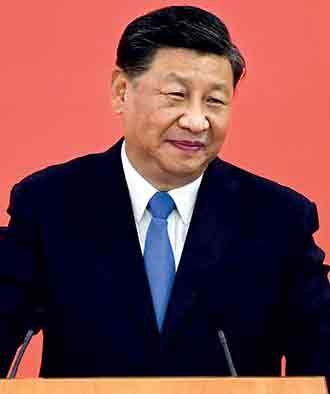
President Xi Jinping
|
Under the national budget, China’s defence allocation for 2026 has been set at ~$281 billion, reflecting a 6.9% increase from the previous year. Defence budget growth has held steady at around 7% annually since 2023, continuing a long term upward trajectory that has seen military spending rise sharply from ~$132 billion in 2014. Increased defence spending is being directed towards advancing the integrated development of mechanisation, strengthening the joint operating system, and accelerating the growth of new domain, high quality combat capabilities. It will also support the modernisation of military logistics, the rapid development of advanced weaponry and defence science, and the enhancement of military training, personal policies, and professional education at academics to cultivate a new generation of highly skilled military talent.
What does it mean for Sri Lanka?
As long standing friends, Sri Lanka and China, having formally established diplomatic relations in 1957, have consistently supported each other on matters involving core interests and key national concerns. Defence and security are such key areas where Sri Lanka can further deepen its cooperation with China, further strengthening the capabilities of the Sri Lankan armed forces.
(The author is a researcher in a private investment research firm. He focuses on broader economic issues, including geopolitical developments, and sustainability matters, and their implications across various sectors with special focus on related developments in China. He holds a Master›s degree in Applied Finance from the University of Sri Jayewardenepura and a Bachelor›s degree in Business Economics with a first-class division from the same university)