Friday Oct 02, 2026
Friday Oct 02, 2026
Monday, 18 May 2026 00:12 - - {{hitsCtrl.values.hits}}
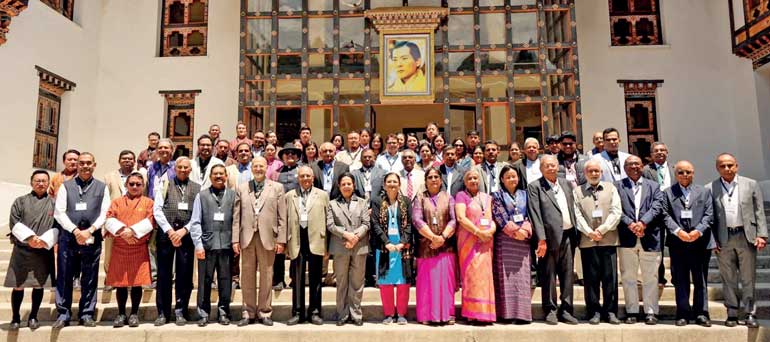
Delegates of the South Asian Management Forum 2026 held at Royal Institute of Management, Bhutan
 I was delighted to be a part of the Sri Lankan delegation representing the Postgraduate Institute of Management (PIM) at the recently concluded South Asian Management Forum (SAMF) 2026, jointly organised by the Association of Management Development Institutions South Asia (AMDISA) and the Royal Institute of Management (RIM), Bhutan. I was looking forward to visiting the “land of the thunder dragon” (Druk Yul), which is famous for pioneering the Gross National Happiness Index (GNHI). Today’s column reflects on that happy and harmonious experience.
Overview
The 17th South Asian Management Forum (SAMF) on the theme “Resilient Leadership and Innovation: Navigating South Asia’s Dynamic Governance Landscape,” took place on 11 - 12 May 2026 in Thimphu, Bhutan. It was widely attended by delegates from many nations, including India and Pakistan. It was an opportune moment to discuss the pertinent challenges affecting the region, with a collaborative future in focus.
The previous forum was held in Dhaka, Bangladesh (2021) on the theme “Impact of Pandemic on Business and Management: Strategies for Sustainability and Growth." Through plenary and concurrent sessions, SAMF promotes dialogue and collaboration, generating actionable strategies for advancing management and governance. I remember myself virtually delivering Forth Dr. Dharnidhar Prasad Sinha Memorial Oration as a Part of the South Asian Management Forum, on “Leading in Pandemic Times: From Resilience to Revival.”
As the conference deliberated, South Asia is at a pivotal moment. Shaped by technological transformation, economic volatility, and global uncertainties, the ability of organisations to remain resilient while fostering innovation has become vital for success.
The conference further explored how adaptive leadership and innovative cultures enable agility, inclusiveness, and foresight in times of disruption. From digital startups to legacy enterprises, the shared imperative is to innovate not just products, but systems and mindsets. By convening scholars, policymakers, and business leaders, the Forum seeks to build cross-sectoral collaboration and actionable insights for shaping a more responsive, inclusive, and future-ready South Asia.
South Asia as a “region of paradoxes”
As the World Bank observes, South Asia is a profound development paradox. It drives rapid global economic growth and boasts a massive pool of elite, world-class talent, yet it houses the largest concentration of multidimensional poverty on the planet. The juxtaposition of "best brains" and "worst poverty" highlights a deeply uneven distribution of opportunity across the region.
South Asia has become a global engine for Science, Technology, Engineering and Mathematics (STEM). I was so impressed by the cost-effective initiatives of Indian Space Research Organisation (ISRO), once I saw their launching pad located in Sriharikota, Andhra Pradesh. Driven by establishments such as Indian Institutes of Technology (IITs), and Indian Institutes of Management (IIMs), with the presence of vibrant IT offshoring corridors, such brains are being utilised for broader purposes.
Despite this undeniable intellectual and economic prowess, the region struggles with severe structural inequalities. South Asia accounts for a massive share of the world's extreme poor, with significant populations living on under $2.15 a day. The region faces notoriously high rates of child malnutrition and stunting, which remains paradoxically high even in areas that have experienced rapid GDP growth.
Further, agrarian societies across countries like Bangladesh and India suffer from inequitable access to land, forcing millions of rural households into vicious cycles of deprivation. If we have a broader look at the South Asian agriculture, which employs roughly 70% of the region’s population and feeds 1.8 billion people, is constrained by climate-induced weather extremes, shrinking land sizes, and global supply chain vulnerabilities. These structural and environmental issues threaten food security and rural livelihoods.
Broad challenge of “bridging the gap”
It is easy to recommend actions but difficult to implement due to a variety of constraints. Closing the infrastructure deficit could be one key aspect. It includes expanding basic services such as roads, telecommunications, and electricity, in connecting marginalised communities to urban economic hubs.
One cannot underestimate the need to invest in human capital. It includes enhancing public health and foundational education that directly equips disadvantaged populations to participate in the modern economy. It also covers economic and gender inclusion. Policies must focus on female labor force participation and reducing caste or location-based discrimination to ensure growth is truly shared.
Regional Integration should be another priority. In terms of digital financial inclusion, expansion of mobile banking and regional fintech integration can be done so that unbanked populations can access micro-credit, remittances, and cross-border digital payments. Implementation of power-sharing agreements to tap into surplus energy (e.g., hydroelectricity from Nepal or Bhutan) and route it to energy-deficit, impoverished regions across the subcontinent, lowering utility costs is also possible.
Investing in regional railways, roads, and maritime logistics to lower trade and transport costs, which are historically up to 50% higher than in OECD nations is another key aspect. This connects rural producers to massive urban and global markets. Digitisation of customs and streamlining of border paperwork to reduce transaction times, allowing small-scale merchants to participate in regional value chains, should be given priority.
Creation of a regional digital talent hub similar to the EU’s framework is another idea already mooted. This allows top-tier tech and research professionals in India or Sri Lanka to collaborate seamlessly with institutions across Bangladesh, Nepal, and Pakistan. Leveraging regional online learning platforms to democratise access to education, bridging the skills gap for rural and marginalised populations also needs to be done.
Establishment of joint research facilities as regional research centres, focused on South Asia’s most pressing issues, such as sustainable agriculture, climate resilience, and affordable healthcare, is another possible action. Proper utilisation of knowledge platforms such as the ones created by the Asian Development Bank for regional cooperation and capacity-building programs, should be focused on.
Back to Bhutan
I saw a better version of Nuwara Eliya in Thimphu, Bhutan with exposure to fresh air. Yet, with its natural beauty, it has numerous barriers for sustained economic growth. To begin with, an estimated 9% of Bhutan's population, particularly educated, working-age adults has emigrated in recent years. This has left critical sectors like disaster management, healthcare, and infrastructure severely over-dependence on imports, and fluctuating foreign currency reserves. While tourism is a major GDP driver, the sector's post-pandemic recovery has been slow due to a hefty tourist levy.
The day we arrived in Bhutan, the newspaper headline spoke of high suicidal rates among the youth. Despite high literacy rates, a lack of private sector opportunities has led to persistent youth unemployment, prompting many to seek jobs in developed nations such as Australia. The way I saw, beneath the conservative nature of the attire, lies a multitude of interests, desires and hopes like any other youths representing any other nationality.
Bhutan’s Gross National Happiness (GNH) index is more a holistic policy tool, than a literal measure of day-to-day emotional joy. It influences the government to prioritise long-term societal well-being such as environmental protection, health, and cultural preservation over rapid, GDP-driven economic growth. Instead of measuring only economic output, it tracks nine specific domains, including psychological well-being, health, education, time use, cultural diversity, good governance, community vitality, ecological resilience, and living standards.
Dynamics of Dasho Tshering Tobgay
It was amazing to meet in person, the brilliant Prime Minister of Bhutan. He shared a few interesting thoughts on governance and accountability at the SAMF. I enjoyed his TED talk on being the world’s first “carbon negative nation” which demonstrated professional mastery. He assumed office on January 28, 2024, representing the liberal People's Democratic Party (PDP).
His western education is very evident in the way he has been conducting himself. In 1990, Tobgay received a Bachelor of Science in mechanical engineering from the University of Pittsburgh's Swanson School of Engineering after obtaining a scholarship from the United Nations. Tobgay also completed a master's degree in public administration from the John F. Kennedy School of Government at Harvard University in 2004. Interestingly, he is a schoolmate and good friend of Singaporean Prime Minister Lawrence Wong.
“Even with our limited resources and huge geographical challenges, we have managed to prioritise climate action, social progress, cultural preservation and environmental conservation because the happiness and wellbeing of our people and our future generations is at the centre of our development agenda,” Tobgay said in an interview with The Guardian. “If we can do it, developed rich countries with a lot more resources and revenue can – and must do a lot more to reduce their emissions and fight the climate crisis.”
Way forward
With my long association with AMDISA, having regular visits to Hyderabad, I have been dreaming of a future South Asia in line with the European Union, having greater mobility and better cooperation. Yet, it is still bizarre with blurring conflicts among nations. Rather than cursing the darkness, it is better to light a candle. That is what we did as like-minded researchers in Bhutan, deliberating actions towards betterment of humanity in the “humanly rich” South Asia.
(The author, a Senior Professor in Management, and an Independent Non-Executive
Director, can be reached at [email protected], [email protected] or www.ajanthadharmasiri.info.)



