Wednesday Nov 18, 2026
Wednesday Nov 18, 2026
Wednesday, 18 November 2026 00:22 - - {{hitsCtrl.values.hits}}

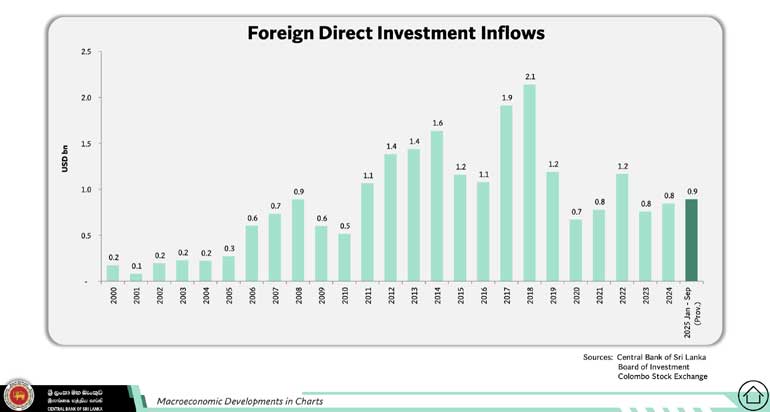
 The President's Budget 2027 announced a proposal to set up a new company dedicated to promoting investment is a welcome step. It is to be wholly-owned by the Treasury, staffed by professionals with private sector and international experience, and offer market-competitive salaries. A bit like ‘GovTech’ today, and similar to ‘InvestSL’ envisaged in the Economic Transformation Act (2024).
The announcement is a timely recognition that the current arrangement has not served Sri Lanka well. Annual average FDI inflows have languished around $ 1.2 billion over the past decade, and in the last five years it barely even reached $ 1 billion a year (CBSL Macroeconomic Chart Pack, 14 January 2026). The Board of Investment has long been asked to be promoter of investment, regulator and facilitator of entry, approver of incentives, and landlord of zones all at once. An agency that must court investors while also policing them, and bound by public sector pay scales and procedures, inevitably struggles to compete with many of the more agile, specialised promotion agencies seen in the rest of Asia.
‘Invest SL’ - a starting point
The Government can draw on earlier thinking to help fast-track the implementation of this Budget 2027 proposal, rather than starting from scratch. Chapter XIII of the Economic Transformation Act of 2024 provides for establishing a new entity called ‘Invest Sri Lanka’, a dedicated investment promotion company incorporated under the Companies Act. The Chapter sets out the details - Invest SL was to be governed by a small professional board and empowered to hire expertise at competitive market rates. Its mandate: identify investment opportunities, promote Sri Lanka as a destination, link investors with local partners, and facilitate the establishment, retention and expansion of investments. That design came out of nearly a year of deliberation on the problems that needed solving, a review of global evidence on what makes promotion agencies effective, and a study of how peer countries do it.
Getting the model right
Beyond the announcement, what will matter next is how the new agency is designed. Two questions deserve careful thought.
First, how will the agency attract the right people? Competitive pay is necessary but not sufficient. The roles must offer a good amount of autonomy and a chance to work on deals that matter, or the best candidates won’t be interested to come. Nor should it be assumed that “a private sector background” alone makes someone the right fit. Selling a country to investors is a distinct skill, needing people who understand both how investors decide and how Government works. The agency should also be open to hiring foreign nationals, including market specialists from the countries Sri Lanka most wants to attract investment from. They can bring networks, language and an insider's understanding of how firms there make decisions. I recall how our approach and messaging to a Japanese investor audience during an investment promotion mission to Tokyo was greatly enriched and refined because the BOI had an in-house Japanese national advisor stationed from JETRO at that time. 
Second, how will the agency use outside expertise without depending on it? When a new agency must show results quickly, the temptation is to fill gaps with consultants. Used well, they can add real value, especially at the start. But consultants must be hired with clear deliverables and responsibility for outcomes. Their contracts can be tied to measurable results, such as qualified investor leads or projects that progress to commitment, and come with an explicit mandate to transfer skills to permanent staff. Above all, the core work cannot be outsourced: ‘learning’ must be an explicit objective. Sector knowledge, investor relationships and institutional memory must be steadily built in-house and retained – dependence on consultants must steadily fade.
Lost between interest and investment
A new, dedicated investment promotion agency is a necessary adjustment to the institutional architecture to drive FDI, but not a sufficient one on its own. An investor's interest converts to actual investment in the country only after land has been allocated, incentives are clarified, approvals have been granted, and operations begin. That is where Sri Lanka has too often lost investors. A recent Auditor General's report was quite revealing, in that regard (as reported in The Morning newspaper of 15 November 2026).
According to the report, of the $ 12.5 billion in investment committed under BOI agreements between 2015 and 2024, only $ 5.2 billion (around 41%) had materialised by the end of 2025. Of the 117 projects the BOI approved in 2025, only 65 went on to sign agreements. Some approvals have dragged on for up to three years. A capable investment promotion that generates strong leads could easily fall flat if the conversion stage is this slow, fragmented, and unpredictable. The appointment of a new Officials Committee on Land Allocation can help ease some of these issues.
Part of a broader reform
This is why the Economic Transformation Act did not stop at a promotions agency. It envisaged Invest SL as one part of a wider institutional overhaul, working alongside a high-powered Economic Commission that would replace the Board of Investment and take charge of facilitating investment, from approvals and incentives to coordinating across Government. Such a holistic reform is needed to avoid this new promotional agency becoming a well-paid front office for a back office that cannot deliver results.
Equally, investment promotion cannot sit apart from strategic thinking on which sectors will transform the economy. The ETA of 2024 recognised this. It tasked the Economic Commission with formulating national investment and trade policy together (section 32), determining investments that are of strategic importance (section 12), and ensuring that trade negotiations are aligned with the country's strategic export and investment objectives (section 14).
Time for greater ambition
Sri Lanka is on a stronger macroeconomic footing today, and averages of FDI inflows in the recent past need not be an indication of future prospects. A new agency can help lift FDI well beyond the current $ 1.2 billion average, to $ 2 billion and beyond, but only if promotion and facilitation are fixed together, and promotion is linked to larger strategic economic goals.
The proposed new agency's targeting must be closely linked to export development plans, and in sync with Sri Lanka's trade policy, especially the offensive and defensive interests carved out in new free trade agreements. Such joined-up thinking is what ensures investors are pursued in a targeted way, in sectors that diversify the economy, expand exports, bring technology spillovers and connect Sri Lankan firms to global capabilities and global supply chains.
(The author is Co-founder/Director of Centre for a Smart Future (CSF), and has advised on trade and investment strategies for countries in Asia, Africa, and the Caribbean. The author welcomes feedback on the article: [email protected])




