Wednesday Oct 21, 2026
Wednesday Oct 21, 2026
Wednesday, 2 September 2026 00:21 - - {{hitsCtrl.values.hits}}
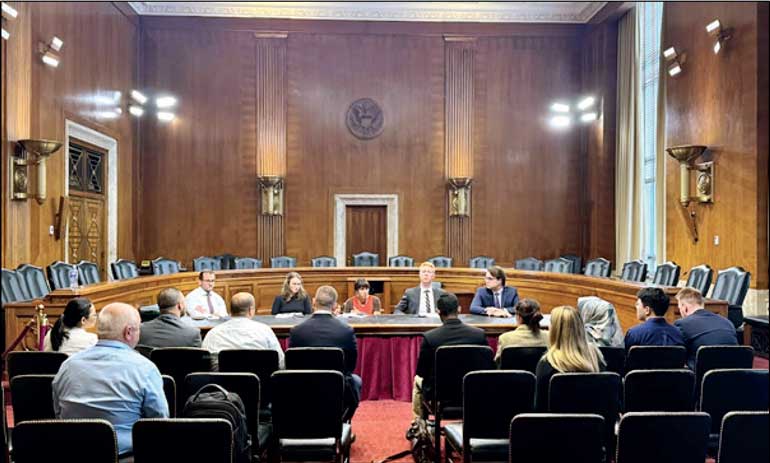
Discussions with US Senate Energy Committee
 The Petroleum Development Authority of Sri Lanka (PDASL) on the 27 August 2026 announced that the country is seeking investors to develop natural gas resources in the Mannar Basin. This presents the country with a question far larger than resource extraction.
If commercially developed, what should success actually look like?
The conventional answer may focus on reserves, production volumes, electricity generation and reduced fuel imports. These outcomes matter. Yet, several other factors weigh in on such developments.
The US Department of State’s International Visitor Leadership Program (IVLP) on Energy as an Economic Driver provided key insights into how the energy industry shapes a country’s entire economy.
Across discussions with US federal agencies, state governments, regulators, utilities, universities and industry, energy was rarely considered in isolation. It was connected to manufacturing, infrastructure, investment, research, employment, regional development and national competitiveness.
The question therefore shifts from, “How do we produce more energy?”, to “What economic opportunities can energy enable?”
That distinction becomes highly relevant as Sri Lanka considers the future of Mannar.
The real opportunity is not simply extracting natural gas from beneath the seabed. It is determining whether that resource can strengthen energy resilience, unlock infrastructure, attract productive investment, develop domestic capability and create lasting economic value.
As such, development of the gas fields in Mannar presents more than an energy opportunity. It presents a forum to rethink how Sri Lanka converts energy resources into national prosperity.
The most valuable aspect of Mannar’s Basin isn’t gas
Discussions following the recent announcement of confirmed natural gas resources in the Mannar Basin should raise questions beyond extraction of the resource. Conversations should also revolve around what it means for Sri Lanka’s economy.
This perspective was repeatedly reinforced through discussions with the U.S. Department of State, the Atlantic Council, and the Wyoming Energy Authority. These institutions demonstrated how energy resources can underpin broader regional development. Reliable and affordable energy can support industrial productivity, attract manufacturing, strengthen supply chains, and create conditions for long-term private investment.
For Sri Lanka, Mannar therefore represents more than another source of energy. Subject to commercial viability, infrastructure requirements and environmental considerations, domestic natural gas could incubate strategic industries across power generation, industrial energy, import substitution and downstream value addition activities. Each of these pathways requires careful evaluation, but collectively they broaden the conversation from resource extraction towards economic value creation.
This distinction is particularly important for an import-dependent economy such as Sri Lanka. The country’s exposure to international fuel prices and geopolitical disruptions has repeatedly demonstrated the economic consequences of energy dependence. A commercially viable domestic resource could potentially strengthen resilience by diversifying energy supply and reducing exposure to imported fuels. However, resilience should not be measured by import substitution alone. The greater opportunity lies in determining whether Mannar can catalyse further productive investment, infrastructure development, employment, and domestic capability.
This thinking is already reflected within Sri Lanka’s National Energy Policy and Strategies (2019), which connects energy security and sustainability with industrial development, investment attraction, competitiveness and environmental stewardship. Mannar now presents an opportunity to translate those principles into an investment strategy.
Ultimately, discovering a resource does not automatically create prosperity. Its economic value will depend on what Sri Lanka chooses to build around it.
If Mannar progresses towards commercial development, success should therefore be measured not only by gas produced or electricity generated, but by the industries, investment, employment and economic resilience that the resource enables.
Infrastructure doesn’t cost economies. It creates them
Finding natural gas does not automatically create economic value. This creates the next question for Mannar: can Sri Lanka plan the infrastructure around Mannar to attract the industries of tomorrow?
Across the United States, infrastructure was not treated simply as an engineering requirement supporting existing economic activity. It was viewed as an economic asset capable of influencing where businesses invest, industries expand, and regional economies develop.
The state of Ohio offered a particularly relevant example. Projects across the state capitalised on established gas, electricity, and rail networks when expanding operations and establishing new facilities. Reliable infrastructure reduced production uncertainty, strengthened supply chains, and provided businesses with greater confidence to commit long-term capital.
In this context, infrastructure did not merely follow investment; it paved the way for investment to occur.
The same principle could shape how Sri Lanka approaches Mannar. Commercial development would require production and processing facilities, gas transportation, storage, and connections to electricity generators or industrial consumers. Associated port, logistics, and transmission infrastructure also become an important topic with this development. These requirements should not be considered independently if Sri Lanka intends to capitalise on its offshore resource.
Instead, Sri Lanka’s infrastructure planning should consider where future industrial demand might emerge and how emerging energy infrastructure could support it. A gas network designed only to move fuel from production to an immediate consumer limits the value generated. Consequently, infrastructure planned alongside industrial zones, ports, power systems, and logistics corridors could potentially create a broader platform for manufacturing, downstream industries, and future regional investment.
Sri Lanka’s National Energy Policy already recognises infrastructure development as a strategic priority, including investment in transmission, natural gas delivery, storage, and modern grid technologies. Now, Mannar provides an opportunity to apply that principle at a larger economic scale.
The strategic question, therefore, is what economic development can Sri Lanka achieve through the infrastructure required for Mannar’s gas fields?
Approached this way, infrastructure planning moves beyond project expenditure and becomes an investment strategy; capable of reducing commercial risk, attracting private capital and shaping where future industries develop.
Innovation does not begin in the laboratory
Developing Mannar should create more than a new domestic energy resource. It should create domestic capability. Sri Lanka’s upstream development will require expertise spanning engineering, geoscience, process technology, environmental management, economics, offshore operations, and other specialised disciplines.
Will these capabilities will simply be imported for individual projects, or will the country deliberately develop this human capital within the country?
The IVLP also demonstrated how universities play broader role in answering this challenge in the U.S. Across the country, universities were active participants in economic development rather than solely centres of academic instruction. Research programs responded to industry challenges, students developed skills for emerging sectors, and partnerships with Government and private industry helped translate academic research into relevant practical applications.
This relationship creates a reinforcing cycle. Industry identifies emerging technical and commercial challenges; universities develop research and talent around those needs; graduates carry new capabilities into industry; while applied research supports innovation and commercialisation.
As industries evolve, their changing requirements flow back into education and research.
The opportunity for Sri Lanka to build a similar connection between resource development and domestic capability has now presented itself. Universities and research institutions should work alongside Government and prospective investors to identify future skills requirements, develop specialised programmes, and align applied research with the technical challenges emerging from offshore gas and upstream development.
Moreover, such collaboration could also extend beyond the immediate requirements of natural gas. Capabilities developed in offshore engineering, subsea systems, environmental management, geoscience, process engineering, and project economics could induce a spillover effect and strengthen Sri Lanka’s ability to participate in other energy and infrastructure industries over time.
Public acceptance cannot be engineered
Discussions with US Senate Energy Committee
While the development of Mannar’s gas basin revolves a lot around discussions about national energy security and economic advancement, many fail to realise its disruption to the locality of the project. This offshore resource inevitably intersects with the communities closest to it; bringing environmental, coastal, fisheries and economic considerations into the same conversation.
This raises a question just as important as the value of the resource itself: what does this development mean for the people of Mannar?
Discussions at the Federal level with the US Department of State reinforced that public confidence is not simply another approval requirement. Successful energy projects depend on communities understanding how development translates into tangible local value. Employment matters, but so do opportunities for local businesses, workforce training, supporting infrastructure, environmental safeguards and sustained regional investment.
Kemmerer, Wyoming, provided a compelling example. Community support for advanced nuclear development was closely connected to the economic opportunities surrounding the project. Employment, workforce development, and long-term regional investment helped position the development as more than new electricity generation. It represented an investment in the community’s economic future.
Mannar presents a similar principle for Sri Lanka, albeit its development context is different. If commercial development proceeds, local communities should not simply host the activities and infrastructure required to develop a nationally significant resource. The hidden potential lies in how local employment, supplier participation, skills development, and regional infrastructure can become part of the project’s value proposition from the outset.
Similarly, credible environmental safeguards and meaningful engagement with coastal and fisheries stakeholders will be essential to building confidence around development. This requires moving beyond consultation as a ‘procedural exercise’. Communities are more likely to develop lasting confidence in the project when they can participate meaningfully in both the decisions and economic opportunities surrounding major infrastructure in their hometowns.
Therefore, the social licence for Mannar will depend not only on what Sri Lanka extracts from the region, but on what the development leaves behind; making public participation a part of the project’s long-term value rather than simply a condition for its approval.
Coordinated institutions build energy economy
Confirming a resource and attracting investor interest are important milestones for Sri Lanka. They are not, however, the measure of Mannar’s eventual success.
The success of Mannar will depend less on discovering gas than on Sri Lanka’s ability to coordinate the institutions required to commercialise it.
This was perhaps the most important institutional lesson from the IVLP. Across the US, energy development involved an interconnected ecosystem of Government agencies, regulators, universities, utilities, economic development organisations, local authorities and private industry. Each performed a distinct function. Governments provided long-term direction, regulators created market certainty, universities developed research and workforce capability, industry mobilised capital and innovation, while local Governments connected development with communities and regional priorities.
The strength of US governance was not the number of institutions involved. It was their ability to perform complementary roles within a broader economic system. For investors considering capital-intensive energy projects, that coordination matters. Regulatory certainty, infrastructure planning, permitting, financing, workforce capability, and community engagement ultimately converge around the same investment decision.
With Mannar’s gas, Sri Lanka is not starting without an institutional foundation. The Petroleum Resources Act provides the regulatory framework for upstream petroleum development, while broader national energy policies establish direction across energy security, infrastructure, and investment. The challenge is converting these individual frameworks into a coordinated pathway from investor selection through exploration, appraisal, and commercial development.
Previous efforts to attract investment into the Mannar Basin also demonstrate why this matters. An earlier 2019 bid round attracted limited investor interest, while subsequent reforms reconsidered how acreage and investment opportunities were structured. The latest investor process therefore represents more than another attempt to attract capital. It provides an opportunity to address the conditions that determine whether investors can confidently commit capital in Sri Lanka over the long development horizons associated with upstream energy projects.
This means institutional coordination must extend beyond petroleum regulation alone. Decisions around gas infrastructure, power and industrial demand, environmental approvals, fiscal arrangements, workforce development, community engagement, and regional infrastructure will directly influence the commercial attractiveness of Mannar. If these areas advance independently, Sri Lanka risks remaining stagnant with a valuable resource and no viable pathway to market.
The investor announcement should therefore be viewed as the beginning of the process, not its outcome. Sri Lanka’s real test is whether its institutions can convert geological potential into commercial confidence, and commercial confidence into lasting economic value.
The real test of Mannar’s Gas Basin begins with economic strategy
The opportunity presented by Mannar extends far beyond gas resources. If approached strategically, it has the potential to reshape how Sri Lanka connects energy development with investment, infrastructure, and the country’s wider economy.
Through learnings from US institutions, successful energy economies do not simply develop resources and wait for prosperity to follow. They deliberately plan and create the infrastructure, institutions, skills, and investment conditions that convert energy into economic wealth.
Mannar provokes Sri Lanka to apply this thinking. Rather than treating upstream development as an isolated petroleum project, decisions around gas production should connect with industrial demand, power generation, ports, logistics, workforce development, and regional investment. The objective should be determining how the resource can create the country’s greatest economic multiplier.
However, at the end of the day, this opportunity cannot materialise without investment.
Sri Lanka must position Mannar not only as an energy proposition, but as a globally competitive investment proposition. Contrary to the enthusiasm following the news release, geological potential alone will not attract long-term capital. Investors also assess regulatory stability, fiscal terms, infrastructure, market access, permitting, contractual certainty, and political risk.
Accordingly, Sri Lanka’s next step should present a coherent pathway from exploration to commercialisation. Transparent procurement, accessible geological data, predictable regulation, targeted engagement with capable international operators, and clear pathways to market can reduce investor uncertainty.
Learning from previous attempts, consistent execution across political cycles will be equally important. This is Sri Lanka’s chance for rebound. Every successfully delivered milestone strengthens the credibility of the next one.
With this, domestic capability should also develop alongside foreign investment. Universities, businesses, and professionals should gain expertise across engineering, geoscience, offshore services, environmental management, and project development for the country to benefit beyond the resource. Along with this, community inclusion through through employment, local businesses, infrastructure, and meaningful engagement are vital for success.
Success should therefore be measured beyond securing an investor or producing first gas. The deeper question is what Sri Lanka possesses decades afterwards - stronger energy resilience, new industries, improved infrastructure, skilled people, stronger communities, and greater investor confidence.
Finally, successfully commercialising Mannar could give Sri Lanka something equally valuable: a proven track record; demonstrating that the country can deliver a complex, capital-intensive project could strengthen its credibility across global energy and infrastructure markets.
An important takeaway from the IVLP isn’t that Sri Lanka should replicate the American energy model. Different resources, institutions, markets, and development priorities demand a distinctly Sri Lankan approach. The transferable lesson is more fundamental: energy creates its greatest value when policy deliberately connects resources with investment, infrastructure, institutions, human capability, and the wider economy.
Mannar could therefore become more than an energy resource. It could become a blueprint for converting natural resources into national prosperity.
(The author is a Chemical Engineer, Project Management Professional (PMP), and MBA graduate specialising in energy, infrastructure, and industrial development. With over six years’ experience, he has been actively engaged in the development of LNG, hydrogen, decarbonisation and critical infrastructure projects, combining technical engineering with commercial strategy and investment analysis. Adrian was selected by the US Department of State as an emerging energy leader for the prestigious International Visitor Leadership Program (IVLP), where he explored global best practices in energy policy, infrastructure, and economic development)




