The Indian Ocean Dipole (IOD) can significantly influence rainfall patterns across Sri Lanka and India and may either strengthen or weaken the effects of El Niño. While climate forecasts indicate a high likelihood of a strong El Niño event during 2026, some of the claims circulating online appear overstated.
Climatic influence of Indian Ocean Dipole

Recent discussions in both social and print media have raised concerns about the potential impacts of the developing El Niño on Sri Lanka. While climate forecasts indicate a high likelihood of a strong El Niño event during 2026, some of the claims circulating online appear overstated. Although El Niño can affect rainfall patterns and water availability, Sri Lanka is unlikely to experience an extreme water crisis solely because of this phenomenon. In fact, the possible emergence of the Indian Ocean Dipole (IOD) could partially mitigate El Niño’s adverse effects by contributing to increased rainfall in the region.
Assessing the likely impacts of El Niño on Sri Lanka requires looking beyond the Pacific Ocean. Another important climate phenomenon, the Indian Ocean Dipole, can significantly influence rainfall patterns across Sri Lanka and India and may either strengthen or weaken the effects of El Niño. The IOD is sometimes described as the Indian Ocean counterpart of El Niño because it also involves ocean-atmosphere interactions that influence rainfall. However, it is a distinct climate system and should not be confused with El Niño or La Niña.
The influence of both El Niño/La Niña and the IOD on South Asian rainfall has long been recognised. However, research has shown that rainfall patterns over Sri Lanka are often explained more accurately when El Niño/La Niña and the IOD are considered together rather than in isolation. A forecast based solely on El Niño may therefore overlook important signals originating from the Indian Ocean.
Climate scientists monitor several key indicators simultaneously, including the Madden–Julian Oscillation (MJO) and seasonal monsoon circulation forecasts. Together, these indicators provide a far more reliable picture of future rainfall patterns than any single index alone.
What is the Indian Ocean Dipole?
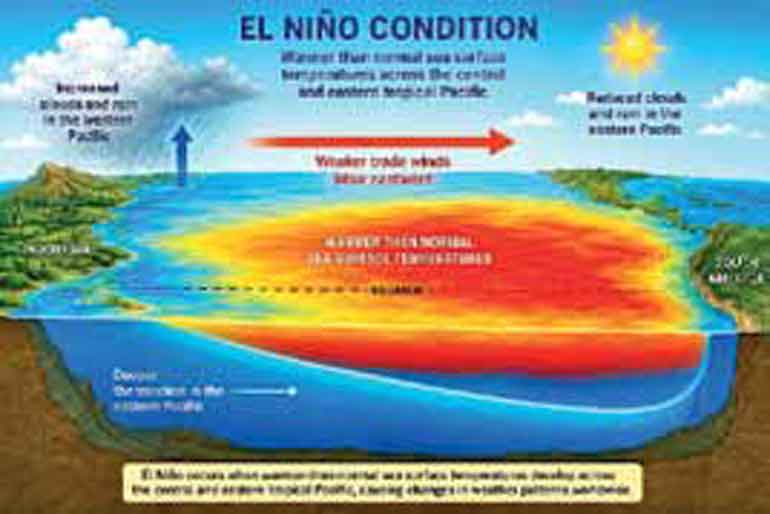
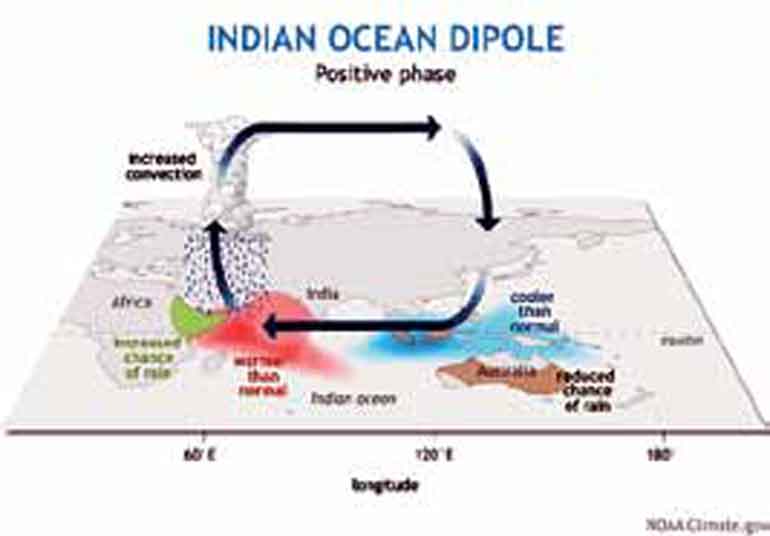
El Niño is a climate phenomenon characterised by abnormally high temperatures in the central and eastern Pacific Ocean and cooler temperatures towards Indonesia and Australia. The Indian Ocean Dipole (IOD) is a climate phenomenon characterised by differences in sea surface temperatures between the western and eastern tropical Indian Ocean.
It occurs in three phases: Positive IOD; Neutral IOD; and Negative IOD.
Many climatologists consider the IOD particularly important for Sri Lanka because it often exerts a stronger influence on October–December rainfall than on the Southwest Monsoon (May to September). This is because IOD events typically reach their peak intensity between September and November.
Positive IOD
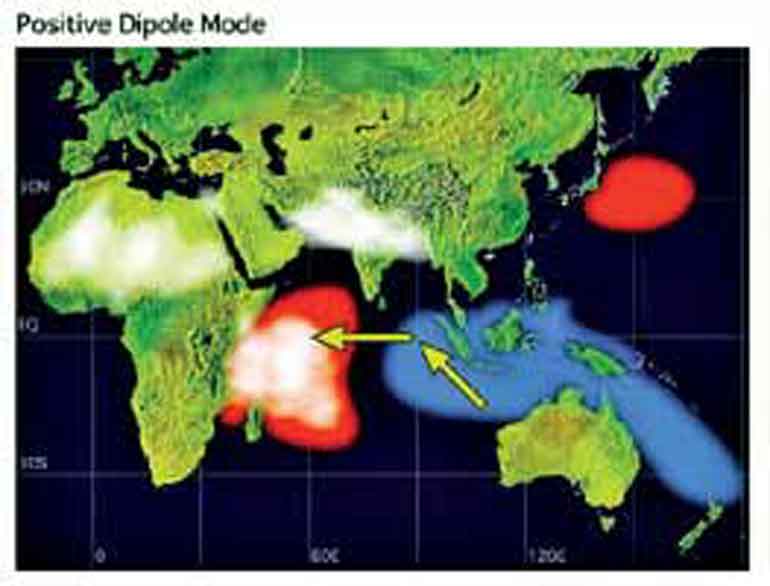
A Positive IOD occurs when sea surface temperatures in the western Indian Ocean become warmer than normal, while waters near Indonesia become cooler than normal. This temperature contrast alters atmospheric circulation and rainfall patterns across the region. During the Southwest Monsoon season, a Positive IOD generally tends to strengthen monsoon activity over India and parts of Sri Lanka, partially offsetting the drying influence often associated with El Niño.
Negative IOD
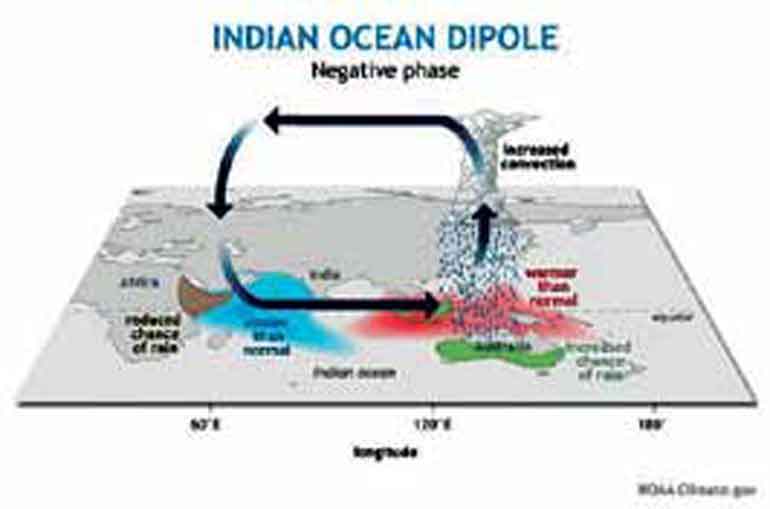
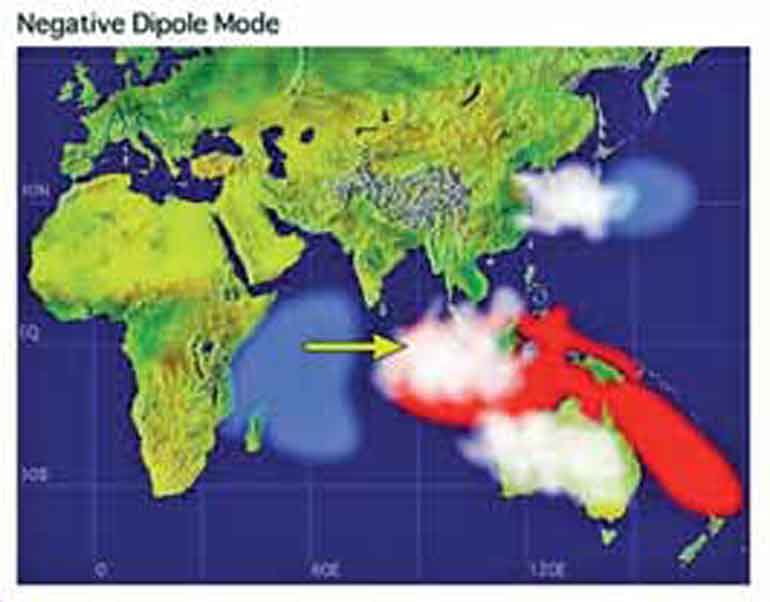
A Negative IOD is the opposite condition, with warmer waters near Indonesia and cooler waters in the western Indian Ocean. During June to September, a Negative IOD generally weakens the Southwest Monsoon by reducing moisture transport towards South Asia. However, timing is critical. If a Negative IOD persists into October–December, it can increase moisture availability over the Bay of Bengal and enhance Northeast Monsoon rainfall over Sri Lanka and southern India. Thus, a Negative IOD may be unfavourable for the Southwest Monsoon but beneficial for the Northeast Monsoon.
Neutral IOD
A Neutral IOD occurs when sea surface temperatures in the western and eastern equatorial Indian Ocean are close to average, resulting in little or no significant influence on normal regional rainfall patterns.
Why timing matters
El Niño and La Niña originate in the Pacific Ocean, whereas the IOD develops in the Indian Ocean. When they occur simultaneously, their effects can either reinforce or counteract each other. The strongest climate impacts occur when ENSO and IOD phases support the same rainfall pattern. Together, they influence whether Sri Lanka experiences droughts, floods, or near-normal rainfall. Climate forecasts are valuable tools for planning, but they should not be interpreted in isolation. Sri Lanka’s climate is influenced by multiple interacting systems, and the outcome depends on how these systems evolve over the coming months.
El Niño and Positive IOD
This combination is particularly important for Sri Lanka and India. A notable historical example occurred in 1997, when one of the strongest El Niño events on record coincided with a strong Positive IOD. While El Niño alone often weakens monsoon rainfall, a Positive IOD can partially offset this effect by strengthening moisture transport over the Indian Ocean. As a result, Sri Lanka may receive more rainfall than would normally be expected during an El Niño year. Although a Positive IOD does not eliminate the impacts of El Niño, it can reduce their severity.
El Niño and Negative IOD
This combination generally produces a stronger drying effect across South Asia. El Niño weakens monsoon circulation, while a Negative IOD shifts convection towards Indonesia. Together, they can significantly reduce Southwest Monsoon rainfall over India and Sri Lanka, increasing the risk of drought.
How are the IOD and El Niño now?
Current climate assessments indicate that the Indian Ocean Dipole remains neutral. However, many climate models suggest a high probability of a transition towards a Positive IOD during July–September 2026, coinciding with the expected development of El Niño conditions in the Pacific. If this scenario materialises, the Positive IOD may help offset part of the rainfall reduction typically associated with El Niño, particularly during the latter part of the Southwest Monsoon season.
Key interpretation for Sri Lanka:
n
El Niño + Positive IOD
→ Drought effects are usually moderated.
n
El Niño + Negative IOD
→ Strongest drought risk.
n
La Niña + Positive IOD
→ Highest likelihood of excessive rainfall and floods.
n
La Niña + Negative IOD
→ Mixed or near-normal rainfall outcomes.
Vigilance, not panic
While there is reason for concern, there is no cause for panic. The most appropriate response to the developing El Niño is proactive preparedness. Government agencies, water managers, farmers, industries, and households should closely monitor evolving climate conditions and take timely measures to minimise potential impacts. Sri Lanka enters this period with a significant advantage: substantial carry-over storage in major reservoirs, many of which continue to receive inflows from the ongoing Southwest Monsoon. These reserves provide an important buffer against possible rainfall deficits, unless the country experiences a prolonged drought.
Priority should therefore be given to the efficient management of available water resources. Reservoir storage should be conserved where possible by limiting hydropower generation and increasing reliance on alternative energy sources, particularly solar power.
Water conservation should be promoted among households, industries, and commercial establishments, while irrigation systems should be managed carefully to maximise efficiency and minimise losses. For the forthcoming Maha season, farmers should be encouraged to commence cultivation early and adopt short-duration crop varieties to reduce exposure to possible late-season water shortages.
Rainwater harvesting and home gardening should also be promoted to strengthen household water and food security.
At the national level, a coordinated preparedness programme involving Government agencies, farmer organisations, research institutions, and local communities would help strengthen resilience to possible climate-related challenges.
At the same time, attention should be given to long-term water security measures, including expediting the proposed saltwater exclusion barrier at Ambatale to enhance water supplies for Colombo and the Greater Colombo area. The key message is clear: preparedness and prudent resource management, rather than alarm, offer the most effective response to the potential impacts of El Niño.
Conclusion
While El Niño deserves close attention, it is only one part of a much larger climate picture. The future behaviour of the Indian Ocean Dipole (IOD) may prove equally important in determining whether Sri Lanka experiences drought, near-normal conditions, or even above-average rainfall in some regions. The coming months will reveal whether the Indian Ocean provides Sri Lanka with an important buffer against the impacts of a strong Pacific El Niño. Until then, preparedness should guide national policy and public response.
(The author holds a B.Sc. in Agricultural Engineering from Tokyo University and an M.Sc. in Soil and Water Management from the University of Wageningen. He is a specialist in watershed management and soil conservation, and a former Director of the Natural Resources Management Centre, Department of Agriculture, Sri Lanka. He has also worked with FAO in Sri Lanka and Bangladesh.)