Wednesday Nov 11, 2026
Wednesday Nov 11, 2026
Wednesday, 11 November 2026 00:26 - - {{hitsCtrl.values.hits}}
Introduction
On 12 November the President, Finance Minister, will present the 2027 Budget to a Parliament. The public that have grown used to fiscal good news have plethora of expectations. The numbers justify some of that optimism. In the first eight months of 2026, revenue and grants came in at Rs. 4,002 billion, an increase of 21% year-on-year and 75.5% of the annual estimate, when a pro-rata basis it would have been 66.7%. The Treasury ran an overall surplus of Rs. 35 billion for the period against a budgeted full-year deficit of Rs. 1,757 billion, and the primary surplus of Rs. 1,645 billion was almost double the Rs. 860 billion targeted for the whole year.
This remarkably different figures are not by accident. Under the IMF’s Extended Fund Facility, the fiscal target has been a primary surplus of 2.3% of GDP; the revised estimates for 2025 show 3.8%. Fiscal revenue, which collapsed to around 8% of GDP in 2021 after the 2019 tax cuts, is now close to 16%. Central government debt fell to 91.6% of GDP at end-2025 from 95.5% a year earlier. Few countries emerging from a sovereign default have consolidated this quickly.
But a fiscal outturn has two sides, and the expenditure side deserves a closer look. Total spending to August was only 56.2% of the annual budget. Capital expenditure and net lending, at Rs. 436 billion, were just 31.8% of an allocation of roughly Rs. 1,369 billion. Execution of public investment in 2025 also fell short, at about 77% of the estimate. This is not part of fiscal discipline, in fact, under-execution of budgeted capital expenditure.
The distinction matters for growth. Restraint on recurrent spending improves the quality of fiscal adjustment. Curtailment on capital expenditure does the opposite: it lowers the economy’s future productive capacity, leaving fewer roads, irrigation schemes, transmission lines and hospitals, and a lower potential growth rate in subsequent years. It is the politically painless form of consolidation, because its cost shows up only years later in the form of slower growth. A surplus built on unspent capital expenditure is not something to celebrate for long.
Public debt: past the peak, not out of the woods
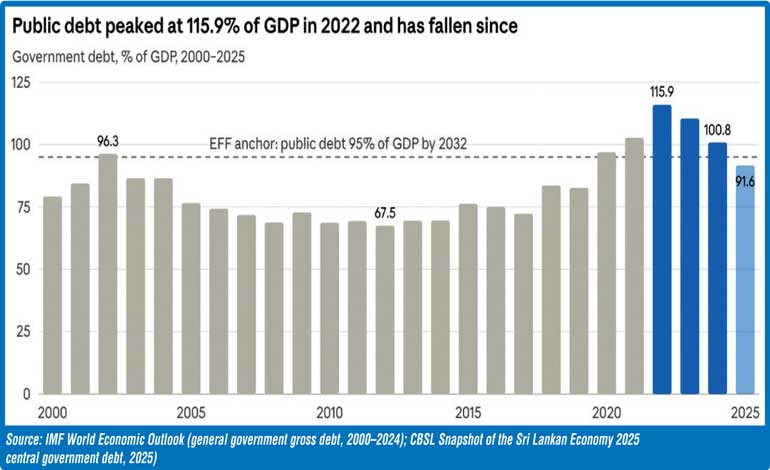
The debt ratio has turned, helped by primary surpluses, a recovery in nominal GDP and the restructuring of external debt. Yet it remains well above the 68–76% band held during 2006–2017, and interest still absorbs close to half of government revenue. The fiscal anchor cannot be loosened yet.
Limitations of the budget
Every year the run-up to the Budget Speech produces a long list of demands. Public servants want a salary revision, pensioners an allowance, professionals tax relief, importers lower duties, farmers fertiliser subsidies, and every electorate a new road or school building. There are very reasonable demands on its own, unfortunately, added together, they exceed any feasible fiscal envelope.
A national budget is not a magic wand. It is the principal instrument of fiscal policy, through which the government decides how much of national income it will absorb through taxation, how it will allocate that spending, and how it will finance the gap. Through these choices the government steers the economy in the direction it wishes to take. The question to ask on 12 November is not what the budget gives me or my group, but where it is taking the economy and whether the instruments chosen will get us there.
The Appropriation Bill tabled in Parliament provides for service expenditure of Rs. 4,993 billion, about 13% above the 2026 Bill, with a net borrowing limit of Rs. 3.8 trillion. Under the IMF program, the primary surplus must stay at 2.3% of GDP. The Budget Speech can reallocate within those limits. The IMF wants the government to present the budget within this agreed framework, continuing its commitment to the part of fiscal consolidation and debt sustainability.
Policy Consistency
Prior to the budget, indication of certain proposals of reasonable expectations were in the public media.
The first is personal income tax relief. The personal relief, which is the tax-free threshold under the Advance Personal Income Tax (APIT), was raised from Rs. 1.2 million to Rs. 1.8 million a year, or Rs. 150,000 a month, from April 2025, while the 6% band was extended to Rs. 1 million. In September the Deputy Minister of Economic Development told Parliament that the government remains committed to raising the monthly threshold to Rs. 200,000, and the President has publicly promised tax relief in this budget. For the salaried middle class, it would be a welcome adjustment.
The trade-off should be stated plainly. When the threshold was last raised, the Finance Ministry estimated that around 200,000 of some 800,000 individual taxpayers would drop out of the net, at a cost of about Rs. 60 billion a year. A narrow direct tax base is precisely why we lean so heavily on regressive indirect taxes.
The second is a rationalisation of indirect taxes. Taxes on goods and services are budgeted at Rs. 3,056 billion in 2026, against Rs. 1,210 billion from income tax, so the indirect tax structure effectively shapes our price level and our cost of production. That structure has become crowded, with VAT, the Social Security Contribution Levy (SSCL), Cess and other border levies layered on top of one another, several of them falling on intermediate and capital goods. Cascading levies of this kind raise the effective rate of protection for domestic sales and act as an implicit tax on exports. Removing them from inputs would support both investment and consumption, at a modest net revenue cost if VAT administration improves at the same time.
The third is policy consistency. Investors can price a high tax rate. What they cannot price is a tax code that changes with every budget. A medium-term revenue strategy, announced once and adhered to, would lower the risk premium on private investment more effectively than any single concession.
The fourth is a clear and well-communicated direction. Expectations drive investment decisions. The budget should set out where the government wants the economy to be in five years, explain the trade-offs involved, and then hold to that course.
The twin deficits: an old ailment
Behind the annual wish lists lies the structural problem that has taken Sri Lanka to the IMF 17 times: the twin deficits. The government has persistently spent more than it collects as tax revenue, and the country has persistently spent more abroad than it earns. In national accounting terms, the current account deficit is simply the gap between domestic investment and domestic savings, and a large, persistent fiscal deficit is public dissaving. The two deficits therefore feed each other. Fiscal expansion raises domestic absorption, much of which leaks into imports, and the resulting external gap has been financed with foreign borrowing, a large share of it by the state itself.
Two features of our development model have kept this cycle going. The first is an excessive reliance on the government for certain activities that private capital could finance. Highways, power plants, ports and water schemes have been built almost entirely through the budget and state-owned enterprises, mostly on borrowed money. The 2026 Budget allocates 4.0% of GDP to public investment, while interest payments alone take 7.6%. A state whose interest bill is almost double its capital budget cannot remain the sole financier of national infrastructure.
Growth that does not earn its keep
The second feature is a growth model biased toward non-tradables. Non-tradable goods and services are those whose prices are determined in the domestic market because they cannot easily be traded across borders: construction, real estate, wholesale and retail trade, domestic transport, personal services and public administration. Tradables, by contrast, compete in world markets: manufactured exports, plantation crops, tourism, and IT and logistics services.
Growth driven by non-tradables looks impressive in the national accounts. But it generates income without generating foreign exchange, while the consumption it finances lifts import demand. Over time it also bids up domestic wages and prices relative to the rest of the world, appreciating the real exchange rate and squeezing the profitability of the export sector. External debt then rises faster than the economy’s capacity to service it. That, in essence, is the story of the decade that ended in default in 2022.
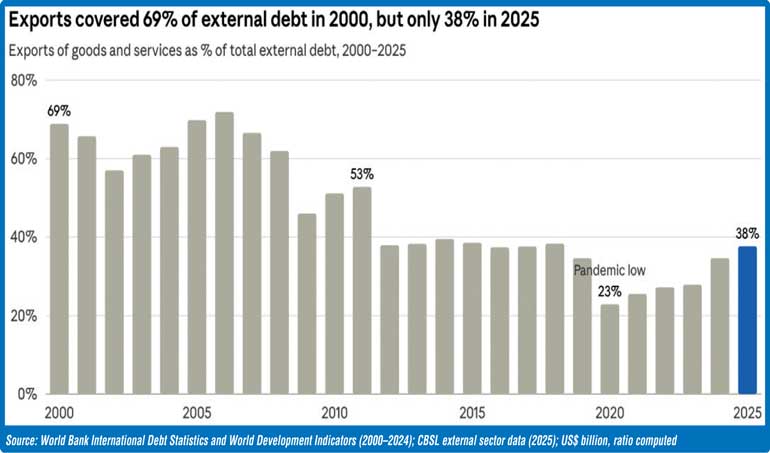
The ratio of exports to external debt reveals the story in a single line. In 2000, exports of goods and services were equal to about 69% of the country’s external debt. By 2020 the figure had fallen to 23%. It has since recovered to about 38%, but the improvement owes as much to debt restructuring as to export growth: total exports of goods and services were US$ 20.6 billion in 2025, up just 4.9%. Debt relief is a one-off. Only a larger export base can keep the ratio rising.
Two export engines losing momentum
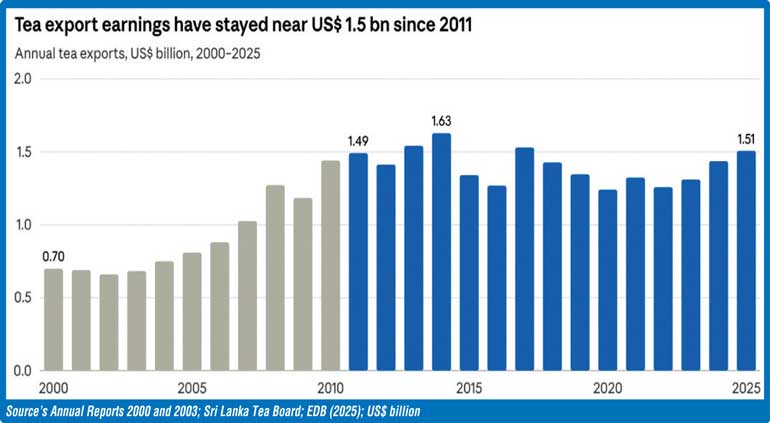
Source’s Annual Reports 2000 and 2003; Sri Lanka Tea Board; EDB (2025); US$ billion
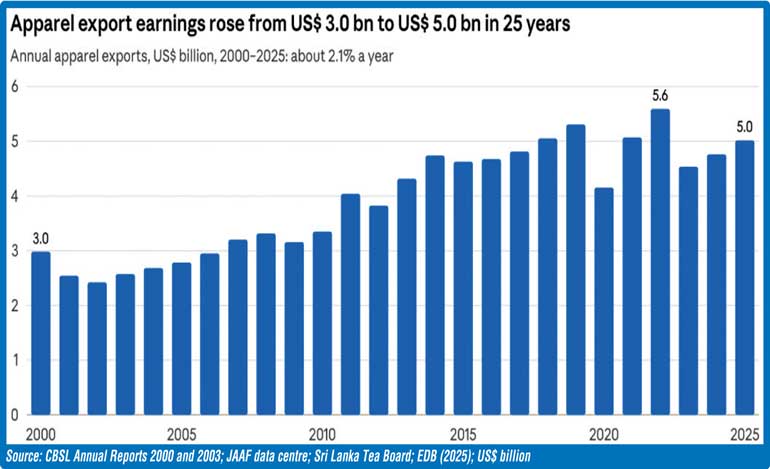
Our two traditional exports illustrate the problem. Apparel earnings rose from about $ 3 billion in 2000 to $ 5 billion in 2025, a compound growth rate of roughly 2% a year. In real terms, the industry earns no more today than it did a quarter of a century ago. Tea has done a little better in nominal terms, rising from $ 0.7 billion to $ 1.5 billion, but it has hovered around the same level for more than a decade as production volumes have stagnated. Together these two products still account for close to half of merchandise exports. An economy that has to service a debt stock of this size cannot depend on two mature industries growing at the pace of world prices. The need of export diversification has become yesterday’s problem rather than a future.
From consolidation to competitiveness
No single budget can unwind structural weaknesses built up over decades. What it can do is signal, clearly and credibly, a change of direction. Five areas deserve priority.
Crowd in private capital for infrastructure. Sri Lanka still lacks a comprehensive legal framework for public-private partnerships. The Cabinet approved the gazetting of a bill to establish a National Agency for PPPs only in October. The budget should commit to enacting it early in 2027, with competitive procurement, a transparent process for unsolicited proposals and full disclosure of the contingent liabilities the Treasury takes on, followed by a published pipeline of bankable projects in energy, transport, water and logistics. Well-structured PPPs allow the state to expand infrastructure without adding to its own balance sheet. Poorly structured ones simply move debt off budget. The law must guard against the latter.
Rebalance growth toward tradables. Incentives, tariff policy and public investment should be tilted toward activities that earn or save foreign exchange. That means a simpler, lower and predictable tariff schedule that does not tax imported inputs, faster VAT refunds for exporters, trade agreements that widen market access, and an end to the anti-export bias that makes selling at home more profitable than selling abroad. A competitive real exchange rate, sustained by fiscal discipline rather than administrative controls, is part of the same agenda.
Invest in human capital, beginning with the young. Unemployment among 20-24 year olds was 17.8% in 2025, close to five times the national rate of 3.9%, according to the Labour Force Survey. Only 49.4% of the population aged 15 and above participates in the labour force, and among women the figure is just 32.4%. Vocational training designed together with employers, English and digital skills, and the childcare and safe transport that allow women to take up paid work are not social spending. They raise both the economy’s labour input and its productivity in tradable sectors.
Allocate scarce resources more efficiently. For a small economy, Sri Lanka leaves a surprising share of its factor endowment idle:
nLabour: an ageing working-age population, half of it outside the labour force, while skilled workers continue to migrate.
nLand: large extents of state-owned land remain unused or underused. Long-term, bankable leases for agriculture, plantations, industry and energy would put it to productive use.
nRenewable energy: some of the best wind and solar resources in the region, particularly in the north and north-west. Harnessing them requires investment in the transmission grid and storage, and competitive, transparent procurement, so that lower-cost power reduces production costs across the export sector.
nStrategic location: Colombo lies beside the main east-west shipping lane, next to an Indian subcontinent whose cargo volumes continue to grow rapidly. Port capacity, transhipment, logistics and bunkering services built around that demand are tradables in the purest sense.
Protect capital spending in execution, not only in allocation. A larger capital vote that is only one-third spent by August achieves very little. Better project appraisal, multi-year expenditure commitments and quarterly public reporting on capital budget execution would do more for medium-term growth than a higher headline allocation.
The test
The stabilisation of the past three years is a platform, not a destination. Budget 2027 will be judged less by the relief it distributes than by the direction it sets. If it holds the fiscal anchor, ensures that public investment is actually delivered, opens infrastructure to private capital and tilts incentives toward what we can sell to the world, it will mark the point at which Sri Lanka moved from repairing its public finances to rebuilding its capacity to grow. If it does not, we risk repeating a familiar cycle: consolidation that looks good on paper, growth led by imports and non-tradables, and a debt problem that returns within a decade.
(The author is a CFA charterholder and holds the FRM designation, with prior experience at the Central Bank of Sri Lanka and the Ministry of Finance. The views and opinions expressed in this article are those of the writer and do not necessarily reflect the official policy or position of any institution)