Monday Nov 16, 2026
Monday Nov 16, 2026
Monday, 16 November 2026 02:58 - - {{hitsCtrl.values.hits}}
The intent is progressive. But for three years running, Sri Lanka has budgeted far more for development than it has managed to spend. Is the problem the estimates, or the machinery that is meant to deliver them?
 The 2027 Budget, presented on 12 November, reads well. Its stated aim is to strengthen the production economy, protect small and medium industrialists, make room for investment, connect technology to the economy, protect the environment and ensure social justice. It does this while keeping to the fiscal discipline the country has painfully rebuilt since 2022.
I have no quarrel with the intent. It is progressive, and in several areas it is genuinely bold. But budgets are not judged by their speeches. They are judged by what is built, paid for and delivered by the following December. And on that measure, the record of the last two budgets should give us pause.
What the Budget gets right
There is a great deal to welcome:
income tax relief rises from Rs. 1.8 million to Rs. 1.95 million a year, the tax bands are revised, and Rs. 230 billion goes to social protection, including Aswesuma.
enterprises, a Public-Private Partnership Act, a Digital Economy Bill and a review of labour laws.
If all of this is delivered, 2027 could be the year Sri Lanka moves beyond stabilisation to growth. The word that matters in that sentence is “delivered.”
The execution gap
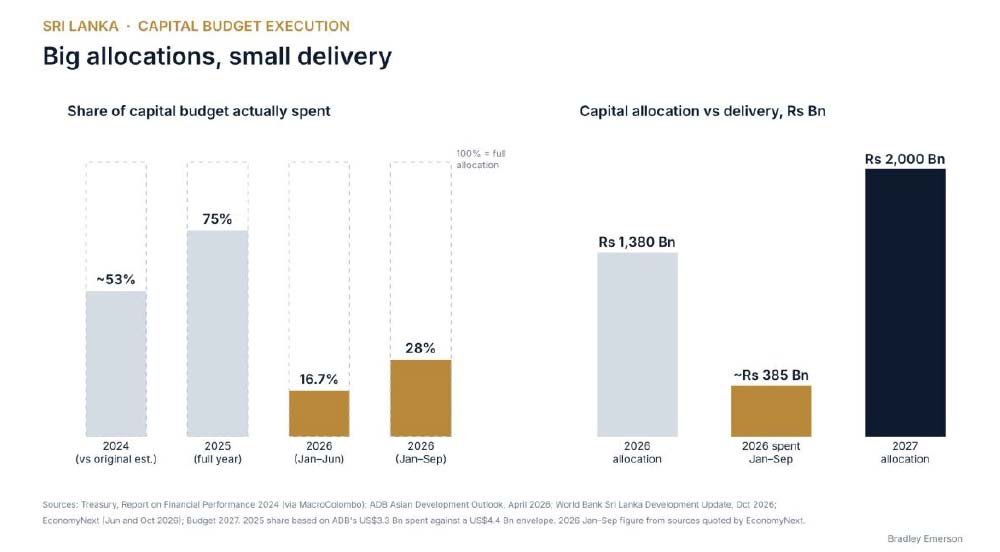
Here is the uncomfortable truth. For three consecutive years, the State has allocated far more for capital investment than it has spent.
Against this record, the 2027 Budget raises the capital allocation to Rs. 2,000 billion, 45% more than the 2026 allocation, and more than five times what had been spent in the first nine months of this year. The Government says most capital spending traditionally happens in the final quarter. That may be so. But that is precisely the problem: money rushed out of the door in November and December is rarely money well spent.
Unrealistic estimates, or a machine that cannot deliver?
The question every reader should ask is why. I see two possible explanations, and the evidence suggests both are at work.
The first is that the estimates are unrealistic. Budgets in Sri Lanka have long served two purposes: as financial plans and as political statements. A large capital allocation signals ambition, even when the projects behind it are not ready. The 2024 estimates assumed that debt restructuring would be completed early and that halted foreign-funded projects would restart quickly. Neither happened in time. An IMF assessment found that only a third of major projects had feasibility studies, and that more than half entered the budget without proper appraisal. When projects are funded before they are ready, under-spending is not an accident. It is built into the budget.
The second is that the line ministries lack the capacity to deliver. The World Bank is explicit on this point. It says the under-execution “reflects weaknesses in public investment management, including project selection, procurement, and implementation capacity,” and not a shortage of finance. That matters. With revenue running ahead of target, money is no longer the binding constraint. The machinery is.
The Citizens Budget itself gives a telling picture of that machinery. The public service employs over 225,000 teachers and more than 100,000 development officers. But its cadre table lists just 1,138 officers in the Sri Lanka Engineers’ Service, 802 in the Planning Service, 1,611 Sri Lanka Accountants and 55 architects. Other technical staff sit in agencies and state enterprises, but this core cadre is the one that plans, procures, supervises and pays for the roads, water schemes and canals the Budget promises. Rs. 2,000 billion of capital investment rests on a remarkably thin layer of technical capacity.
Add to this outdated procurement rules, land acquisition delays, weak coordination between agencies and the long-standing habit of starting more projects than can be finished, and the pattern becomes clear.
There is also a third, less discussed factor. In an environment of heightened scrutiny, which the country rightly demanded after 2022, many public officials have become reluctant to sign. Delay carries no personal risk; a decision that is later questioned does. Accountability is essential, but when it is not matched by clear rules and protection for honest decisions made in good faith, the safest course for an official is to do nothing. The result is a public service that is clean but slow.
Why under-spending is not a saving
Some will argue that unspent money is money saved. It is not.
A Budget has vision and strategy. Execution needs system, structure competency
In my work with organisations, I often use a simple framework. Vision is where we are going. Strategy is how we will get there. But neither delivers anything without a system, the processes, measures and incentives through which work actually gets done, and a structure that makes clear who owns what.
Budget 2027 has a clear vision and, in most areas, sensible choices. What it does not yet have is a delivery system and a structure of accountability strong enough to carry Rs. 2,000 billion of investment. That is where the Government's attention must now turn.
What India does differently
On 1 February this year, India’s Finance Minister presented a Budget for 1.45 billion people in 85 minutes. India is at a very different stage, with an economy many times our size and no recent default to recover from. Its capital program of about ₹12.2 trillion, roughly $ 130 billion, is beyond anything we can contemplate. But the lesson that matters is not the size of its Budget. It is the delivery.
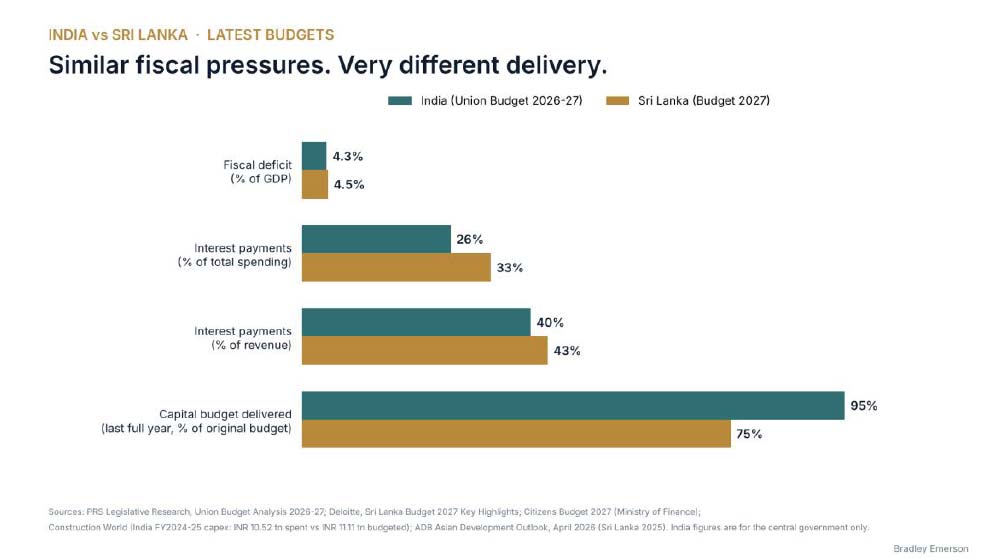
The usual comparisons between the two budgets mislead more than they inform. Set side by side in dollars, India’s Budget dwarfs ours, and some have even claimed that Sri Lanka spends more per citizen. That ignores the fact that India’s Union Budget covers only its Central Government, while its states run most health, education and policing from their own budgets. The fairer comparison is in ratios, and there the two countries look surprisingly alike. India’s Central Government plans a fiscal deficit of 4.3% of GDP; ours is 4.5%. India spends 26% of its Budget on interest; we spend about a third. Interest absorbs about 40% of India’s central revenue and about 43% of ours. Where the two countries part company is in what happens after the Budget is passed.
In 2024-25, India’s Central Government spent about 95% of its original capital budget, against about 75% in Sri Lanka in 2025. In 2025-26, it spent about ₹10.75 trillion, 98% of its revised target, as reported by Construction World citing a senior official. Sri Lanka, by contrast, had spent less than 30% of its 2026 capital allocation by the end of September.
Part of the difference lies in a discipline India has built into its Budget process. Since 2017, every major central scheme has been published with an Output-Outcome Monitoring Framework: about 400 schemes and nearly 4,000 indicators, tracked on a public dashboard and tabled in Parliament with the Budget. This is accountability demonstrated. Under India’s General Financial Rules, a scheme’s performance against those targets helps decide whether it continues and how much it receives the following year. In other words, ministries are funded for outcomes, not just for intentions.
India is not perfect. Its states, which build much of its infrastructure, struggle with capital spending too. But at the centre, it has made one thing clear: an allocation is a promise, and promises are tracked.
What must change
1. Fund only projects that are ready. No major project should enter the budget without a completed feasibility study, appraisal, land and approvals in place. Projects that are not ready should be funded for preparation, not construction.
2. Budget for outcomes and publish execution every quarter. As India does with its Output-Outcome Monitoring Framework, each ministry’s allocation should come with measurable outputs and outcomes. Parliament’s Committee on Public Finance and the public should see allocation, spending and project milestones every quarter, and next year’s allocation should depend on this year’s delivery. What gets measured and published gets managed.
3. Create a delivery unit with real authority. A small, highly skilled unit of professionals under the President, of the kind Malaysia used to drive its transformation program, should track the top 50 projects, unblock bottlenecks across ministries and report progress openly.
4. Fix procurement. Expand e-procurement, update the Administrative and Financial Regulations, set fixed timelines for each procurement stage, and delegate authority to the level where decisions can be made quickly.
5. Buy in the capacity we lack. Engage engineers, quantity surveyors and project managers on contract, use the new PPP framework, and draw on private-sector project management where the state lacks skills.
6. Protect honest decisions. Officials who follow due process and act in good faith must be protected when outcomes are later questioned. Accountability should target corruption and negligence, not judgement.
7. Budget on a realistic baseline. Start each year's capital allocation from what was actually delivered the year before, plus a credible pipeline of ready projects. Ambition should be shown in delivery, not in the size of the allocation.
The real test
This Government came to office on a promise of a different kind of governance, and its fiscal management has earned genuine credit. Revenue is up, the deficit is under control, and the country is emerging from the IMF program in March 2027 in far better shape than it entered it.
But the next phase is harder. Stabilisation was largely about saying no: to waste, to new taxes on the wrong people, to unfunded promises. Growth is about saying yes, and then delivering. The President's aspirations can only be realised through ministries, departments and officials who have the competency, the systems and the confidence to act.
The pudding has been well described. By 31 December 2027, we will know whether it was cooked.
(The author is a former Senior Banker, Regional Director of CIMA for the Middle East, South Asia and North Africa, Head Of PPP (2017) and has served on two national Education Reform Commissions. He is the Founder of Business Athletes and Teen Academy)