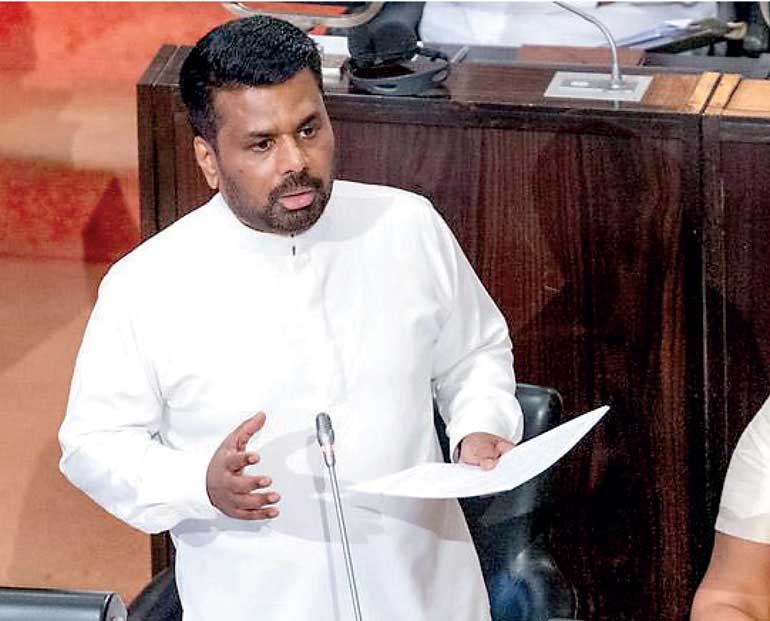
President and Finance Minister Anura Kumara Dissanayake delivering 2027 Budget speech in Parliament
 For the people of Sri Lanka, development, as the President invoked at the start of his Budget speech, remains a longstanding but unachieved aspiration. Sadly, the 2027 Budget fails to lay the groundwork for fulfilling that aspiration. Worse than a mere failure, it hoodwinks people, as many past Budgets have done.
The 2027 Budget is best read not as a fiscal plan for development and wellbeing but as a chant of the IMF mantra: a primary surplus of 2.3%, Budget deficit below 5% and debt sustainability. As this article illustrates, a Government enchanted by the IMF mantra deceives people in three ways.
First, it declares grand fiscal allocations but under-executes them. Second, it subordinates productive investments and social security to investor requirements. Third, it subjects life-sustaining infrastructure to a neoliberal grip. The result is a Budget that acts as a saint abroad and a devil at home.
Under-execution is new austerity
The Government’s claim that the Budget is transformative gains legitimacy from grand Budget allocations. But numbers on paper are not a reason for optimism. Not spending allocated capital expenditure has become a norm, constituting a strategy of fiscal consolidation and a new form of austerity.
To begin with the last Budget: the 2026 Budget had allocated Rs. 1,380 billion for capital expenditure. However, according to the Mid-Year Fiscal Position Report 2026 issued by the Treasury, only 16.1% had actually been spent by June 2026. According to the Budget, Economic and Fiscal Position Report issued in November, capital expenditure and net lending had increased to 31.6%, equivalent to Rs. 436 billion.
In 2025, the corresponding figure was 17.2%. The Mid-Year Fiscal Position Report 2025 attributes the fall in expenditure to “delayed execution of the capital Budget” (p. 12).
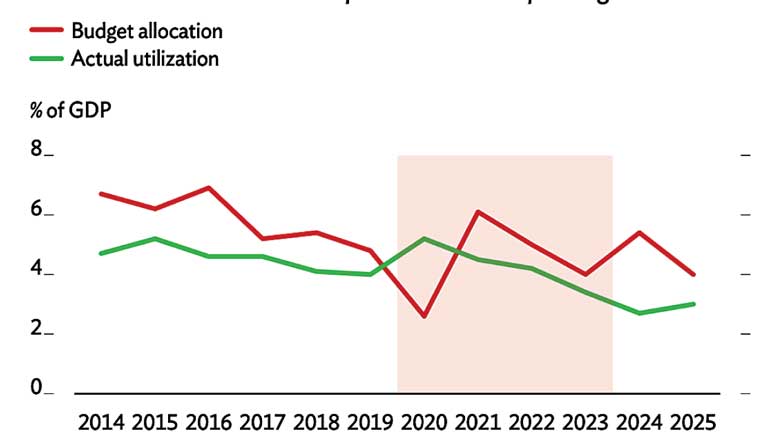
According to the Asian Development Bank (ADB), Sri Lanka has consistently fallen behind in terms of capital expenditure. Between 2022 and 2025, only 3% of GDP was spent, whereas the Budget allocations ranged between 5% and 6% of GDP. Figure 1, extracted from the Asian Development Outlook for Sri Lanka issued in April 2026, proves that under-execution of capital expenditure is a standard practice.
Figure 1: Under-Execution of Capital Expenditure
Source: ADB Outlook for Sri Lanka, April 2026
The conventional understanding of austerity is living within one’s means or slashing of public expenditure. What the data show is something beyond that: Governments, including the NPP Government, have not spent even the funding allocated. The ADB and IMF analyses of underutilisation of funds point to limitations of the public sector in terms of capabilities, and governance (delays in procurement, land acquisition, feasibility assessment and inter-agency coordination), which could be overcome through more public-private partnerships. These analyses assume that private sector is better endowed with skills and expertise. However, what if under-execution is an outcome of austerity internalised into Government psyche through decades of austerity imposed on Governments by the IMF, ADB and World Bank? 
Cross-country data, particularly for countries under IMF programs, show that under-utilisation of capital funds is a shared practice. According to an early IMF report, Economic Adjustment and Reform in Low-Income Countries (1999), one strategy to contain deficit was to adjust expenditure by cutting capital expenditure. An IMF report in 2026 confirms that cutting capital expenditure is the “residual adjustment tool when fiscal pressures emerge” (IMF, May 13, 2026). The IMF recognises that such fiscal pressures emerge not only from revenue shortfalls but also from delays in external financing.
As World Bank data on world debt explains, external financing for developing countries has been chronically inadequate. More than being inadequate, external financing has become a major means of capital outflow, thereby working against the developmental aspirations of countries in the global south. The International Debt Report 2026, published by the World Bank, highlights a recurrent pattern that it also identified in previous reports: “Between 2022 and 2025, [Lower-Middle Income Countries] (LMICs) paid about $436.1 billion more in debt service than they received in new financing” (p. xviii). According to the same report, even though low-income countries returned to capital markets in 2025, access came at a greater cost. Except for China, all other low-income countries experienced higher growth rates of debt than of national income. This is the context in which both the IMF and neoliberal lobby groups in Sri Lanka encourage the NPP Government to return to the Bond market.
Capital under-execution when revenue is not falling, as in Sri Lanka, could hint at dangerous policy moves. Under-investing in capital expenditure while subordinating fiscal policy to the IMF mantra could be interpreted as a purposeful policy to make lending to Sri Lanka attractive to foreign creditors, particularly those in international Bond markets. A primary surplus itself signals positively to creditors indicating that Government has surplus revenue after meeting all non-interest expenses (expenses on salaries, goods, services and capital projects). Under-spending on capital projects, therefore, leaves more money to spend on other things, such as debt servicing. The Government, expecting to return to the international Bond market in the future, is under-spending to enhance its credibility among creditors.
As Sri Lankans are experiencing firsthand, more borrowing will not by itself deliver development. The very acts of restructuring the economy to please the creditors impose severe constraints on the transformative change that people and the economy need. Apart from imposing undemocratic stabilisation policies, such as raising VAT, reducing employment levels and cutting social security, that ordinary working people in Sri Lanka have had to endure since the default in 2022, purposefully keeping capital investments low so the economy will look better for foreign creditors is almost an act of class warfare against the people who voted the NPP Government to power.
Liberating investors in shackles
Rewarding private investors is as much an overriding theme of the Budget as inspiring foreign creditors. The President’s Budget speech interprets new legal and institutional reforms as a means of “removing shackles that bind our feet from reaching the economic transformation we envisage” (p. 11). In rendering a new meaning to the word “shackles”, historically used in left literature as a rallying cry for working people, the 2027 Budget advocates pro-market reforms to set private investors free from binding State regulations or established communal practices. 
For example, the Microfinance and Credit Regulatory Act 2026 seeks to formalise low-income credit landscape while also eroding the financial commons that low-income people have practised for centuries. As traditional community credit mechanisms are weakened, formalisation will invariably benefit large finance companies with ample opportunity to access financial capital and with the institutional capabilities to respond to regulatory requirements. Other forthcoming Bills, such as the Non-Governmental Organisation (Registration and Supervision) Bill 2026 (not listed in the Budget), also contribute towards formalisation, with the apparent aim of eliminating all forms of informal collective action at community level so that they cease to exist in the future.
Similarly, the Acts on Public-Private Partnerships (PPPs), and State-Owned Business Enterprises Management Act will carry forward the transfer of public assets and wealth into the hands of the private sector. Forthcoming labour law reforms, specifically eliminating protective clauses on hiring and firing in the Termination of Employment of Workmen Act, which the Chamber of Commerce has been advocating for years, would render workers completely submissive to the whims and fancies of employers.
Compromising resilience
The word “resilience” figures four times in the Budget speech. The repeated emphasis on resilience, by the Government as well as by the IMF, World Bank and ADB, however, is not a positive sign. Rather than recognising the need to invest in and strengthen community infrastructure that enables resilience and helps people preserve life during hard times, both the IFIs and the Government, under the IFI’s spell, approach resilience as a resource pool to be grabbed.
While this might look like a baseless accusation, comparing Sri Lanka’s trajectory under the IMF with Ghana’s, for example, illustrates how compromising the Sri Lankan Governments have been, and at what cost to ordinary people. Ghana defaulted on its external debt payments in December 2022. Unlike Sri Lanka, Ghana refused to subject pension funds to domestic debt restructuring. Moreover, in 2026, Ghana received a concession from the IMF to lower primary surplus target from 1.5% to 0.5% from 2027 onwards.
Despite facing acute crises such as Cyclone Ditwah in November 2025 and spillovers from the war against Iran in 2026, the Sri Lankan Government failed to gain flexibility in how IMF targets are achieved, let alone concessions. What we have seen so far is the Government legitimising both the IMF program and the debt restructuring process, making it possible for the IMF to make a comeback as essential and useful mediator in instances of debt crises in the Global South. For the people on whose backs this success story has been written, the future is still bleak. A preliminary report issued by the Department of Census and Statistics on the Household Income and Expenditure Survey 2025 reveals that income inequality between the poorest and richest Sri Lankans has deepened. The poorest 20% earn an average income of Rs. 22,612 while the richest 20% earn Rs. 335,679 per month. The Budget 2027 lowered income tax that the richest 20% are likely to pay, while the poorest 20% received only marginal tax benefits. 
Instead of expanding investment in social security programs, the Government is introducing new loan schemes, akin to 2018 Enterprise Sri Lanka Budget that substituted loans for welfare. New concessional loan programs directed at micro, small and medium enterprises (MSMEs), women-headed households and entrepreneurs employing Aswasuma beneficiaries are meant to spur the growth potential of the rural sector. How can we reconcile introduction of new loan programs in an environment in which household debt is already alarming?
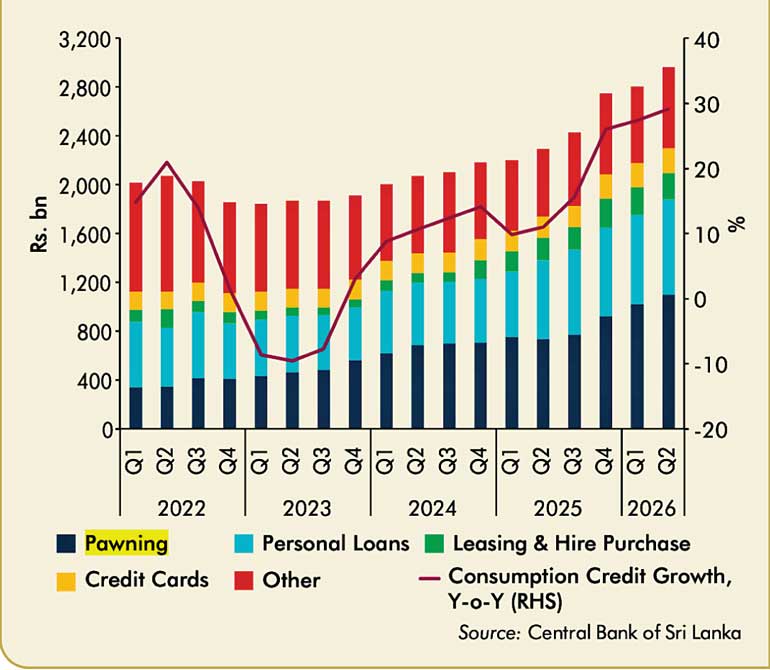
The Central Bank of Sri Lanka (CBSL) in its Financial Stability Review 2026 cautions about household debt, illustrating how an increase in pawning in the first quarter of 2026 could indicate financial stress at the household level. Figure 2, taken from the CBSL report, illustrates how household consumption loans expanded. In 2026, pawning accounts for the largest source of household consumption loans.
Figure 2: Credit to Consumption
In considering household behaviour vis-à-vis debt, women pawn their gold in times of extreme hardship. During the COVID-19 pandemic, for example, when lockdown regulations were relaxed, long queues in front of pawning shops were a common sight. Even though the CBSL rationalises the increase in pawning as driven by rising gold prices, pawning as a last-resort option when they urgently need cash, better explains the pawning behaviour of Sri Lankan women. The household debt crisis, particularly among low-income households affected by microfinance, remains unresolved despite women’s protests and election promises, and it is deeply rooted. The increase in pawning shown in Figure 2 could be an indicator of deep indebtedness, not an indicator of any particular capitalising behaviour of people, as the CBSL believes.
Saint abroad, devil at home
What households in Sri Lanka need is not more debt but more enabling investment, in MSMEs, agriculture and fisheries sectors, to break the decades-long funding crisis and financial grip of both money lenders and the formal banks and finance companies. As a people striving to emerge from default, we need more public investment in education, health care, social security and livelihoods to ensure that no one is left behind. Yet, as World Bank human development indicators illustrate, the indicators that matter to ordinary people still lag behind pre-crisis levels.
Governments have chased macroeconomic stability indicators in a quest to stage a recovery attractive to foreign creditors and investors. The result is a Budget that presents Sri Lanka as a saint abroad while acting as a devil at home: under-executing capital investment, inundating productive sectors and households with more debt, and eroding the very community resilience that has helped people survive hard times. This promises not recovery but deepening crises.
(The author (PhD, Hawai‘i) is a feminist political economist, a senior researcher at the Bandaranaike Centre for International Studies, and a member of the Movement for Climate and Economic Justice (MCEJ) and Yukthi Collective)