Friday Nov 20, 2026
Friday, 20 November 2026 00:27 - - {{hitsCtrl.values.hits}}

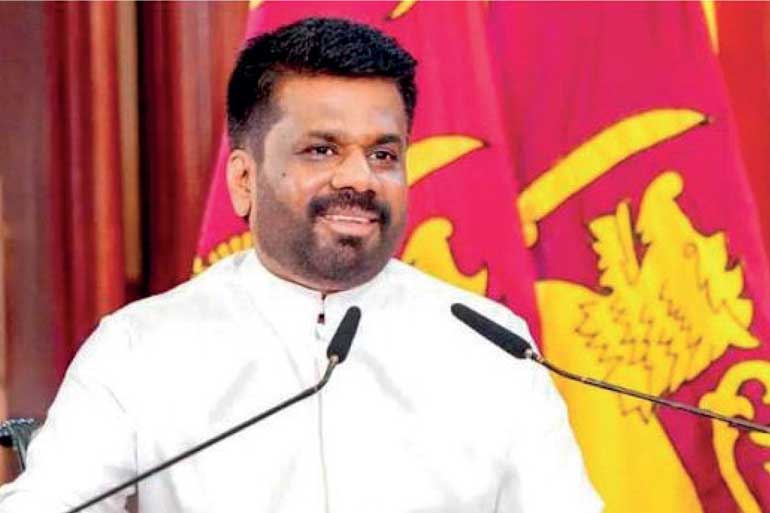
President and Finance Minister Anura Kumara Dissanayake
That 2027 is an important year cannot be disputed. Sri Lanka graduates from the IMF EFF program, having completed many of its commitments on the fiscal front. This Budget was a test of the country’s commitments to its new public financial guardrails. On that front, the Government has done well. There were no major tax concessions granted, although there was a lot of public pressure for it.

My assessment of Budget 2026 was that it was cautious where needed, but not bold enough where it could be. On Budget 2027, my assessment is that the Government’s cautiousness continues while its sense of boldness seems to have vanished altogether.
Things that are going right: Taxes, investment and digitalisation and trade
While there was much talk about personal income tax relief and VAT relief at many political gatherings in the run up to the Budget, the Government only conceded a little. Raising the personal income tax threshold to Rs. 1.95 million per year and tweaking the tax bands. Books and printed materials have been exempted from VAT, but that is unlikely to cause a major dent in Government revenues. There was no reduction in the rate nor changes to the threshold.
Proponents of a VAT rate reduction pointed towards cost-of-living relief, but does reducing VAT lead to a reduction in the cost of living? Reducing VAT did not lead to a reduction in the cost of living in December 2019, when rates were almost cut in half. In fact, food prices even rose by 6.3%. More recently, exempting local dairy from VAT did not lead to the expected price drop in April 2025 either. It was a lose-lose situation – the Government lost revenues while consumers continued to pay the same prices. So, reducing VAT for cost-of-living relief is unlikely to have such a desirable outcome.
This Budget appears serious about addressing investment promotion and digitalisation. Many new Bills, amendments, agencies and funding have been pledged for achieving these. Given the level of private sector involvement and interest in these two areas, they may prove to be some of the more successful endeavours of this Government. Land is a major barrier to investment in Sri Lanka – and this Budget takes aim at resolving these too with a Rs. 800 million allocation for the Bimsaviya program and Rs. 140 million for the registration of land titles, digitalisation of land records and the modernisation of land information systems.
Not so right: Para-tariffs and trade agreements
Last year, the Government announced the implementation of the National Tariff Policy. While I raised a concern about the fact that the Government’s revenue numbers at the time didn’t reflect this, this issue seems to have been rectified now. Revenues from para-tariffs like Ports and Airports Development Levy and Cess are indeed phasing out. However, surreptitiously, the revenues from the Special Commodity Levy (SCL) are rising. It is estimated to generate Rs. 170 billion in 2027, Rs. 187 billion in 2028 and Rs. 204 billion in 2029 – these are higher than what was projected in the 2026 Budget.
The SCL was a tariff brought about in 2007 as a composite levy that would ease administration of Sri Lanka’s then-highly complex import tariff regime. It is currently exclusively levied on food items – dhal, onions, potatoes, sprats, dried fish, dairy, fresh fish, pulses and fruits.
SCL revenues rising is an incredibly strange twist. With the move towards a simplified 4-band Customs duty, and the phasing out of para-tariffs, SCL is a redundant tariff. The need to ease administration of complex tariffs is addressed by the former. However, it appears that the Government intends to use SCL to make up for the revenues lost from the phasing out of PAL and Cess. This may also placate the local industrialists who have been opposing the para-tariff phase out, by offering them some protection against import competition.
The imposition of SCL is done by Gazette notice, at the discretion of the Minister of Finance. So SCL may be expanded to cover things beyond food – things that the para-tariff phase out was supposed to help with. On the other hand, if SCL continues to be collected on food items, this is an extra burden to consumers – especially when the cost of living is already unaffordable to many.
In mid-2026, the Ministry of Industry and Entrepreneurship Development announced that they would introduce new import standards among other measures to counterbalance the effects of the phase out. Coupling this with the projected SCL revenues, one could argue that it is essentially a continuation of the para-tariff regime in all but name.
On other aspects related to trade, there was mention of the intention to pursue trade agreements with China and India and even negotiate economic cooperation agreements with Oman and UAE. However, there has been no mention of establishing a dedicated office that can see such negotiations through. Negotiating free trade agreements typically take 1-3 years, but Sri Lanka usually takes much longer – 5 or 6 years. Without an institution dedicated to such a feat, it is unlikely that such an ambitious plan can be executed.
Not at all: SOEs, public sector reforms and poverty
This Budget is suspiciously absent on State-owned enterprise reforms. The much-delayed public commercial business management Bill was referred to in passing, but no mention of when it will be tabled in Parliament. The last year Budget also referred to the Bill and promised to present it to Parliament in the first 6 months of 2026. It has not been done so. It further pledged to restructure 44 and liquidate 13 non-commercial entities. Neither has this been done.
It appears that Sri Lanka will fall back into malaise with respect to State-owned enterprises. Even the well-known problem child – SriLankan Airlines – was only referred to in passing as a burden on the Treasury, with yet another committee appointed to find solutions.
In a similar vein, public sector reforms too are absent in this Budget. While many new allowances and benefits have been announced for various civil servants, there is no mention of rationalising or right-sizing the public service. In fact, Budget estimates show that the Government spending on salaries and benefits and pensions will keep pace with Government revenue – at around 16% and 10% respectively. There is nothing on reforming the civil pension scheme which will be a huge fiscal burden in time to come.
Budget week happened to coincide with the Department of Census and Statistic’s decision to finally release at least preliminary results from the much-delayed Household Income and Expenditure Survey (HIES) 2025. The survey results are extremely concerning. From my reading of the numbers, my conclusions are that we may be poorer and more in debt than we think. Inequality has surged, and Sri Lanka’s ‘middle-class’ seem to have vanished. Median household income is Rs. 75,882, and median household expenditure is Rs. 94,057 – a gap that is likely bridged with debt.
The poorest 40% of Sri Lankans live with an average household income of Rs. 36,564. On the other hand, the official poverty line was Rs. 16,417 per person per month and an average household of 3-4 people would need Rs. 55-65,000 per month to meet their basic needs. This means that at least 40% of Sri Lankan households do not earn sufficiently to be above the poverty line.
Poverty and food insecurity are major prevailing economic issues in the country, but despite this stark reality, the allocations for the Aswesuma program are not growing – in fact it is less than what was estimated for 2026; Rs. 230 billion in 2027, against Rs. 240 billion in 2026. There is limited action on food security, besides a few allocations for improving irrigation and the fisheries sector, and reducing the SCL on sprats and dry fish. These are unlikely to alleviate the cost of living nor increase food security in the near future.
All in all, this Budget lacks the decisiveness to address the many ills that plague our country; from underperforming State-owned entities to poverty and food insecurity. Although the President spoke a lot about economic, social and structural transformation, this Budget fails to embody it. What Sri Lanka really needs is a Government that is bold enough to push the envelope – to upset the apple cart. Otherwise, we risk sliding back into our old ways.
(The author is an Economist and Co-Founder/Director of Arutha, an economic research and civic education organisation)