Wednesday Oct 21, 2026
Wednesday Oct 21, 2026
Thursday, 3 September 2026 00:28 - - {{hitsCtrl.values.hits}}
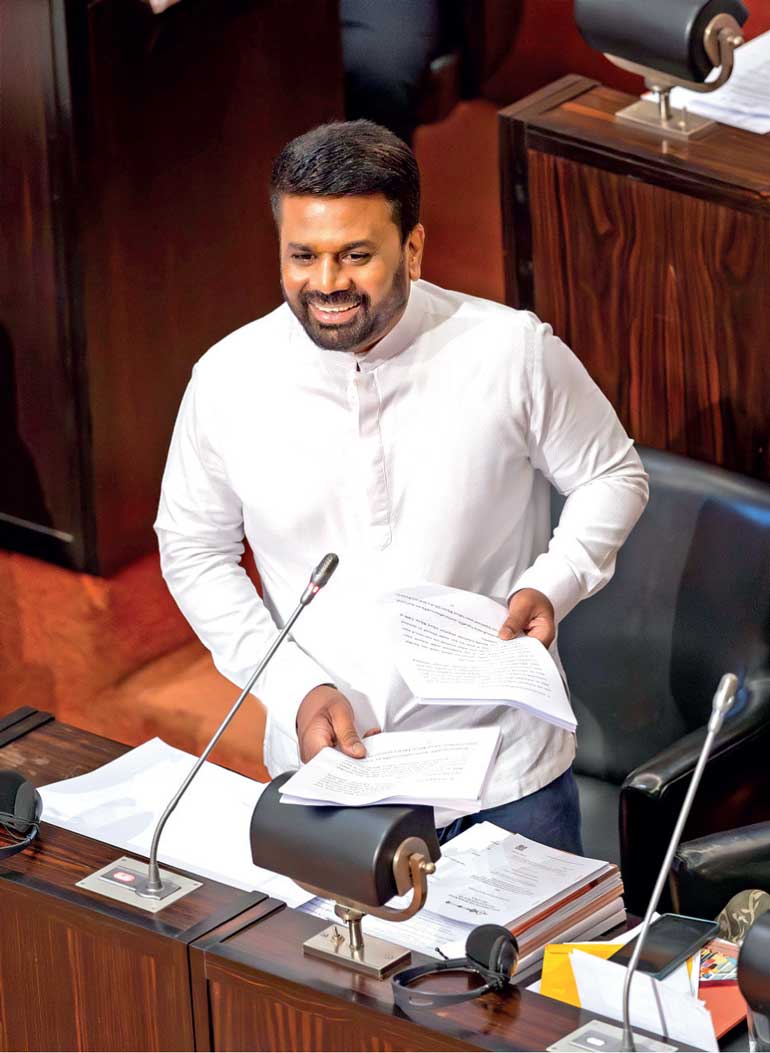
President and Finance Minister Anura Kumara Dissanayake presents the 2026 Budget in Parliament
 Sri Lanka has strengthened national tax collection after the economic crisis. But Municipal Councils, Urban Councils and Pradeshiya Sabhas remain financially weak. Budget 2027 provides an opportunity to begin a long-delayed reform of local-government finance.
Sri Lanka is approaching the preparation of Budget 2027 at an important stage of its economic recovery. Much attention will understandably be given to government revenue, expenditure control, debt sustainability, investment and economic growth.
But there is another area of public finance that receives surprisingly little attention: the financial capacity of local government.
Municipal Councils, Urban Councils and Pradeshiya Sabhas are the level of government closest to citizens. They deal with many services people encounter in everyday life—roads and drains, waste disposal, markets, public health, street lighting, permits, community facilities and local infrastructure.
Yet the financial system supporting these institutions has changed remarkably little.
Recent evidence covering 2019–2024 reveals a serious mismatch between the responsibilities assigned to local authorities and the financial resources they can raise themselves. In other words, Sri Lanka has decentralised many administrative responsibilities without adequately decentralising the financial capacity needed to perform them.
The numbers tell a worrying story
At first sight, local-government revenue appears to have improved.
Locally generated recurrent revenue increased from approximately Rs. 28.1 billion in 2019 to Rs. 56.7 billion in 2024. That looks like a doubling within five years.
But inflation changes the picture completely.
When expressed in 2021 prices, the Rs. 56.7 billion collected in 2024 was worth only about Rs. 27.4 billion. Thus, despite the large nominal increase, local authorities had gained very little—and in this comparison actually had less—real purchasing capacity than the headline figures suggest.
This is particularly important because citizens judge local government not by nominal revenue figures but by whether roads are maintained, garbage is collected, drains are cleared and services are delivered efficiently.
Central revenue has recovered—but local revenue has not kept pace
The contrast with central-government taxation is even more striking.
Central-government tax revenue increased to about Rs. 3.70 trillion in 2024, and the provisional figure for 2025 was approximately Rs. 5.05 trillion. Local-government own recurrent revenue, however, amounted to only Rs. 56.7 billion in 2024.
Local own revenue represented around 3.1% of central tax revenue in 2020, when national revenue had fallen sharply, but by 2024 the ratio had declined to only 1.5%. 
This does not mean that local government should collect some predetermined percentage of central taxes. It does show something more fundamental: Sri Lanka’s recovery in national tax mobilisation has not been accompanied by a comparable strengthening of the revenue capacity of the level of government closest to the citizen.
That imbalance deserves attention in Budget 2027.
Why are local authorities financially weak?
One reason is the narrow and outdated local tax base.
Rates and taxes accounted for only about 27.5% of locally generated recurrent revenue in 2024. Local authorities therefore depend on a mixture of rents, licence fees, service charges, fines and other receipts in addition to taxation.
Property taxation should be one of the strongest revenue instruments available to local government. Property is immovable, its value often rises with urban development and public infrastructure, and revenue collected from it can be visibly linked to improvements in the locality.
Yet the system suffers from outdated property valuations, incomplete coverage and administrative weaknesses. The underlying academic study, drawing on IMF analysis, points to precisely these constraints.
Consider how much Sri Lanka has changed physically during the past two decades. New houses, apartments, commercial buildings, hotels and business premises have appeared throughout urban and semi-urban areas. Land and property values have changed enormously.
But if valuation registers, property databases and collection systems do not keep pace with these changes, local government cannot capture even a reasonable share of the revenue potential created by development.
This is not simply a question of imposing higher taxes. It is fundamentally about modernising an outdated revenue administration system.
Not every local authority is equally capable
There is another important issue that Budget 2027 must recognise.
A Municipal Council in a commercially active urban area and a rural Pradeshiya Sabha do not have the same revenue base.
The 2024 figures illustrate the difference clearly. Municipal Councils generated enough own recurrent revenue to cover approximately 86% of their expenditure. For Urban Councils the figure was about 77%. For Pradeshiya Sabhas it was only around 56%.
Rates and taxes represented about 41% of Municipal Councils’ own recurrent revenue, but only about 12% for Pradeshiya Sabhas.
This means that simply telling every local authority to “raise more revenue” is not a solution.
A commercially strong municipality has hotels, offices, shopping centres, high-value property and large businesses from which revenue can potentially be mobilised. A poorer rural Pradeshiya Sabha may have none of these.
Therefore, fiscal reform must combine two principles:
greater responsibility for raising local revenue, and greater fairness in distributing national resources.
Without the second, fiscal decentralisation could actually widen inequalities between richer and poorer parts of the country.
Transfers are necessary—but they should be predictable
Transfers from higher levels of government are therefore not necessarily a weakness. They are an essential component of a properly designed decentralised fiscal system.
During 2019–2023, government grants were equivalent to roughly 40–50% of total local-government expenditure. In 2024 the ratio rose to approximately 65%, largely because of unusually high capital grants.
The problem is not simply that transfers exist.
The real questions are: How are they determined? Are they predictable? Do poorer areas receive adequate support? Do transfers reward improved revenue collection and better service delivery?
These questions should become part of the Budget 2027 reform discussion.
Five reforms Budget 2027 could initiate
Budget 2027 does not have to redesign the entire local-government finance system overnight. But it can provide a credible starting point for reforms that have been delayed for too long.
First, modernise property taxation. Sri Lanka needs updated property registers and regular valuation cycles, supported by digital systems connecting valuation, billing, land information and payments. Better administration should come before simply increasing tax rates.
Second, strengthen local own-source revenue. Rates, licence fees and appropriate user charges should be reviewed and collection systems modernised. Digital billing and payment facilities can simultaneously increase revenue and reduce inconvenience, discretion and opportunities for leakage.
Third, introduce transparent formula-based transfers. Recurrent equalisation grants should be distinguished from development and performance grants. Local authorities should be able to anticipate their resource envelope rather than depending excessively on discretionary allocations.
Fourth, establish an explicit equalisation mechanism. Poorer Pradeshiya Sabhas cannot be expected to provide comparable basic services from much weaker tax bases. National transfers should therefore take account of population, fiscal capacity, service needs and other relevant indicators.
Fifth, build a national local-government fiscal information system. Sri Lanka should be able to see annually—and preferably digitally—how much each authority collects, receives and spends, together with indicators of tax effort and fiscal capacity. The academic analysis itself recommends a consolidated central–provincial–local fiscal database.
Revenue reform must also mean better services
There is an important warning.
Citizens will understandably resist paying higher rates and charges if they see no corresponding improvement in services.
Therefore, local fiscal reform should not become simply another revenue-raising exercise.
It should create a new relationship between local revenue, accountability and service delivery. When a council collects more efficiently, citizens should be able to see where the money goes and what improvements it finances.
Digital revenue systems should therefore be accompanied by transparent budgets, published performance indicators and stronger mechanisms for citizen participation.
The objective should be a virtuous circle:
better revenue → better local services → greater citizen confidence → stronger willingness to pay → greater local accountability.
Budget 2027 should begin the transition
Sri Lanka has undertaken painful national fiscal reforms following the economic crisis. Central-government tax mobilisation has strengthened considerably since 2022.
But strengthening Colombo’s revenue collection while leaving hundreds of local authorities financially weak cannot be the final destination of fiscal reform.
The evidence shows that locally generated revenue remains very small relative to national taxation; inflation has severely reduced its real purchasing power; the local tax base remains narrow; transfers finance a substantial part of expenditure; and Pradeshiya Sabhas are considerably weaker financially than Municipal and Urban Councils.
Budget 2027 therefore offers an opportunity to place local-government fiscal reform firmly on the national reform agenda.
The immediate objective need not be to transfer a large new tax burden to citizens or suddenly make every local authority financially self-sufficient. That would be neither realistic nor equitable.
The objective should instead be to build a modern system in which local authorities mobilise a reasonable share of their own resources, the Central Government provides transparent and predictable equalisation support, and citizens can see a clearer connection between what they pay and the services they receive.
Sri Lanka’s economic recovery will ultimately be experienced not only through national statistics but also in its cities, towns and villages. If decentralisation is to mean anything to an ordinary citizen, local institutions must have both the responsibility and the financial capacity to deliver.
Budget 2027 is an appropriate place to begin that long-delayed reform.
(The author is theVice President, Sri Lanka Economic Association. The views expressed in this article are those of the author and do not necessarily reflect the views of the Sri Lanka Economic Association)




