Friday Sep 25, 2026
Friday Sep 25, 2026
Friday, 25 September 2026 00:21 - - {{hitsCtrl.values.hits}}

Introduction
In my previous article: A reply to “Budget 2027: From stabilisation to transformation” in the FT on 9 September 2026, the emphasis was on the Budget 2027, embracing three national missions: raising productivity, mobilising investment, and improving living standards, that would create a structural foundation upon which Sri Lanka can build a stronger, more resilient, and more prosperous nation, with sustainable growth rates above 7% being a more realistic aspiration.
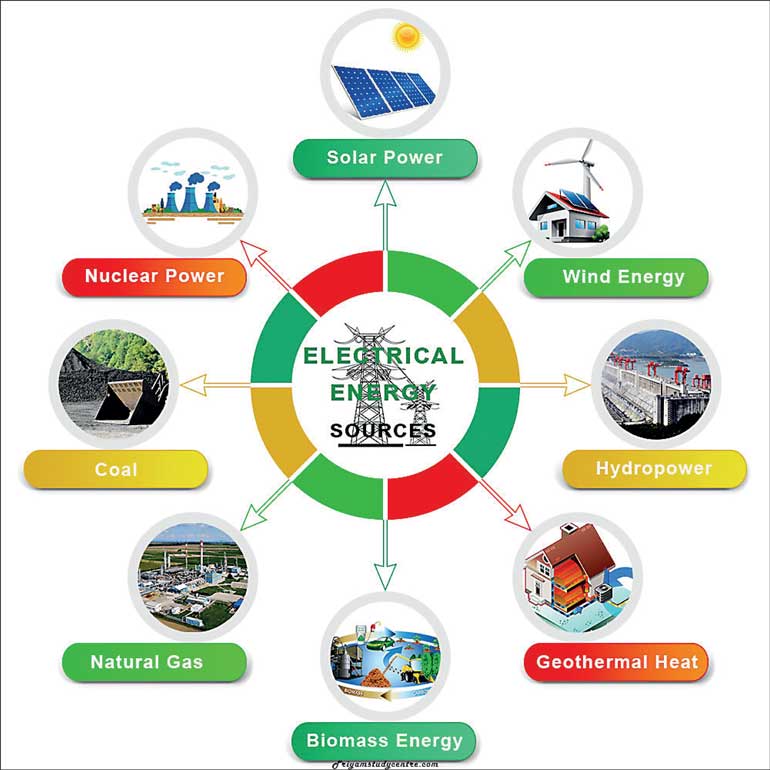
The purpose of this article is to focus on Energy, the challenges faced, how they are being addressed and what more can be done to attain energy self-sufficiency by transitioning Sri Lanka’s economy to renewables.
Reform of the Power Sector
Reform of the power sector was the first thing that was required, and this commenced earlier this year with the restructure of the CEB into separate Government owned companies. Credit is due to the Electricity Reform Unit team for getting this done over many hurdles.
Primary goals of restructuring was to create business entities that are sufficiently robust to face a multitude of challenges in a changing external environment, including the exposure to various international shocks and weather events exacerbated by climate change. An unprofitable, debt heavy, politicised, hierarchical monster that had developed a culture of impunity had to be dismantled and that was achieved.
Currently, 70% of the unit cost of electricity goes for power generation. Therefore, focussing on the productivity in the power generation area is crucial. This is partly being addressed through the Government’s policy of using competitive tendering for new power procurements, where productivity improvements can be expected. Prioritising the harnessing of maximum renewable energy from indigenous resources will allow the transition to electricity for the entire economy, away from the volatility of both supply and price issues associated with imported energy sources.
Moreover, restructuring of the CEB is expected to drive cost efficiencies in other areas, primarily through the formation of leaner organisations with more focused management and performance-driven operations (using KPIs). However, there are many shortcomings. The process in setting up the new companies and the appointment of management and personnel ultimately became just a “cut and paste” type exercise, simply to appease unions and tick the boxes without hard negotiations. The result is that productivity improvements will take long to achieve, unless the Government reinvigorates this process.
Mobilisation of investments - Grid modernisation
SL has set a target of meeting 70% of its energy requirements via renewable energy sources by 2030 and achieving carbon neutrality by 2040. This will also help reduce the country’s dependence on imported energy sources which have been volatile, impacting energy supply and prices in SL. Hence, even leaving international commitments on climate change aside, SL must aim to transition energy usage to renewable energy, for power utilisation, transport and other services. Mobilisation of investments with this objective, will contribute to improving the living standards of the people in the longer term, primarily from electricity price reduction.
There are bound to be arguments against this concept, and the diverse views of people are acceptable. Philosophical, egoistic, political differences and outdated technology practitioners’ views, will all be heard, but the decision makers must be convinced on what needs to be done. The Government’s plans to electrify part of railways and the introduction of electric buses is a positive step in this direction.
Moreover, the national grid is being progressively strengthened to accommodate more renewable energy. There is currently an oversupply of solar energy during day time and the installation of Battery Energy Storage Systems (BESS) to store this excess energy to use at evening peak times is the way to go. Many countries are doing this. SL needs more renewable energy and the program to install another 300 MW of solar power is logical.
The rollout of the 160MW / 640 MWh BESS program is currently underway. Procurement frameworks to add an additional 560MW / 2240 MWh of battery storage by the end of 2027, scaling towards an eventual 1200MW / 2250 MWh of battery storage is also progressing.
To supplement battery storage, advanced engineering studies are underway to build a 600MW hydro pump storage at Maha Oya between Nawalapitiya and Aranayaka.
To transport massive amounts of renewable energy from remote areas of the country where there is high potential for wind and solar energy, the physical grid is undergoing structural reinforcement with transmission line upgrades at 220kV and also introducing 400kV ultra high voltage transmission lines for the first time in SL.
From a power system control perspective, new renewable energy control centres, distribution control centres and introduction of smart meters are all being rigorously pursued with for early implementation.
Let’s focus on the first BESS installation program in more detail to understand the concept and the economics.
Phase 1 -BESS Installation Program
Phase 1 of the project to install 160MW / 640 MWh BESS has commenced. It is a Build, Own, and Operate (BOO) project structured under a 15 year operational agreement funded by private SL developers. These developers have partnered with global tier-1 companies to supply utility scale battery systems.
The project was made possible thanks to the ADB providing a $200 million loan to the Government to strengthen the grid for integrating renewable energy, under the grid modernisation program. This was the catalyst that provided confidence to private developers and facilitated local banks guaranteeing loans of up to 80% of cost, so developers had to fork out only the balance 20%. The ADB loan effectively de-risked the project for developers and their banks, as the grid would now be physically capable of absorbing battery power, which has been a bottleneck for connecting and transporting solar energy via the grid for the past few years.
16 BESS units of 10MW / 40MWh each, are being installed in 16 grid substations throughout the country, one developer will own 12 of them, the other 2, and 1 unit will be equally owned (50/50) by the two parties. One BESS unit has already been installed in Galle.
Financing BESS projects
A public - private partnership mechanism is being used to finance investments in the power sector. Under the tender guidelines, developers are compensated using a flat Capacity Charge Rate of Rs 20 per kWhr over the 15-year Build, Own, and Operate (BOO) agreement, for keeping the batteries loaded up for use during peak hours for 97% of the time.
Target Payback Period is 5.5 to 7 years, which is standard for utility-scale lithium-ion battery projects deployed in emerging markets under long-term capacity agreements.
To keep their returns stable, developers must maintain a strict 97% monthly system availability and a minimum AC-to-AC roundtrip efficiency of 85%. Missing these numbers incurs performance penalties, pushing the payback period further out.
The impact on consumer electricity tariffs
The integration of these grid-scale batteries has a profound impact on what consumers pay, and there are debates about the ultimate cost depending on the assumptions used, but it is clearly in the right direction, that is, trending lower.
1. The immediate cost-saving effect (Lowering Tariffs)
The primary driver behind the Government’s targeted 30% tariff cut, is the systematic removal of emergency thermal power plants.
2. Grid optimisation and unlocking solar
Before the BESS deployment, Sri Lanka’s rapid push into rooftop solar (~1,935 MW connected) created severe localised stability issues. Substations regularly hit “hosting limits” because they could not absorb massive reverse power surges at midday. BESS could alleviate this by:
For the 160 MW / 640 MWh BESS, the pricing is tightly controlled because the owner-operators won their contracts through tight competitive bidding and are bound by the strict Rs. 20/kWh ceiling, as their capacity payments. This acts as an aggressive deflationary force on the national grid. They effectively lower consumer electricity bills by directly replacing the country’s multi-million dollar thermal diesel footprint.
Let’s discuss some of the emerging issues following the Phase 1 BESS program,
What are the issues with BESS going forwards
a) Are there similar programs in other countries SL can learn from?
Certainly, three examples are, Western Australia, Chile (The Atacama Desert Network) and United Kingdom (National Grid Capacity Market).
Western Australia operates the South West Interconnected System (SWIS). Like Sri Lanka, the SWIS is an islanded grid - it is physically isolated from the national grid in the Australian eastern states.
The SWIS has the same problem like SL, as massive amounts of daytime rooftop solar flood the network, causing severe low-load issues at noon, followed by a dramatic demand spike at night when the sun sets. Through its Reserve Capacity Mechanism (RCM), the Australian Energy Market Operator (AEMO) awards private standalone BESS developers guaranteed Capacity Credits. Developers are paid a fixed, monthly capacity fee just for maintaining readiness during the 4-hour evening peak window, mirroring Sri Lanka’s model. These batteries already shave off high-cost gas plants and handle up to 20% of peak evening grid demand.
Whether it is in Perth, Santiago, London, or Colombo, utility planners choose this model because it cleanly separates the physics of the grid from market speculation.
By paying a flat fee for a 4-hour window, the grid operator gets a predictable tool to replace expensive fossil-fuel plants, while the developer secures a guaranteed revenue stream to satisfy commercial bank loans.
b) Could the Rs 20 / kWh capacity payment be lower?
The Phase 1 BESS tender achieved highly aggressive, low pricing through raw competition. However, it is being argued that the Rs. 20/kWh capacity payments could be lower, considering what has taken place in other markets. Rates between Rs7.50 and Rs10 had been obtained for massive utility scale tenders in India,
There may be many reasons for this, for one, SL is not India., the Indian market is more mature whilst the SL market is relatively new and this is the first tender of the sort. Also, SL is financially a high-risk country to invest in, after recent bankruptcy and its low credit rating. Investors will factor in that risk, which is ultimately reflected in the price offered
Also, the Phase 1 tender had to be progressed hurriedly, due to the anticipated El Nino conditions in the early part of 2027.
Initial data from the bids just opened for the 2Phase - 250MW / 1000MWh BESS tender indicates that because of massive investor interest and plunging global technology costs, the latest bids have come in significantly lower. It is possible to be between Rs 15 to Rs 20 per kWh.
c) Is the Regulator (PUCSL) specifying Feed in Tariffs (FIT) that are higher than market determined rates, which effectively affects prices for consumers over a 15 year period?
There is dissatisfaction amongst some about PUCSL using its regulatory powers guaranteeing private developers an administrative flat rate of Rs. 40 to Rs. 66 per unit. It is being argued that such payments may overpay developers and prevent consumer electricity bills from dropping, in an environment where open competition has forced developers to accept Rs. 20 per unit.
It is the prerogative of the Government to look into this discrepancy as the Government’s election promise is to reduce electricity prices by 30%.
It has been a long standing issue in SL that the Regulator and utility engineers view the same problem in different ways, which is utterly confusing to the public and even to the Government. This is partly due to the poor culture that prevailed in the old CEB where the engineers reigned supreme to ordinary citizens and even mocked Governments. Independence of the Regulator is mandatory as it represents the consumers’ interest and their powers are laid out by law. Albeit, the Regulator has to be seen to be reasonable and not act as a dictator under the guise of protecting consumers. It is up to the relevant minister in Government to set a clear path in this eternal tussle, as it is not a healthy situation to have these two factions to be always at loggerheads.
Conclusion
Structural transformation in the Energy sector has well and truly commenced with a plan, determination and commitment by the current Government. However, there are constraints that need to be dealt with and overcome.
Hitherto, the budget management process involved performance measured by percentage spent against the allocated sums. Linking budgetary performance to key drivers, productivity and improving living standards is mandatory for a rapidly growing economy. The performance in these areas need to be continuously measured and reported transparently. Progress or lack of it must be communicated to the public to keep them informed as equal partners with the Government in the growth journey,
As for energy, the transition to renewable energy for every sector of the economy that utilises fossil fuels must be identified and a plan for conversion must be developed. There will be “low hanging fruit” like BESS and electrifying buses and trains, but a deep rooted plan involving most aspects of our lives including usage of electricity in homes and work places must be given due consideration, particularly in the case of high end energy users.
Improvement of living standards of the people will come directly by electricity costs coming down and indirectly by the reduction of the cost of living due to the overall reduction of manufacturing costs in the economy due to reduced electricity prices.
(The author is an electrical engineer with over 25 years’ experience in Australian Electricity Networks as a Manager and a Principal Engineer. He has a keen interest in National Development in Sri Lanka, particularly in the Energy Sector. He can be contacted via email [email protected])




