Thursday Nov 19, 2026
Thursday Nov 19, 2026
Thursday, 19 November 2026 03:31 - - {{hitsCtrl.values.hits}}
 Sri Lanka’s 2027 Budget, presented by the President on 12 November 2026, is an important test of the country’s economic recovery. It comes at a critical juncture: the current IMF program is due to conclude in March 2027, debt remains a major constraint, and the economy must move from stabilisation towards sustainable, investment-led growth.
The Budget has several positive features. It recognises the need to increase capital investment, strengthen revenue administration, support SMEs, improve infrastructure and accelerate digital transformation. The proposed public investment of approximately Rs. 2 trillion, equivalent to 5.12% of GDP, including the supplementary allocation for Cyclone Ditwah recovery, is significant. However, the real test will not be the size of the allocation, but how much is translated into productive investment.
Sri Lanka has repeatedly demonstrated an ability to announce ambitious budgets. Its more persistent weakness has been implementation.
The financing challenge
The Government’s gross borrowing requirement of Rs. 3.8 trillion raises important questions about financing sustainability. With no International Sovereign Bond issuance explicitly indicated in the 2027 borrowing plan, the extent to which domestic financial institutions will be required to finance Government borrowing deserves scrutiny. Excessive reliance on domestic borrowing could crowd out private-sector credit and increase the banking system’s exposure to sovereign debt.
|
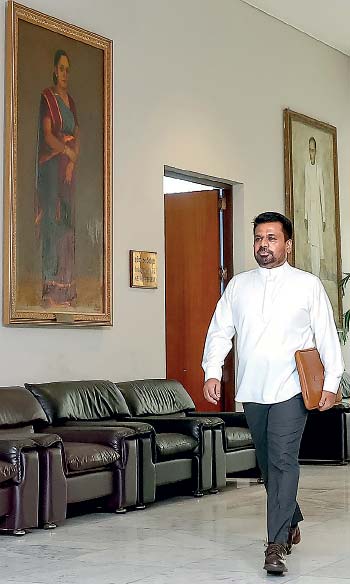
President and Finance Minister Anura Kumara Dissanayake making his way along the Parliament corridors on 12 November on his way to deliver the 2027 Budget Speech
|
The debt-service burden
Approximately Rs. 4,850 billion is required for debt servicing, equivalent to nearly 79% of projected Government revenue of approximately Rs. 6.15 trillion. With foreign debt-service obligations expected to rise further in 2028, the Government must demonstrate how it intends to build adequate foreign-exchange buffers.
The conclusion of the current IMF program also requires clarity on the way forward beyond 2027. The Government has appointed a committee to examine the suitability and nature of a successor arrangement. Sri Lanka needs to make this decision early. Fiscal credibility, access to external financing and investor confidence cannot be left to uncertainty.
Tax relief and revenue mobilisation
The Budget’s tax proposals provide some relief. Increasing the personal income tax-free threshold to Rs. 162,500 per month will benefit salaried employees, while reducing CESS rates on 800 selected Harmonised System (HS) code lines by 25% could lower trade costs and improve competitiveness.
However, these tax concessions are estimated to result in a net annual revenue loss of approximately Rs. 28.4 billion. The Government must balance relief measures with revenue mobilisation and ensure that these concessions do not compromise its revenue targets.
Closing the capital expenditure execution gap
The most important question is whether the Government can execute its ambitious capital program. Historical performance shows that only 64% of the capital budget was utilised in 2023, 54% in 2024 and 76% in 2025. Increasing allocations without addressing procurement delays, fragmented approvals, weak project management and shortages of technical expertise will not deliver the desired economic returns.
The Government must move towards a project-based accountability system. Every major investment should have a clearly identified project owner, measurable milestones, a realistic cash-flow plan and quarterly progress reporting. Projects should be assessed for economic viability and implementation readiness before funds are allocated.
Equally important is the capacity of the public service to deliver. The Government must attract and retain the engineers, procurement specialists and project managers required to implement an investment program of this scale. Budget allocations must translate into completed infrastructure rather than remain unspent provisions.
Unlocking private investment
Public investment alone cannot deliver the growth Sri Lanka needs. The country must attract domestic and foreign private capital, particularly into infrastructure, energy, tourism, logistics, manufacturing and technology. The proposed public-private partnership framework and reforms to State-owned enterprises are therefore important.
The Government’s medium-term ambition of achieving sustainable economic growth of 7% or higher will require a more competitive investment environment, predictable policies, faster approvals and stronger investor protection. The challenge is how quickly the Government can translate its ambitions into an investable project pipeline capable of attracting domestic and foreign investors.
The proposed SME financing programs are welcome, but credit schemes must be supported by appropriate risk-sharing arrangements, sound lending criteria and transparent reporting of repayment performance. Ultimately, sustainable SME growth must come from improving productivity, market access and competitiveness rather than relying solely on subsidised credit.
Technology, AI and automation
Digital transformation offers an opportunity to improve tax collection, public procurement and service delivery. Investment in revenue administration systems is particularly important if Sri Lanka is to broaden its tax base and improve compliance. Digital project tracking, e-procurement and AI-based analytics could also help identify implementation delays, reduce inefficiencies and strengthen public accountability.
However, technology investment must be accompanied by investment in people. Government officers need the digital, analytical and AI competencies to use these systems effectively. Cybersecurity and the protection of citizens’ personal data are equally important.
Parliament, business chambers and citizens should also have access to regular progress reports showing how Budget proposals are being implemented, how much has been spent and what outcomes have been achieved.
Turning ambition into results
Sri Lanka has made considerable progress in restoring macroeconomic stability. The next phase must focus on productivity, exports and sustainability, alongside infrastructure upgrading, investment and employment creation. The Government must also ensure that the burden of economic recovery does not fall disproportionately on the private sector and ordinary citizens.
Budget 2027 has the potential to become a turning point. But potential is not performance. The real measure of success will be whether the Government can convert its plans into working projects, its allocations into productive assets and its reforms into sustainable economic opportunities.
Ultimately, the Government’s challenge is not only to grow revenue through taxes and fees and strengthen public finances, but also to grow the economy, create productive employment and improve the livelihoods of ordinary people, thereby reducing poverty. Fiscal discipline must be a means to an end, not an end in itself.
The true measure of Budget 2027 will be whether economic growth translates into better incomes, greater opportunities and a higher quality of life for all Sri Lankans.
References