Tuesday Nov 10, 2026
Tuesday Nov 10, 2026
Tuesday, 10 November 2026 00:40 - - {{hitsCtrl.values.hits}}
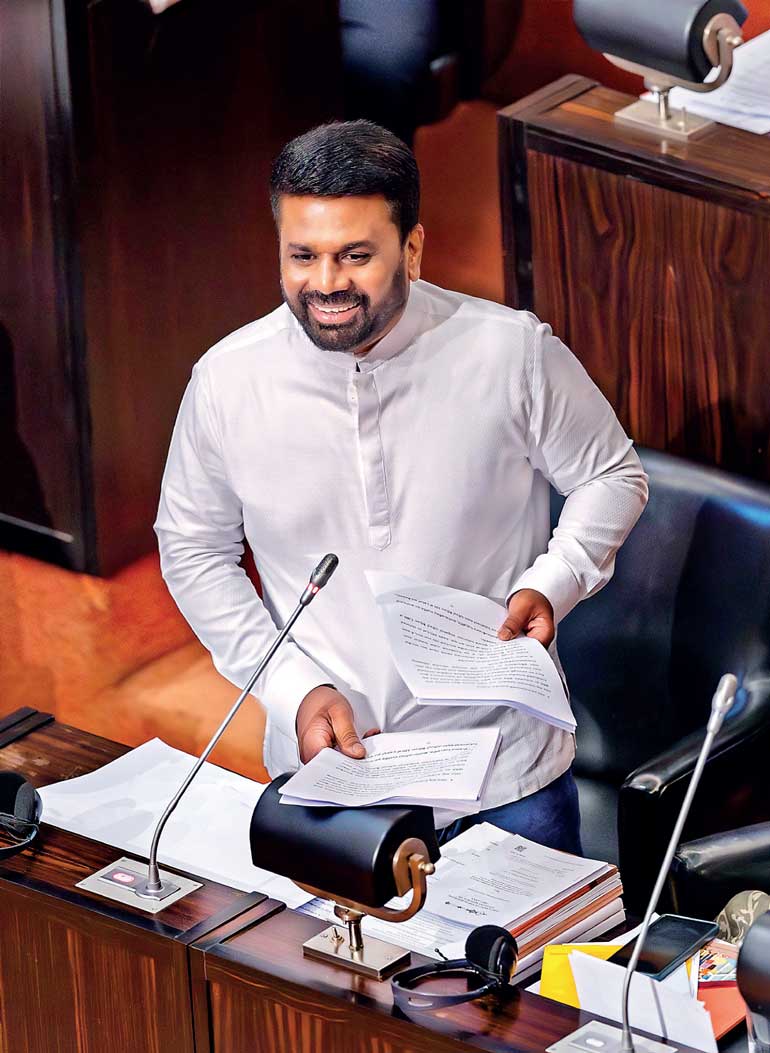
 Why better incomes, productive investment, effective public administration and responsible spending must become the measures of economic progress
Sri Lanka’s 2027 Budget Speech is scheduled for 12 November 2026. After years of economic hardship, public expectations are understandably high. Families want relief from living costs, better employment, reliable public services and greater confidence in the future.
Discussion has focused particularly on public sector salary increases. Fair remuneration matters, but a more fundamental question must guide the Budget debate: Will the government’s decisions produce lasting improvements in people’s lives?
Since the 2022 crisis, Sri Lanka has restored a measure of stability. Growth has resumed, foreign exchange reserves have improved and public financial management has strengthened. According to the World Bank, the economy grew by 4.7% during the first half of 2026. Yet recovery in national statistics does not automatically translate into recovery for households.
The 2027 Budget should therefore be judged less by the size of its promises than by its capacity to increase real incomes, expand productive employment, attract investment and turn public resources into measurable results.
Salary increases must improve real incomes
Public servants have faced considerable financial pressure, and higher salaries can provide welcome relief. But the increase expected in 2027 largely completes the three-stage salary revision announced in the 2025 Budget, rather than constituting an entirely new initiative.
It is also important to distinguish between nominal wages—the money an employee receives—and real wages—what that money can purchase. If a worker earning Rs. 60,000 receives an additional Rs. 5,000, the nominal increase is about 8.3%. But if prices have risen by roughly 8% over the same period, the gain in purchasing power is small.
Households do not evaluate prosperity from salary slips alone. They assess whether earnings can meet the costs of food, transport, electricity, housing, education and healthcare.
Regular salary reviews are justified, but they must be financially sustainable and accompanied by efforts to improve productivity, contain living costs and raise earnings across the economy. The objective should be better living standards, not merely higher figures on payrolls.
Recovery has not reached every household
Despite the improvement in headline indicators, many Sri Lankans remain under financial strain. The Colombo Consumer Price Index recorded annual inflation of 8.3% in October 2026. The World Bank estimated poverty at 16.9% in 2025. Although overall unemployment stood at 4% in the second quarter of 2026, unemployment among people aged 15–24 was 17.8%, while labour force participation was only 50%.
The Health Ministry’s 2025 Nutrition Month data also reported that 16.1% of children under five were underweight. These indicators remind us that economic hardship cannot be measured by GDP growth alone. Poverty, weak labour market participation and poor nutrition are not isolated social concerns: they reduce human potential and ultimately weaken the economy’s productive capacity. Policies should therefore be evaluated for their effects on employment, opportunity and the distribution of gains, not growth alone.
Another distinction is often overlooked: lower inflation does not necessarily mean lower prices. If a food item rises from Rs. 100 to Rs. 200, a subsequent slowdown in inflation may simply mean that it becomes more expensive at a slower rate. Families still have to pay the higher price.
For pensioners, low-income households, informal workers and unemployed young people, recovery will feel incomplete until purchasing power and economic security improve. Budget policy must therefore combine stability with targeted support and opportunities to earn sustainable incomes.
Build an economy that produces, exports and employs
Sri Lanka cannot sustainably improve living standards through salary increases, subsidies and tax concessions alone. Those measures depend ultimately on the country’s capacity to produce more goods and services, generate income and collect revenue without creating renewed fiscal instability.
Agriculture, manufacturing, tourism, technology and export-oriented services all offer potential. Small and medium-sized enterprises are especially important because they create jobs and economic activity throughout the country. Yet, many struggle with expensive finance, outdated equipment, limited market access and cumbersome administrative procedures.
Farmers need reliable irrigation, storage, transport and opportunities to add value to what they grow. Entrepreneurs need accessible finance, skilled workers and predictable rules. Exporters need productive infrastructure and efficient trade procedures.
A stronger productive economy also depends on improving the quality of employment. Young Sri Lankans need pathways from education and training into rewarding work. This requires practical cooperation among universities, technical institutes, employers and regional businesses. Supporting enterprise outside Colombo would help distribute opportunities more fairly and reduce the pressure on young people to seek their future abroad.
Foreign exchange earnings deserve particular emphasis. Borrowing dollars is not the same as earning dollars. Loans can temporarily meet financing needs, but they bring repayment obligations. Sustainable foreign exchange comes from competitive exports, tourism, services and other productive activities, supported by formal workers’ remittances.
A credible national strategy should connect investment in skills and infrastructure with measurable targets for production, exports and employment. Announcements without sustained implementation will not build a competitive economy.
Restore confidence for domestic and foreign investors
Investment brings employment, technology, tax revenue and opportunities for growth. But investors commit capital when they believe policies will remain reasonably predictable and institutions will treat them fairly.
Sri Lanka must address delays in approvals, uncertainty over contracts, abrupt policy changes and inconsistent application of regulations. Existing investors also require timely, transparent remedies when legitimate concerns arise. Their experiences influence the decisions of potential new investors.
Investment promotion should consequently be judged by projects that actually begin operations, jobs created and exports generated—not only by investment pledges or memoranda of understanding. A transparent, time-bound approval system, with clear channels for resolving disputes, could make a substantial difference. Equally important is consistent treatment of domestic enterprises, which are often the starting point for sustainable expansion.
The Government must, of course, investigate corruption and hold wrongdoers accountable. Strong institutions and the rule of law are essential to confidence. Yet public communication should also convey a positive economic direction: where investment opportunities lie, how obstacles will be removed and what policies businesses can reasonably expect.
Accountability and investment promotion should reinforce rather than undermine one another. A credible government can investigate past misconduct while providing lawful, consistent and efficient conditions for future investment.
Make public administration accountable and capable of acting
Even well-designed policies will fail if public institutions cannot implement them. Salary improvements alone cannot create an effective civil service. Officials also need professional training, modern systems, clear responsibilities and the authority to make timely decisions.
There is concern that some officials hesitate to approve contracts, procurement decisions or projects because they fear later investigations. Such caution can delay development and discourage investors. But weakening anti-corruption institutions is not the answer.
The proper response is to establish clear procedures, transparent procurement standards, reliable documentation and fair review mechanisms. Deliberate misconduct must be investigated and punished. Officials acting honestly, reasonably and within the law should receive appropriate procedural protections.
Political leaders and administrators must share responsibility for removing unnecessary complexity and improving coordination across agencies. Good governance means decisions that are both accountable and timely—not the absence of decisions.
The public should not have to navigate overlapping offices to obtain routine approvals. Simplified procedures, better digital services and clearly assigned responsibilities would improve the experience of citizens as well as businesses. Administrative reform is therefore not a separate concern from economic policy. It is one of the conditions for translating policy into results.
Balance development, inflation
and taxation
Public investment in transport, energy, irrigation, education and healthcare can reduce business costs and expand opportunity. However, every major project should be assessed for economic benefits, financial affordability, environmental effects and long-term maintenance needs. Large expenditure is not, by itself, evidence of development.
Price stability also requires sound monetary and fiscal policies, dependable supplies and competitive markets. A reasonably stable exchange rate helps households and firms plan, but an artificially strong rupee could damage export competitiveness. Durable currency stability depends on productivity, foreign exchange earnings, adequate reserves and confidence.
Tax relief is understandably popular after years of hardship. Nevertheless, broad reductions without alternative revenue could weaken public finances and threaten recovery. A better approach is to widen compliance, reduce evasion, improve administration, limit waste and offer carefully targeted relief when affordable.
The Budget must confront these trade-offs directly. Social protection and economic development are both necessary, but they must be financed within a credible fiscal framework.
This means choosing among competing priorities rather than pretending all demands can be met immediately. Protecting essential healthcare and education, maintaining productive infrastructure and providing well-targeted assistance may yield greater benefits than highly visible but poorly prepared projects. Responsible budgeting is ultimately a question of priorities as much as accounting.
Close the gap between Budget allocations and delivery
Perhaps the clearest test of the 2027 Budget is whether allocated development funds become completed projects.
During the first half of 2026, approximately Rs. 1,719 billion was allocated for capital expenditure and net lending for the full year, but only about Rs. 280 billion had been spent by the end of June—just 16.3%. By comparison, total government expenditure had reached 39.2% of annual allocations and recurrent expenditure 45.9%. The comparable first-half capital expenditure and net lending rate in 2025 was 17.5%.
These numbers do not establish that the whole year will end poorly. Construction and procurement payments are often concentrated later in the year. Nor is every unspent rupee evidence of failure. Still, such low first-half implementation rates deserve careful investigation.
Delayed expenditure has consequences beyond financial statements. If a hospital project stalls, patients wait for services. If a school building remains incomplete, students lose learning opportunities. Delayed irrigation systems affect farm output, while unfinished roads prolong transport costs.
Postponed projects also reduce demand for construction workers, materials, machinery, transport and local suppliers. Thus, implementation failures can weaken both immediate economic activity and long-term productivity.
The causes are varied: inadequate preparation, land acquisition problems, procurement delays, environmental approvals, weak interagency coordination, shortages of technical expertise and difficulties releasing funds. Uncertainty among decision-makers may also contribute. No single official or institution can reasonably bear all the blame.
A serious response must examine the complete project cycle—from selection and preparation to procurement, funding, execution and evaluation—rather than merely calling for faster spending.
Projects should enter the Budget only when their feasibility, land requirements, approvals and implementation responsibilities are sufficiently clear. Otherwise, the government creates unrealistic expectations and later confronts predictable delays. Treasury funding plans and implementing agencies’ work schedules also need to be aligned from the outset. More disciplined preparation could prevent many delays before they arise.
Measure results, not just money spent
Spending an allocation before year-end is not necessarily good management. Rushed purchases, weak construction and unnecessary projects can waste public money. Equally, lower spending may sometimes reflect cost savings or sensible cancellation of unnecessary activities.
The central question is not how much the government spends, but what that spending achieves.
This is the value of performance-based budgeting. A road project should be assessed not only by its construction cost but by whether it reduces travel time, improves access to markets and benefits nearby communities. A hospital investment should be evaluated through service quality and patient access. Irrigation spending should be linked to agricultural productivity and farmers’ incomes.
Every major publicly funded project should have a realistic timetable, a responsible institution, published financial and physical milestones, and measurable intended benefits. Quarterly progress reports should show what has been completed as well as what has been paid.
Projects falling behind schedule need early diagnosis and corrective action. Officials should be held accountable for performance while receiving the resources, training and lawful protections needed to do their jobs. Government should also prioritise completing worthwhile existing projects before multiplying new announcements.
Independent evaluation has a role here. Citizens deserve to know not only whether a project was completed, but whether its promised benefits materialised. Publishing straightforward evaluations would help policymakers learn from mistakes, improve future project selection and strengthen public trust. The aim should be improvement, not simply assigning blame when targets are missed.
At year-end, citizens should be able to ask a simple question: What tangible improvements resulted from the funds Parliament approved? If there is no convincing answer, impressive Budget figures offer little comfort.
What the 2027 Budget should deliver
The Budget should combine immediate relief with a credible plan for future prosperity. Public sector salary commitments and targeted assistance matter, but they should not overshadow private sector workers, self-employed people, farmers, pensioners, small businesses and unemployed youth.
The Government should explain how it will strengthen production, create productive jobs, expand exports, encourage domestic and foreign investment and improve essential services. Each priority needs a realistic target, adequate financing, a responsible agency and a public timetable.
This also requires an honest account of fiscal limits. Sri Lanka remains constrained by debt obligations and available revenue. Ambitious promises that cannot be funded or implemented may endanger hard-won stability.
Above all, ministries should be judged by outcomes, not the number of projects they announce. Parliament and the public need accessible information on costs, progress, delays and results. Transparency should support practical problem-solving rather than become another reporting exercise.
A useful Budget should also distinguish clearly between measures that provide immediate relief and reforms whose benefits will emerge over several years. People can accept difficult choices more readily when the government explains the purpose, likely timing and costs of its decisions. This requires honest communication and consistent follow-through, not merely ambitious language on Budget day.
Conclusion: Turn recovery into real improvement
Sri Lanka has made important progress since the 2022 economic crisis. But stability and growth are only the foundation. The deeper test is whether families can afford essential needs, young people can find meaningful work, businesses can invest confidently and public services deliver reliably.
These goals demand a more productive and export-oriented economy, responsible fiscal management, investor confidence and public administration that combines integrity with the ability to act.
The 2027 Budget should mark a shift from promises to implementation, from allocations to outcomes, and from short-term relief to lasting prosperity.
This is not simply a matter of political criticism. It is a constructive test of economic leadership. Ultimately, the success of a national Budget should be measured not by the promises made in Parliament, but by the improvements people experience in their everyday lives.




