Monday Oct 12, 2026
Monday Oct 12, 2026
Tuesday, 25 August 2026 06:39 - - {{hitsCtrl.values.hits}}

 Sri Lanka’s Value Added Tax (VAT) delivered a record performance in 2025. Net VAT revenue rose to Rs. 1,746.9 billion, reflecting a 33.4% increase from 2024, and VAT overtook all other taxes to become the single largest contributor to Government revenue, accounting for 5.3% of GDP. At the same time, the number of VAT-registered persons surged by an extraordinary 56.3% within just 12 months. On the surface, these figures appear to offer the clearest evidence yet that Sri Lanka’s long-standing effort to broaden its tax base is finally gaining traction.
However, a closer reading of the Inland Revenue Department’s 2025 Annual Performance Report presents a more nuanced picture. It suggests that taxpayer growth significantly outpaced the revenue collected from those taxpayers, while the main driver of the VAT windfall was a familiar one: imports.
Growing VAT base
According to the IRD Annual Performance Report, VAT registrations increased sharply in 2025. The number of persons registered for VAT rose from 21,227 as at 31 December 2024 to 33,187 as at 31 December 2025 — an increase of 56.3% within a single year. This rate of growth was significantly higher than the expansion of the overall income tax base, which grew by a more modest 19.2% over the same period, from 1,093,134 to 1,302,596 registered taxpayers. The upward trend continued into 2026, with VAT registrations reaching 34,769 by February 2026, according to the Ministry of Finance’s Final Budget Position Report 2025.
The IRD attributes much of this increase to the full-year impact of reducing the VAT registration threshold from Rs. 120 million to Rs. 60 million per annum, effective 1 January 2024. In principle, this is the type of base-broadening reform that tax administrations are typically encouraged to pursue. It brings more businesses into the formal tax net, reduces dependence on a narrow group of large taxpayers, and distributes the compliance burden more evenly across the economy.
Revenue growth and VAT base increase
Net VAT revenue grew strongly in 2025, increasing by 33.4% from Rs. 1,309.7 billion to Rs. 1,746.9 billion. Viewed in isolation, this is an impressive outcome. However, when set against the 56.3% expansion in the VAT-registered taxpayer base, a clear divergence emerges. The number of registered taxpayers grew much faster than the revenue collected from them, raising an important question: if the expansion in registrations had translated into proportionate revenue growth, why were VAT collections not considerably higher than the reported figure?
A simple calculation using the IRD’s published figures shows that average net VAT revenue per registered person declined from approximately Rs. 61.7 million in 2024 to around Rs. 52.6 million in 2025. Put differently, the additional VAT-registered businesses brought into the system in 2025 appear, on average, to have contributed significantly less to the VAT pool than those already registered before the threshold reduction.
This picture would have been clearer if the authorities had separately quantified registrations arising after 11 April 2025. Under VAT Act No. 04 of 2025, effective from 11 April 2025, persons importing or exporting goods for commercial purposes were required to register under section 10 of the VAT Act. This amendment may therefore have been an additional factor behind the sharp rise in VAT registrations.
This should not be read as a criticism of the businesses brought into the VAT net. Rather, it is the predictable outcome of lowering the registration threshold: smaller taxpayers are brought into the system, and they will naturally have smaller VAT liabilities. The policy implication is therefore an important one. Growth in the number of VAT registrations itself is not a reliable measure of genuine revenue-base broadening. Policymakers should be careful not to treat an expanding network of VAT registrants and a stronger, more durable revenue base as the same achievement.
Real driver of VAT collection
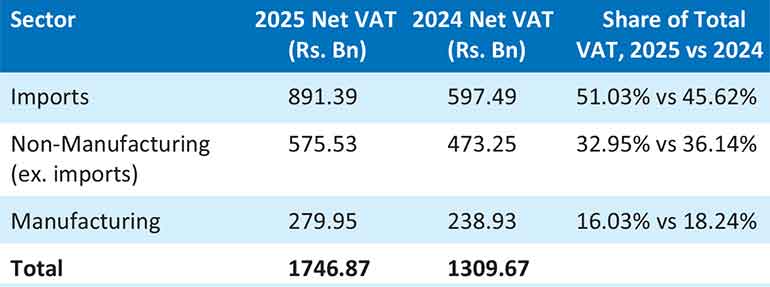
If the growth in registered businesses was not the primary engine of the 2025 VAT surge, what was? The IRD’s sector-wise breakdown of VAT collection is as follows.
Imports were the standout driver of VAT growth in 2025. VAT collected from imports increased by 49.2% year-on-year and accounted for just over half of total net VAT revenue, rising from 45.6% of the total in 2024 to 51.03% in 2025. In GDP terms, VAT from imports increased from 1.99% to 2.72%, making it the single largest contributor to the overall improvement in the VAT-to-GDP ratio. The IRD itself attributes this surge largely to the removal of restrictions on vehicle imports, together with enhanced efficiency in VAT collection mechanisms. By contrast, the domestic sectors played a relatively smaller role in the overall shift. The manufacturing sector’s share of total VAT declined from 18.24% to 16.03%, while the non-manufacturing sector’s share fell from 36.14% to 32.95%, even though their absolute contributions increased.
The headline growth was not primarily a story about a newly broadened, more resilient domestic tax base. It was, to a significant degree, a story about the resumption of vehicle imports following the lifting of earlier import restrictions — a cyclical and policy-contingent driver rather than a structural one.
The domestic VAT picture was not entirely weak. One clear bright spot was financial services, where VAT collections increased sharply by 64.7%, rising from Rs. 120.4 billion in 2024 to Rs. 198.2 billion in 2025. This made financial services the fastest-growing VAT sub-category in the year, whether compared with domestic sectors or imports. The registration base also widened, with the number of persons registered for VAT on financial services increasing from 315 in 2024 to 347 in 2025.
Widening gap in tax mix
The distinction between registration growth and revenue-per-registrant growth is more than a technical point. It goes to the quality and durability of Sri Lanka’s revenue recovery. In 2025, the country’s tax-to-GDP ratio rose to a historic high, while the VAT-to-GDP ratio increased from 4.35% to 5.33%, continuing its sharp recovery from just 1.75% in 2021. VAT now accounts for 54.22% of total IRD revenue collection, firmly establishing it as the backbone of Sri Lanka’s tax system.
At the same time, the tax mix moved further away from the Government’s stated objective of strengthening direct taxation. At the IRD level, the direct-to-indirect tax ratio weakened from 40:60 in 2024 to 36:64 in 2025. The overall position reported by the Ministry of Finance shows an even sharper imbalance, with the ratio moving from 28:72 to 23:77. This reinforces Sri Lanka’s long-standing dependence on consumption-based taxation — a structural issue that the IRD itself has highlighted, particularly in light of the Government’s stated objective of moving towards a 60:40 ratio in favour of direct taxes.
If a large share of VAT growth continues to come from cyclical import activity rather than a genuinely broader and more compliant domestic base, then the underlying resilience of Sri Lanka’s revenue base is more fragile than the headline numbers suggest.
Compliance signal — A red flag
An expanding pool of VAT registrants inevitably places greater administrative strain on the tax authority, making it essential that the Tax Administrator tightens compliance enforcement to ensure new entrants meet their obligations from the outset. This dynamic may also help explain the declining trend in average VAT collection per registrant — a pattern further substantiated by compliance data presented in the IRD’s 2025 Annual Performance Report.
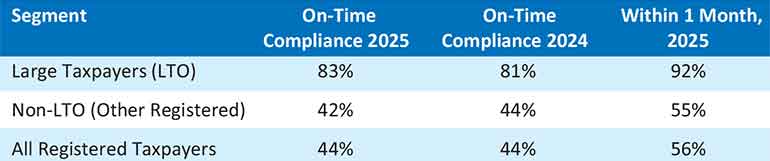
Large Taxpayers (LTOs), who are directly responsible for the bulk of VAT revenue, filed their returns on the statutory due date at an 83% rate in 2025. Within one month of the due date, LTO compliance climbed further to 92%, up from 89% in 2024.
Non-LTO taxpayers - the much larger population of small and medium businesses that make up the vast majority of VAT registrants tell an entirely different story. Their on-time filing rate for 2025 stood at just 42%, rising to only 55% within one month of the due date. The IRD’s Performance Report states: “in sharp contrast to the high compliance seen in the Large Taxpayer segment, VAT registered persons within the Non-LTO segment exhibited significantly lower filing rates…”.
Combining both segments, the total VAT-registered taxpayer base was expected to file 112,427 returns in 2025. Only 49,042 — 44% — were filed by the due date, rising to 63,427, or 56%, within one month. In 2024, the equivalent figures were 44% and 57% on a smaller base of 86,326 expected returns. In other words, the taxpayer base grew by over 26,100 returns — a 30% increase — yet the overall compliance rate did not improve at all.
Compliance gap: Critical risk as net widens
Since policymakers chose not to pursue the move to lower the VAT registration threshold (the reduction up to Rs. 36 million from Rs. 60 million) — a step that would otherwise have drawn a larger pool of SMEs into the tax net — this pause presents an opportune moment for the Tax Administrator to focus on strengthening compliance among existing registrants.
Expanding VAT coverage on paper means little if the Inland Revenue Department cannot ensure that newly registered businesses actually comply: filing accurate returns, remitting collected tax on time, and maintaining proper input-output records.
If a significant share of newly registered SMEs remain non-compliant — whether through under-reporting, late filing, or simply lacking the accounting infrastructure to manage VAT obligations — the effect is not neutral. It actively distorts the VAT system: compliant businesses absorb a proportionally larger share of the tax burden and face a competitive disadvantage against non-compliant peers who effectively continue operating outside the net despite nominal registration. Over time, this erodes both revenue collection and the fairness rationale that underpins VAT reform in the first place.
Widening VAT net, tightening compliance
The 56% increase in VAT registrations is a real administrative achievement, and the threshold reduction that enabled it was a sound structural reform. However, registration growth is not the same as revenue growth, and the 2025 figures show a clear divergence between the two. Much of the year’s VAT windfall appears to have come from imports, underscoring that genuine base-broadening should not be measured merely by the number of taxpayers added to the register, but by the additional, sustainable revenue they generate and the resilience of that revenue over time.
Bringing a wider base of SMEs into the VAT net without weakening the system’s integrity calls for parallel investment in taxpayer education, simplified compliance tools tailored to smaller businesses, and clear, accessible guidance on registration and filing obligations. Without this groundwork, any future expansion of the tax net risks trading a narrow but functional VAT system for a wider one riddled with compliance gaps.
Reference has been made to the Inland Revenue Department’s Annual Performance Report 2025 and the Ministry of Finance Annual Report 2025. The views and opinions expressed in this article are those of the author in her personal capacity




